



Board packets have a reputation problem. They arrive at 40 pages, three-quarters of which nobody reads, and the one thing the board actually needs — a clear-eyed view of cash, the forecast you trust, and the specific asks that require their attention — gets buried on slide 23 behind a wall of program photos.
The fix isn't a prettier deck. It's a discipline. A board fundraising KPI framework that collapses your forecast hygiene, your scenario planning, and your investment asks into one page a busy board chair can digest in four minutes and make a decision from. Not a dashboard. A brief. The difference matters, and most development shops never make that distinction.
What follows is the system that actually works — not the theory of it, but the connective tissue between forecast accuracy, cash scenarios, and the moment a board says yes or no to money.
Why the board brief falls apart before it even reaches the room
The failure almost never starts in the boardroom. It starts weeks earlier, in the gap between what the development team thinks is coming in and what finance books as real.
The pattern shows up constantly: the development director maintains a pipeline in the CRM, finance maintains the actuals in the accounting system, and the two reconcile maybe quarterly, if someone remembers. By the time a board brief gets assembled, you're stitching together a forecast from two sources that disagree by 15–20%. The person building the deck quietly "adjusts" numbers to make them line up. Now the brief isn't a forecast — it's a negotiated fiction.
A typical example looks like this. A mid-size org projects roughly $1.2M in fourth-quarter revenue. The CRM shows $1.4M in weighted pipeline, finance shows $980k booked year-to-date against a trend that suggests $1.1M by December. Somebody splits the difference, writes "$1.2M" on the brief, and the board approves a spending plan against a number nobody can actually defend. When December closes at $1.05M, the conversation in January is about trust, not cash. And trust is the expensive thing to rebuild.
This is why forecast hygiene has to come before any framework. You can't build a decision-ready page on top of numbers that haven't been scrubbed. A clean brief is downstream of clean inputs, and the inputs are where the real work lives.
Forecast hygiene: the part everyone skips
Forecast hygiene is boring, which is exactly why it gets neglected and exactly why it's the highest-leverage thing you can fix. The goal is simple: every number on the board brief should trace back to a source someone can point to without flinching.
Simplify donor management and fundraising workflows.
Givioly helps you organize campaigns, engage donors, and maximize fundraising impact seamlessly.
- Unified donor profiles
- Real-time donation tracking
- Automated impact reporting
No credit card required
Before a single figure goes on the page, run the forecast through a hygiene checklist. This isn't a one-time audit — it's a recurring routine, ideally the week before each board cycle.
-
Pipeline aging check — Flag any gift marked "committed" that's older than 90 days with no documented next step. Stale commitments inflate forecasts more than anything else.
-
Probability discipline — Confirm each pipeline stage maps to a consistent close-rate assumption. "Verbal yes" shouldn't be weighted the same across a $500 gift and a $250k gift.
-
CRM-to-finance reconciliation — Match booked revenue against the CRM for the trailing period. If the gap is over 5%, stop and find out why before you forecast forward.
-
Restricted vs. unrestricted split — Separate what's spendable from what's locked. A $300k grant restricted to a specific program is not cash you can use to cover payroll.
-
One-time vs. recurring tagging — Strip out last year's unusual gift before you trend. One major bequest can make your year-over-year growth look like a strategy when it was luck.
-
Pledge collection realism — Apply an actual historical fulfillment rate to outstanding pledges. Most orgs assume 100%; reality is usually somewhere in the 85–95% range.
-
Owner sign-off — Every forecast line has a named person who stands behind it. No orphan numbers.
Run the hygiene checklist the week before each board cycle so inputs stay fresh and defensible.
This discipline feeds directly into how you report metrics everywhere else. If you haven't built a sensible measurement foundation yet, it's worth revisiting a pragmatic framework for nonprofit fundraising metrics and attribution — forecast hygiene is essentially that framework applied forward in time instead of backward.
The insight most teams miss: hygiene problems compound. A 5% error in pipeline weighting, plus a 10% optimism bias on pledge collection, plus one mis-tagged restricted gift, and your "conservative" forecast is suddenly off by a quarter. The errors don't cancel. They stack in the same optimistic direction, because the person building the forecast wants good news.
The KPI rows that belong on the page (and the ones that don't)
A board doesn't need 30 metrics. It needs the five or six that answer: Are we on track, is the cash healthy, and is anything about to break?
The hard part is resisting the urge to show everything you measure. Internal operations dashboards and board briefs are different documents with different jobs. Your team might track open rates, lapsed donor counts, and cost-per-dollar-raised by channel — all useful, none of which belongs on a board brief unless it's driving a decision.
| KPI Row | Belongs on the Brief? | Why |
|---|---|---|
| YTD revenue vs. forecast | Yes | The single most important accountability number |
| Weighted pipeline (next 2 quarters) | Yes | Forward visibility, the whole point of a forecast |
| Unrestricted cash runway (months) | Yes | The number that keeps the org alive |
| Major gift close rate (trailing 4 qtrs) | Yes | Explains pipeline realism at a glance |
| Donor retention rate | Sometimes | Belongs if it's trending badly or driving an ask |
| Cost to raise a dollar | Sometimes | Useful context, but easy to misread without framing |
| Email open rates | No | Operational noise at the board level |
| Event attendance | No | Belongs in a program report, not a cash brief |
Each KPI row on the brief should carry three things: the current number, the comparison point (forecast or prior period), and a one-word status. Green, watch, or red. The board's eye should scan the status column and immediately know where to spend their limited attention.
One recurring mistake: putting "cost to raise a dollar" on a board brief without the context that fundraising costs are lumpy and seasonal. A board member who sees that number spike in Q1 — when you've paid for the annual gala before the revenue lands — will panic for no reason. If your cost attribution is shaky to begin with, that panic is probably justified. This is exactly the trap covered in when overhead numbers mislead leadership, and it's worth sorting out before you ever put a cost ratio in front of governance.
Three-scenario cash forecasting, without the spreadsheet theater
Single-point forecasts are a comfortable lie. Nobody's December actuals land exactly on the number. The honest version is a range, and the useful version is three named scenarios the board can actually reason about.
Not five. Not a Monte Carlo simulation. Three: conservative, expected, and stretch. Each one needs to answer the same question — what does our cash position look like under this set of assumptions, and what decision does it force?
-
Define the swing variables first. For most orgs there are only two or three that actually move the forecast: major gift close rate, year-end campaign response, and the timing of one or two big grants or pledges. Don't model everything. Model the levers that matter.
-
Set the conservative case. Assume your major gift close rate drops to the low end of its historical range, year-end comes in 15% soft, and one anticipated grant slips to next fiscal year. This is not doom — it's a bad-but-plausible Tuesday.
-
Set the expected case. Use your hygiene-cleaned pipeline with realistic probability weighting. This should be the number you'd bet your own money on.
-
Set the stretch case. Everything breaks your way
close rates at the high end, year-end strong, grants land on schedule. Useful not as a plan but as a ceiling.
-
Translate each into cash runway. Revenue is interesting; cash is survival. Each scenario should end in a months-of-runway figure, because that's what forces board decisions.
-
Attach a trigger to each. "If we're tracking to the conservative case by October 15, we delay the new hire and pause the program expansion." Pre-committed triggers turn scenarios from a thought exercise into a decision tool.
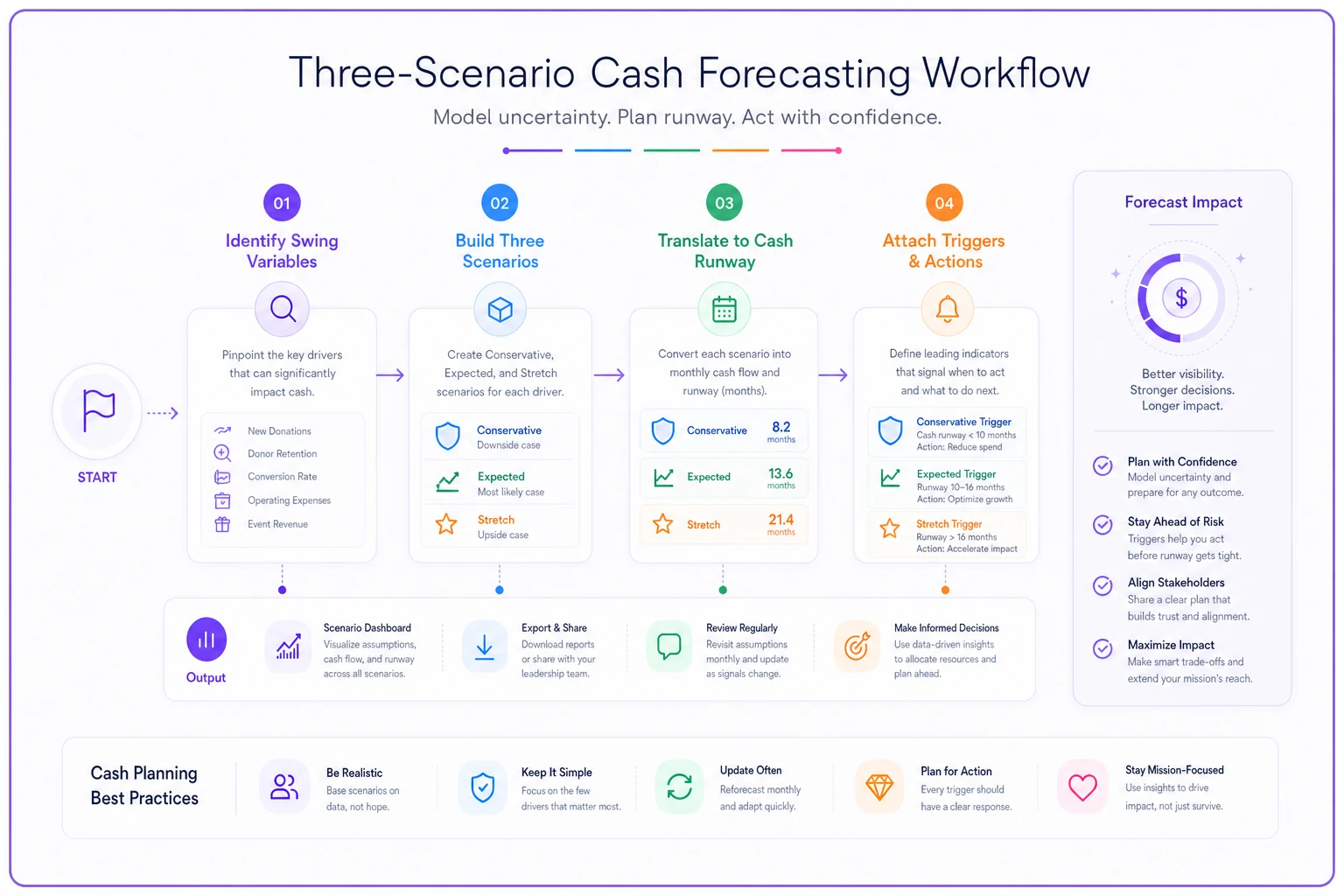
The point of the triggers is to move the hard conversation earlier, when options still exist. A board that's agreed in September on what happens if the conservative case materializes doesn't have to negotiate cuts in December under pressure. The decision was already made; October 15 just activates it.
What shows up across a lot of these forecasts: the spread between conservative and stretch is usually wider than leadership is comfortable admitting out loud. A $2M org can easily have a $400k swing between scenarios. Naming that spread honestly is uncomfortable, but a board that understands the range makes far better capital decisions than one handed a false point estimate.
Folding the investment ask into the same page
Most briefs lose the thread here. The forecast lives on one page, the "we need to invest in X" conversation happens somewhere else entirely — usually verbally, usually without numbers tied to the forecast that justifies it. So the board is asked to approve spending without seeing how it connects to the cash picture they just reviewed.
A decision-ready brief ties the ask directly to the scenarios. The investment case isn't a separate pitch — it's the natural next line after the forecast. Given the expected case, here is what we're asking you to fund, here's the return we expect, and here's what triggers a pause.
-
The ask $85k over 12 months for a dedicated major gifts officer.
-
The thesis Current major gift pipeline is capacity-constrained — we have more qualified prospects than we can move. Adding staff capacity converts stalled pipeline, not net-new.
-
The expected return Based on trailing major gift close rates, a conservative estimate is $220k–$300k in incremental revenue by month 18, with ramp accounting for the first two quarters being near-zero.
-
The scenario dependency This ask holds under the expected and stretch cases. Under the conservative case, we delay the hire to Q2 and revisit.
-
The downside Worst case, the role underperforms and we've spent roughly $85k to learn our pipeline wasn't as deep as we believed — which is itself worth knowing.
The return is a range, the ramp is acknowledged, and the downside is stated plainly. Boards trust asks that admit their own risk far more than asks dressed up as certainties. An investment case with no downside section reads as either naive or dishonest, and experienced board members smell it immediately.
The investment case also needs to survive contact with your impact reporting. If the board funds a major gifts officer and then can't see, six months later, whether it worked, you've broken the feedback loop that makes the next ask credible. Tying the investment back to measurable outcomes — the way you'd handle any donor-facing impact reporting — is what earns you the benefit of the doubt on the next one.
When the one-page discipline actually makes sense
This framework isn't free. It takes real reconciliation work, and for very small or very early organizations, the overhead can outweigh the benefit.
When it makes sense: You have a board that's actively governing finances, a budget above roughly $750k–$1M, multiple revenue streams that need reconciling, and at least one staff person who can own the forecast hygiene routine. At that scale, the gap between CRM and finance is large enough that a disciplined brief prevents real mistakes.
When it's overkill: You're an all-volunteer org with a $120k budget and a board that meets twice a year. The one-page brief isn't the answer — a clean cash statement and a short narrative do the job. Building elaborate three-scenario models for an org that can't act on them fast is just performance.
Who should hold off entirely: Teams whose underlying data is still a mess. If your CRM-to-finance reconciliation is off by 20% and nobody knows why, a prettier board brief just packages the chaos more convincingly. Fix the inputs first. A polished brief built on broken data is more dangerous than an ugly one, because it manufactures confidence you haven't earned.
A real scenario: from 40-page packet to one page
A regional health nonprofit — budget around $3.2M, a six-person development team — was running board meetings off a packet that averaged 38 pages. The finance committee spent most of each meeting arguing about which revenue number was correct, because the development report and the finance report never matched.
The reconciliation gap was the root cause. The CRM showed about $2.9M in weighted pipeline for the year; finance had booked closer to $2.4M with two months left. Nobody could confidently say which direction the real number sat, so every board meeting relitigated the same argument.
The team spent about six weeks on hygiene before touching the brief design. They set consistent probability weights by gift stage, applied a real 88% pledge fulfillment rate instead of assuming full collection, and stripped a one-time $180k bequest out of the trend. The cleaned expected forecast landed at roughly $2.65M — lower than development's optimistic number, higher than finance's booked-only view, and defensible by both teams.
The board brief shrank to a single page: six KPI rows with status flags, three cash scenarios with runway figures and triggers, and one investment ask for a part-time grants writer tied explicitly to the expected case. The 38-page packet became a two-page appendix nobody needed to open during the meeting.
The outcome wasn't dramatic revenue growth. It was something quieter and arguably more valuable. The finance-versus-development argument disappeared, because both sides had signed off on the inputs before the meeting. Board decisions that used to take two meetings took one. And when the year closed about 4% under the expected case, the conversation in January was a calm adjustment, not a crisis, because the conservative scenario had already mapped the fallback.
Keeping the brief honest over time
The one-page board brief is not a document you build once. It's a cycle. The hygiene routine runs before each board meeting, the scenarios get re-weighted as the year unfolds, and the investment cases get tracked against the returns you promised. The framework holds together only if the inputs stay disciplined and the feedback loop stays closed.
Where the system tends to decay: the hygiene checklist gets skipped during busy season, the scenarios drift back toward single-point optimism, and the investment cases stop getting reviewed once they're approved. Each of those is a small slip, but they compound the same way forecast errors do — quietly, all in the direction of making the picture look better than it is.
The organizations that keep their board briefs trustworthy treat the reconciliation and the hygiene routine as non-negotiable calendar items, not things to get to if there's time. That's less a process insight than a cultural one. The brief reflects whatever discipline exists upstream of it, and that discipline either gets protected or it quietly erodes.
The real value of a board fundraising KPI framework isn't the page itself. It's what the page forces upstream: the reconciliation, the honest probability weighting, the pre-committed triggers, the willingness to show a range instead of a comforting number. Get those right, and the one-page brief practically writes itself. Skip them, and no amount of formatting will make the board trust what's on it.
Ready to elevate your fundraising efforts?
Join 2,000+ nonprofits using Givioly to save time, increase donations, and build lasting donor relationships.