


Most nonprofit fundraising teams track everything wrong. Not because they don't care about metrics, but because they're drowning in spreadsheets that tell them nothing useful while their actual fundraising operations fall apart.
You've got donation data in your CRM, event metrics in random Excel files, email engagement scattered across platforms, and someone's tracking major donors in a personal notebook. Meanwhile, your board keeps asking the same question: "How much did that campaign actually raise?" And nobody can give a straight answer.
The real problem isn't lack of data. Nonprofits build measurement systems backward—starting with whatever reports their tools spit out instead of what actually drives fundraising success.
Why nonprofit metrics break at exactly the wrong time
A nonprofit starts small, maybe tracking donations in QuickBooks and sending thank-you emails manually. Everything's visible because one person handles it all. Then you grow to about $500k in annual donations, add a few fundraising channels, hire another person, and suddenly nobody knows which activities actually generate revenue.
The breaking point usually hits around three full-time fundraising staff. That's when informal tracking collapses. Your development director thinks the gala raised $45,000, but accounting shows $32,000 after expenses. Email campaigns show 2,000 opens but only twelve donations. The monthly giving program grows by twenty donors, but fifteen others quietly cancelled. Everyone's working harder, but revenue stays flat.
What makes this worse is that nonprofit boards often come from corporate backgrounds where attribution seems simple. They ask for ROI calculations on community events. They want cost-per-acquisition for monthly donors. They demand marketing attribution models designed for e-commerce, not relationship-based fundraising.
The measurement chaos creates a vicious cycle. Staff spend more time creating reports than fundraising. Board meetings become defensive presentations instead of strategic discussions. And the actual donor relationships—the thing that drives everything—get lost in spreadsheet gymnastics.
The three-tier framework that actually works
Tier 1: Under $1M annual fundraising (1-3 fundraising staff)
Simplify donor management and fundraising workflows.
Givioly helps you organize campaigns, engage donors, and maximize fundraising impact seamlessly.
- Unified donor profiles
- Real-time donation tracking
- Automated impact reporting
No credit card required
At this size, complex attribution wastes time you don't have. Focus on:
-
Total donations by source (events, mail, online, major gifts)
-
Donor retention rate (overall, not segmented)
-
Average gift size trends
-
Cost to raise a dollar (total expenses/total raised)
Track these monthly in a simple spreadsheet. Don't overthink it. A food bank spent six months building a complex dashboard, then realized their Excel sheet from 2019 gave them better insights in five minutes.
Tier 2: $1M-5M annual fundraising (4-10 fundraising staff)
Now you need attribution, but keep it simple:
-
First-touch attribution for new donors (what brought them in)
-
Last-touch attribution for renewals (what triggered the gift)
-
Campaign-specific ROI (direct costs vs direct revenue)
-
Donor lifetime value by acquisition source
-
Engagement scoring for major donor prospects
Pick one attribution model and stick with it. An animal rescue organization kept switching between first-touch and multi-touch attribution every quarter, making year-over-year comparisons impossible.
Tier 3: $5M+ annual fundraising (10+ fundraising staff)
Only at this scale does complex attribution make sense:
-
Multi-touch attribution across channels
-
Predictive modeling for major gifts
-
Cohort analysis by program affinity
-
Interaction-based scoring models
-
Channel contribution analysis
Even here, don't go crazy. A university foundation had 47 different attribution models running simultaneously. Their gift officers ignored all of them and kept tracking relationships in personal spreadsheets.
The donor journey mapping exercise nobody does right
Before building any metrics system, map your actual donor journeys. Not the idealized version from your strategic plan—the messy reality of how donors actually interact with your organization.
Start with your last ten major donations over $1,000. For each one, trace back every touchpoint: How did they first hear about you? What events did they attend? Which emails did they open? Who introduced them? What finally triggered the gift?
You'll probably find patterns that surprise you. A youth services nonprofit discovered that 60% of their major donors first engaged through volunteer activities, not fundraising events. They'd been pouring resources into galas while their volunteer coordinator worked alone with outdated systems.
Document these patterns in a simple table:
| Donor Segment | First Touch | Key Engagement | Conversion Trigger | Average Timeline |
|---|---|---|---|---|
| Major Donors ($1k+) | Board connection | Site visit | Personal ask | 8-12 months |
| Monthly Givers | Social media | Email series | Specific campaign | 2-3 months |
| Event Donors | Friend invite | Event attendance | Follow-up call | 1-2 months |
| Corporate Sponsors | Staff networking | Proposal meeting | Board involvement | 4-6 months |
This becomes your attribution baseline. Now you know what to measure.
Building dashboards that people actually use
The best nonprofit dashboard fits on one page. One page that everyone from the CEO to the database coordinator can understand in thirty seconds.
Monthly Snapshot Section:
-
Total raised vs goal
-
Number of gifts
-
Average gift size
-
New donors acquired
-
Donor retention rate
Trending Section (last 12 months):
-
Monthly revenue chart
-
Cumulative vs goal line
-
Donor acquisition cost trend
Channel Performance Section:
-
Revenue by source (pie chart)
-
Conversion rates by channel (table)
-
Cost efficiency by channel
Alerts Section:
-
Retention rate changes
-
Major donor engagement drops
-
Campaign performance warnings
Keep the one-page dashboard to the metrics that trigger immediate actions.
That's it. Everything else goes in secondary reports that specific people need for specific decisions.
The mistake everyone makes? They build dashboards for data analysts, not fundraisers. Your development team doesn't need 15 tabs of pivot tables. They need clear signals about what's working and what needs attention today.
Sample queries that answer real questions
This is where operational software makes a massive difference. Instead of manually pulling data from five systems, you need queries that answer the questions your team actually asks.
"Which donors are at risk of lapsing?"
Pull everyone who gave last year but hasn't given this year, sorted by giving history and last engagement date. Add their preferred contact method and last interaction notes. This query alone can save thousands in lost donations.
"What's our true cost to acquire monthly donors?"
Sum all marketing costs for monthly giving campaigns, divide by new monthly donors acquired, then factor in first-year retention rates. Most nonprofits discover they're losing money on monthly donors for the first 8-10 months.
"Which board members are actually helping with fundraising?"
Track soft credits, event attendance from their invites, and introduction meetings. One environmental nonprofit found only 3 of their 15 board members generated any fundraising activity despite all claiming to be "actively fundraising."
"What campaigns should we repeat next year?"
Compare campaign costs (including staff time) against total revenue generated within 60 days. Include both direct gifts and influenced gifts. Sort by ROI and donor acquisition effectiveness.
The queries themselves matter less than having them automated. Manually pulling this data monthly means it won't happen. Building it into your operational workflow means you actually make decisions based on data, not hunches.
The attribution options that make sense for nonprofits
Forget the complex multi-touch attribution models from the marketing world. Nonprofits need attribution that reflects relationship-based fundraising, not transaction-based sales.
Source-based attribution:
Track which channel brought in each donor initially. Simple, clear, and good enough for most organizations under $5M. A homeless services nonprofit used only this for three years and doubled their acquisition efficiency.
Campaign-based attribution:
Credit revenue to specific campaigns within a time window. If someone attends your gala then gives online two weeks later, the gala gets credit. Set your window based on donor behavior patterns—usually 30-60 days works.
Influenced revenue tracking:
For major gifts, track all touchpoints but don't try to split credit. Either someone influenced the gift or they didn't. A community foundation started doing this and discovered their newsletter, which they almost cancelled, influenced 40% of major gifts.
Relationship attribution:
Credit gifts to the staff member who maintains the relationship. Controversial but effective for major gift programs. Just be careful about creating unhealthy competition.
Hybrid model for different gift levels:
Use source attribution for gifts under $500, campaign attribution for $500-5,000, and relationship attribution above $5,000. This matches how donors actually behave at different giving levels.
Pick one model per gift level and stick with it for at least a year. Changing attribution models mid-year makes your data worthless.
What breaks when you scale past ten staff
Everything changes around ten fundraising staff. Not because of the headcount, but because that's when informal coordination fails. The development director can't personally know every donor interaction. The database manager can't manually clean every gift record. The events team doesn't know what major gifts is promising sponsors.
The metrics breakdown happens first. Different teams start tracking their own versions of success. Events counts gross revenue, finance counts net, major gifts counts pledges, annual giving counts cash received. Board reports become fiction because nobody agrees on basic numbers.
Then attribution falls apart. The gala committee claims credit for the $25,000 sponsor that major gifts cultivated for two years. The marketing team claims their email campaign drove monthly giving growth, but the telefunding team made the actual asks. Everyone's right, everyone's wrong, and donors get confused by the mixed messages.
This is where you need actual operational software, not just better spreadsheets. When multiple people touch the same donor relationships, when campaigns overlap, when attribution gets complex—manual tracking breaks. You need systems that automatically capture interactions, assign attribution based on rules, and generate consistent reports regardless of who runs them.
A performing arts nonprofit learned this the hard way. They grew from six to twelve fundraising staff in eighteen months. Revenue grew 40% but nobody could explain why. Different departments showed conflicting results. Board meetings became arguments about whose numbers were right. They finally implemented proper fundraising operations software and discovered their corporate sponsorship program was losing money while their previously ignored planned giving program generated 35% of net revenue.
When to throw out your attribution model entirely
Sometimes the best attribution model is no attribution model. This sounds crazy, but small grassroots organizations often succeed through community momentum that attribution can't capture. When everyone knows everyone, when board members are also donors and volunteers and program participants, when fundraising happens through relationships not channels—attribution becomes meaningless.
A neighborhood community center tried implementing attribution tracking for their $400k annual budget. They spent three months setting it up, two months training staff, then realized something crucial: their donors gave because of accumulated trust built over years, not because of specific campaigns. The attribution model showed their newsletter had zero ROI, so they stopped sending it. Donations immediately dropped 30%.
Attribution also fails for highly relationship-based major gift programs. When a donor gives $100,000 after five years of cultivation including sixteen meetings, four site visits, three board interactions, and dozens of touchpoints—what gets credit? The first introduction? The final ask? The program visit that created emotional connection?
Here's when to minimize or abandon attribution:
-
Your budget is under $500k
-
You have fewer than 100 donors
-
Most gifts come from personal relationships
-
Your donors are also volunteers/board members
-
You're in tight-knit community where everyone knows everyone
In these cases, track basic metrics (total raised, retention rate, average gift) but don't obsess over attribution. Focus on strengthening relationships and delivering programs.
The implementation roadmap nobody follows
Everyone wants to jump straight to dashboards and attribution models. That's like decorating a house with no foundation.
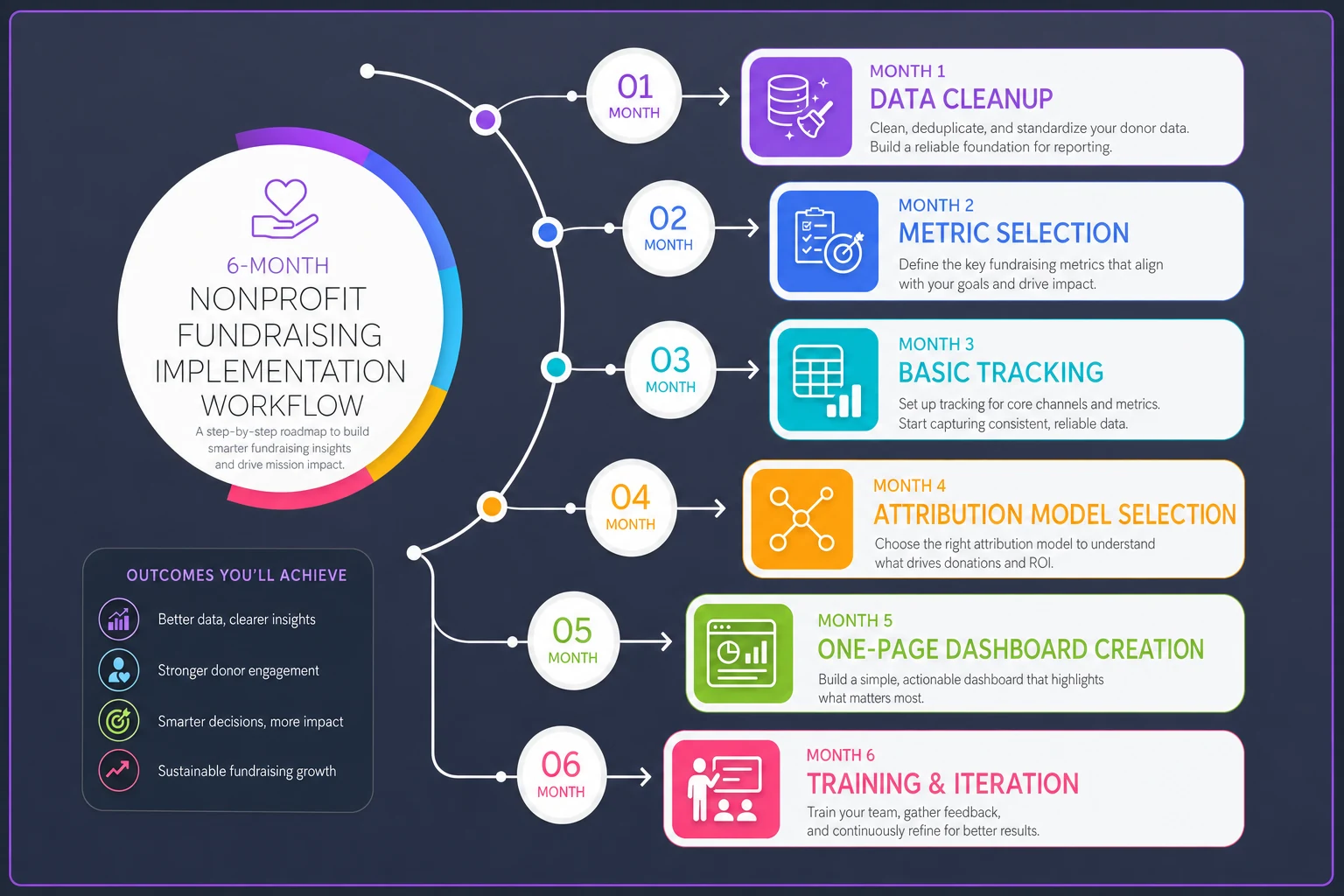
Month 1: Clean your data Start with donor records. Merge duplicates, update contact information, standardize naming conventions. One healthcare foundation found 2,800 duplicate records in their 9,000 person database. Their retention rate jumped 15% just from cleaning data.
Month 2: Pick your primary metrics Choose 5-7 metrics that matter most. Get leadership agreement. Document the exact calculation for each one. No changes for twelve months minimum.
Month 3: Build basic tracking Simple spreadsheet or database reports. Nothing fancy. Just consistent weekly/monthly numbers for your primary metrics.
Month 4: Add attribution model Start with the simplest model that answers your questions. Usually source-based for organizations under $3M, campaign-based above that.
Month 5: Create your one-page dashboard Only after you have clean data and consistent tracking. Make it automated if possible, but manual is better than nothing.
Month 6: Train everyone and iterate Show staff how to use the data. Get feedback. Adjust the dashboard (not the metrics). Make it part of weekly/monthly routines.
Most organizations try to do all this in two weeks, fail, then go back to tracking nothing. The six-month timeline seems slow but actually gets you to useful metrics faster than rushing.
A simple visual of the six-month implementation process can help align stakeholders.
Most organizations try to do all this in two weeks, fail, then go back to tracking nothing. The six-month timeline seems slow but actually gets you to useful metrics faster than rushing.
Making peace with imperfect attribution
All nonprofit attribution models are wrong. Every single one. Because human giving behavior doesn't follow neat attribution paths.
A donor might give because their neighbor asked them to support the gala they're chairing, but only because they've been receiving your newsletter for three years and their kid benefited from your programs a decade ago. What gets credit? The neighbor? The gala? The newsletter? The program experience?
The goal isn't perfect attribution. It's useful attribution that helps you make better decisions. An arts education nonprofit stopped trying to track every touchpoint and started asking one question: "What would happen if we stopped doing this?" That simple framework led them to cut three underperforming events and double down on their peer-to-peer campaigns, increasing net revenue by 25%.
Accept that your attribution will be directionally correct, not precisely accurate. Track it consistently, use it for big decisions, but don't let perfect measurement prevent good fundraising.
The software question you're actually asking
By now you're wondering if you need specialized software or if spreadsheets are enough.
Spreadsheets work fine until:
-
Multiple people need to update the same data
-
You're pulling reports weekly instead of monthly
-
Attribution crosses multiple channels
-
You have more than 1,000 active donors
-
Manual reporting takes more than 4 hours monthly
The transformation happens when you can automate the boring stuff. AI-powered operational software doesn't replace fundraisers—it eliminates the manual work that keeps them from actually fundraising. Automatic attribution assignment, integrated dashboards, donor journey tracking, alert systems for at-risk donors—this isn't fancy tech for its own sake. It's about freeing your team to build relationships instead of building reports.
A social services nonprofit implemented operational software with AI automation for their fundraising metrics. Their development coordinator went from spending twelve hours monthly on reports to thirty minutes. But the real win? They could finally see donor patterns across channels, identify at-risk monthly givers before they lapsed, and prove which acquisition channels actually generated long-term value.
You don't need the most sophisticated system. You need a system sophisticated enough to answer your questions without drowning your team in complexity.
Build for tomorrow's problems, not yesterday's
Most nonprofits build metrics systems to solve last year's problems. They implement complex attribution because they couldn't answer a board question six months ago. They create elaborate dashboards because someone complained about reporting gaps.
Build for where you're going instead. If you're at $500k annual fundraising, build metrics for $2M. If you have three fundraising staff, build systems that work for eight. Not because you need that complexity now, but because rebuilding your measurement system every two years destroys historical data and exhausts your team.
Start simple, stay consistent, and add complexity only when simple stops working. Track what matters, accept imperfect attribution, and focus on insights that drive action. Your donors don't care about your attribution model. They care about your mission. Build measurement systems that help you deliver on that mission, not ones that look impressive in board presentations.
The nonprofits that thrive don't have perfect metrics. They have useful metrics, consistently tracked, that help them make better decisions.
Ready to elevate your fundraising efforts?
Join 2,000+ nonprofits using Givioly to save time, increase donations, and build lasting donor relationships.