



Most attribution arguments inside nonprofits aren't really about attribution. They're about money. When a mailed appeal and an email series and a peer-to-peer page all touch the same donor before a $5,000 gift lands, three different people suddenly have a reason to claim that revenue — and two of them are writing next year's budget request based on it.
That's the part nobody warns you about. Attribution isn't a reporting problem you solve once in a spreadsheet. It's a governance problem that quietly decides how you allocate budget, how you defend your numbers to the board, and whether your audit holds up when a funder asks where the number came from. Without rules that are written down, versioned, and enforced the same way every quarter, your attribution model becomes whatever the loudest channel owner says it is.
This piece is about building the governance layer underneath attribution — the canonical source mapping, the audit-log requirements, the budget gates, and the cadence for changing rules — so that credit assignment stays consistent even as channels multiply and staff turns over.
Why attribution quietly becomes a budgeting weapon
There's a pattern that plays out across small and mid-sized development shops. Early on, channels are simple. Direct mail, events, maybe a monthly e-appeal. Credit is obvious enough that nobody fights about it. Then digital grows, a peer-to-peer program launches, a corporate match flows through a third-party portal, and suddenly the donor journey has five or six touchpoints before conversion.
At that point the model stops being descriptive and starts being political. The digital team wants last-touch because their landing pages close gifts. The direct mail team wants first-touch because the mail piece is what introduced the donor to the org. Events wants full credit for anyone who gave within 90 days of the gala. All three are partially right, which is exactly the problem.
What shows up across a lot of fundraising operations is that whoever controls the attribution logic ends up controlling the budget conversation. If your CRM defaults to last-touch and nobody decided that on purpose, you've effectively handed your acquisition budget to whichever channel happens to sit closest to the donation button. That's a governance failure disguised as a software default.
The fix isn't picking the "correct" model — there isn't one. The fix is making the choice explicit, documented, and tied to a review cadence so that when someone disagrees, the conversation happens in a scheduled governance meeting instead of in the footnotes of a board deck.
The three layers that actually need governing
People think attribution governance means "choose a model." It's broader than that. There are three distinct layers, and most orgs govern zero of them formally.
Simplify donor management and fundraising workflows.
Givioly helps you organize campaigns, engage donors, and maximize fundraising impact seamlessly.
- Unified donor profiles
- Real-time donation tracking
- Automated impact reporting
No credit card required
Layer 1 — Canonical source mapping. Before you can assign credit, every touchpoint has to resolve to a single, agreed-upon source name. This is where things rot first. The same campaign shows up as EOY2024, End of Year 2024, eoy-email, and Year-End Appeal across four systems. Credit rules can't run on inconsistent inputs.
Layer 2 — Credit assignment rules. The actual logic: which touchpoints get what share of a gift, over what lookback window, with what tie-breakers. This is what people usually argue about.
Layer 3 — Budget and audit linkage. How attributed revenue feeds allocation decisions, and whether every credited gift can be traced back to source data on demand.
The mistake is treating these as one thing. In real operations, your attribution breaks at Layer 1 long before anyone argues about Layer 2. If facebook, FB, and Meta-Paid are three different sources in your data, no credit rule on earth produces consistent numbers. Clean the mapping first, then argue about models.
The diagram below shows how the three layers interact and where governance checkpoints belong.
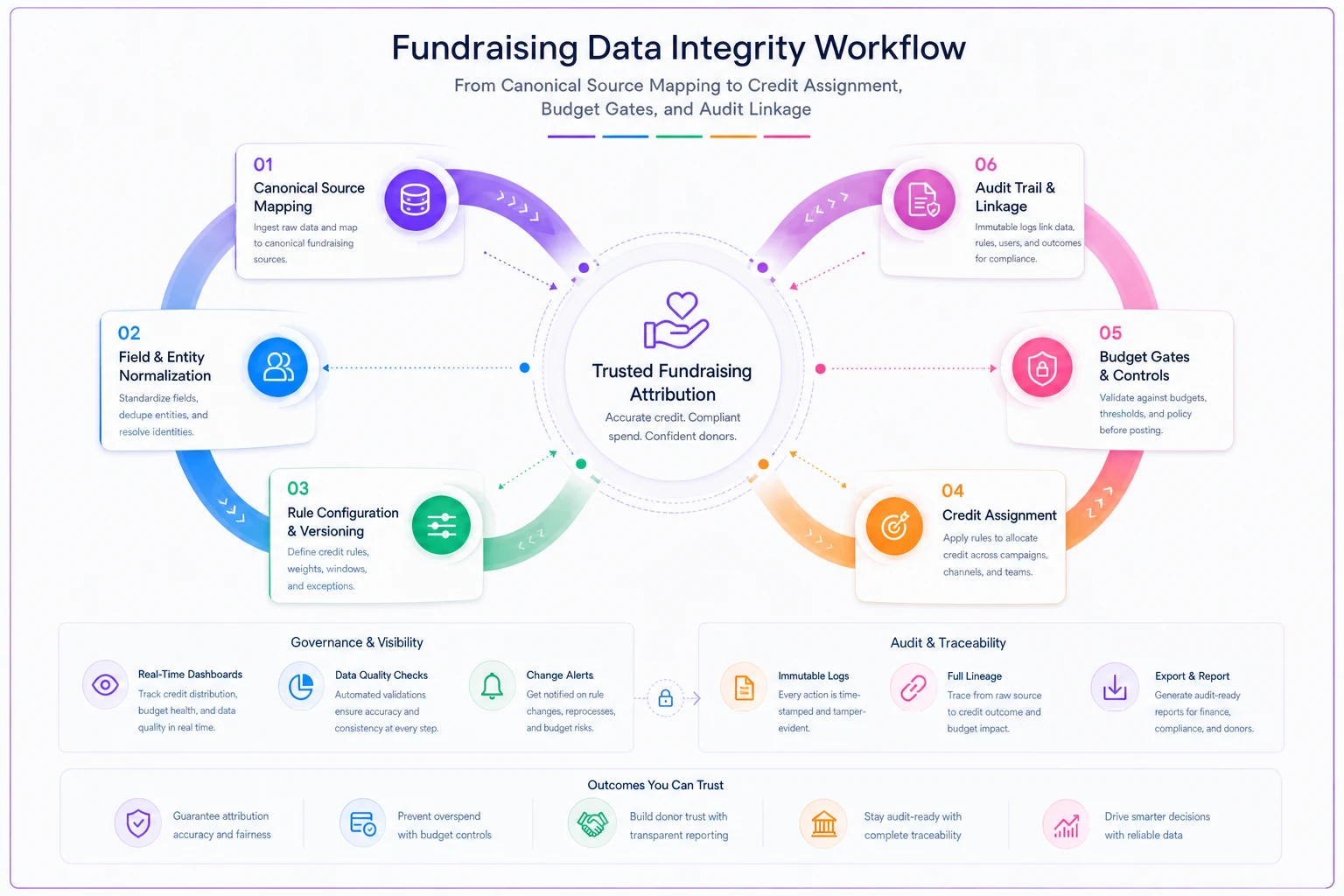
Keep the ownership and versioning explicit at each step so you can always trace a credited gift back through mapping, rule logic, and budget decisions.
Canonical source mapping: the template that prevents most of the chaos
A canonical source map is just an enforced dictionary. Every raw value that lands in your CRM, your email platform, your event tool, and your payment processor maps to one approved canonical source. New raw values can't be credited until someone maps them.
Here's a working template structure:
| Canonical Source | Channel Group | Accepted Raw Values | Default Credit Role | Owner |
|---|---|---|---|---|
directmailappeal | Direct Mail | DM, mail, letter-ask, appeal-print | First-touch eligible | DM Manager |
email_appeal | Digital | eoy-email, e-appeal, newsletter-ask | Mid/last eligible | Digital Lead |
p2p_page | Peer-to-Peer | p2p, teamraise, personal-page | Full-credit (isolated) | P2P Coordinator |
event_gala | Events | gala24, event-table, auction | Soft-credit window | Events Manager |
corpmatchportal | Corporate | benevity, yourcause, match-portal | Match-linked only | Corp Partnerships |
organic_web | Digital | direct, none, unattributed | Catch-all residual | Data Steward |
The rule that makes this work: nothing enters the credited dataset through an unmapped raw value. Unmapped values route to a review queue, not to organic_web. The default-to-organic behavior is the single biggest silent distortion in nonprofit attribution — unattributed gifts pile into a bucket that makes "direct/organic" look like your best channel when it's really just your mapping gaps.
Require channel owners to approve new raw-value mappings before those values flow into the credited dataset.
If you already built canonical mapping during a platform migration or a data-governance project, reuse it. The discipline that powers clean fundraising data governance is the same discipline that powers attribution — one source of truth, one owner per field, one review process.
Writing credit rules that survive an argument
Once mapping is clean, the credit rules need to be written like policy, not preference. A usable credit-rule spec answers five questions in plain language:
-
Lookback window — How far back does a touchpoint count? (e.g., 90 days for email, 180 for mail, event credit only within 60 days of the event.)
-
Model — First-touch, last-touch, linear, position-based, or a documented hybrid. Pick per channel group if needed, but write down why.
-
Tie-breakers — When two touchpoints qualify equally, what wins? Usually recency, but say it explicitly.
-
Isolation rules — Some channels (p2p especially) should get full isolated credit rather than fractional, because the fundraiser owns that donor relationship. Decide and document.
-
Residual handling — Where do genuinely unattributable gifts go, and how is that bucket reported so it doesn't masquerade as performance?
Here's the part most teams skip: every rule needs a version number and an effective date. When your Q3 numbers look different from Q1, the first question is "did the rule change?" If you can't answer that instantly, your attribution isn't auditable — it's just a current snapshot with no history.
For the broader measurement philosophy that sits above these rules, our pragmatic framework for fundraising metrics and attribution covers how to choose models without over-engineering them. This article is the governance layer that keeps those choices honest over time.
Audit-log requirements: what "auditable" actually means
"Auditable" gets thrown around loosely. In practice, an attribution system is auditable when you can take any single credited gift and reconstruct exactly how it got its credit. That requires logging more than the final number.
A minimum audit record for each credited gift should capture:
-
The gift ID and amount
-
Every touchpoint considered, with raw source value and canonical mapping applied
-
The credit rule version that was active at processing time
-
The resulting credit split (which source got what share)
-
Timestamp and the process/person that ran the assignment
-
Any manual overrides, with a reason code and who approved them
That manual-override line is the one that saves you in an audit. In real operations, overrides happen — a major gift officer knows a $25k gift came from a lunch meeting the CRM never recorded, so they reassign it. Fine. What's not fine is reassigning it silently. Log the override, the reason, and the approver, every time. An attribution dataset full of invisible manual edits is worse than no attribution at all, because it looks authoritative while being untraceable.
The same source-to-record traceability you'd build for donor-facing numbers applies here. If you've worked through source-to-dashboard mapping for impact reporting, you already know the shape of this: every number on the dashboard should trace cleanly back to a logged source event. Attribution is just that discipline applied to credit instead of impact.
Governance gates for budget allocation
This is where attribution stops being an analytics exercise and starts touching real dollars. If attributed revenue drives next year's channel budgets — and it usually does, directly or informally — then you need gates between "the model produced a number" and "we're reallocating budget based on it."
A practical gate sequence looks like this:
-
Data completeness gate. Before attribution runs for a reporting period, the mapping review queue must be cleared. No crediting against unmapped sources.
-
Rule-stability gate. Budget decisions can only use periods where the credit rule version was stable for the full period, or where mid-period rule changes are explicitly flagged and the affected revenue is annotated.
-
Materiality gate. Reallocations above a set threshold — anything moving more than roughly 10–15% of a channel's budget — require a second reviewer and a documented rationale, not just a dashboard screenshot.
-
Residual sanity gate. If the unattributed/residual bucket exceeds a defined ceiling (say 20% of credited revenue), budget decisions pause until the mapping gaps are investigated. A ballooning residual usually means broken tracking, not a genuinely dark channel.
The point of gates isn't bureaucracy. It's preventing the very common scenario where a channel gets its budget cut because of a tracking glitch, not a performance problem. Gates force a pause between "the number dropped" and "we're defunding the program."
When this level of governance makes sense — and when it doesn't
Not every org needs all of this. Be honest about where you are.
This makes sense when: you're running four or more channels that genuinely interact, your annual revenue is large enough that a 10% misallocation is real money, you have board or funder scrutiny on fundraising efficiency, or you've already had an internal argument about which channel "deserves" credit for a big campaign. If any of those are true, informal attribution is already costing you.
This is overkill when: you run two or three clean channels with little overlap, your gift volume is low enough to eyeball, and nobody's making six-figure budget swings off attributed numbers. In that case, a documented last-touch default plus a simple source map is plenty. Don't build governance gates for a two-person shop.
Who should NOT do this yet: teams that haven't cleaned their source data. If your canonical mapping is a mess, building sophisticated credit rules on top is like putting a security system on a house with no walls. Fix Layer 1 first. Everything else is premature.
A real scenario
A regional environmental nonprofit — roughly $4M annual revenue, five channels, a three-person development team plus a shared data person — kept making budget calls off their CRM's default last-touch attribution without anyone having actually chosen it. Their email channel looked like a monster, pulling credit for nearly every online gift, while direct mail looked flat and kept landing first on the chopping block each budget cycle.
When they finally logged the touchpoint data and ran a documented position-based model with a 180-day mail window, the picture shifted. A large share of those "email-sourced" gifts had a direct mail first touch months earlier — the mail piece was doing the acquisition and email was just closing. Direct mail's real contribution had been undercounted by something like 30–40% under the unexamined default.
Nothing about donor behavior changed. The only thing that changed was that credit assignment became a decision instead of an accident. They kept direct mail funded, documented the rule with a version number, and the next time someone wanted to cut it, the conversation happened against a logged, auditable model instead of a misleading default.
A cadence for changing the rules (so you don't change them constantly)
Credit rules should be stable most of the time and reviewed on a schedule — not tweaked every time a result looks off. A workable cadence:
-
Quarterly Review the mapping queue, check residual bucket size, confirm no rules drifted. Mostly a health check, not a change window.
-
Annually Formal rule review. This is the only time models, lookback windows, or isolation rules should change under normal circumstances. Version the new rule set, set an effective date, and keep the old version archived.
-
Ad hoc (rare) A new channel launches or a tracking system changes. Document it, flag the affected period, and don't retroactively rewrite history unless you log exactly what you reprocessed and why.
The discipline here mirrors how mature teams handle any governed system — change on a cadence, document the change, preserve the history. When rule changes happen whenever someone's unhappy with a number, you lose the one thing that made attribution trustworthy: the ability to compare periods and know the comparison is fair.
Bringing it together
Attribution governance for nonprofits isn't about finding the one true model. It's about making credit assignment a decision you can defend — mapped to canonical sources, run against versioned rules, logged so any gift can be traced, and gated before it moves real budget. Each of those layers protects a different failure point: mapping protects against garbage inputs, rules protect against arbitrary credit, logs protect against silent edits, and gates protect your programs from being cut on bad data.
The orgs that handle this well aren't the ones with the fanciest models. They're the ones where everyone agrees on the rules in advance, writes them down, and only changes them on a schedule. Get those habits in place and attribution stops being a quarterly fight and starts being what it should have been all along — a quiet, boring, trustworthy input to how you spend your money.
Ready to elevate your fundraising efforts?
Join 2,000+ nonprofits using Givioly to save time, increase donations, and build lasting donor relationships.