
Verbal pledges rot fast. Someone says "yes, put me down for $500" during a phone-a-thon, the caller writes it on a legal pad, and by the time anyone types it into the CRM three days later, half the details are gone. Was it $500 or "around $500"? One gift or split across two payments? Did they want to pay by card now or get an invoice? The gap between the call and the record is where pledge revenue quietly leaks.
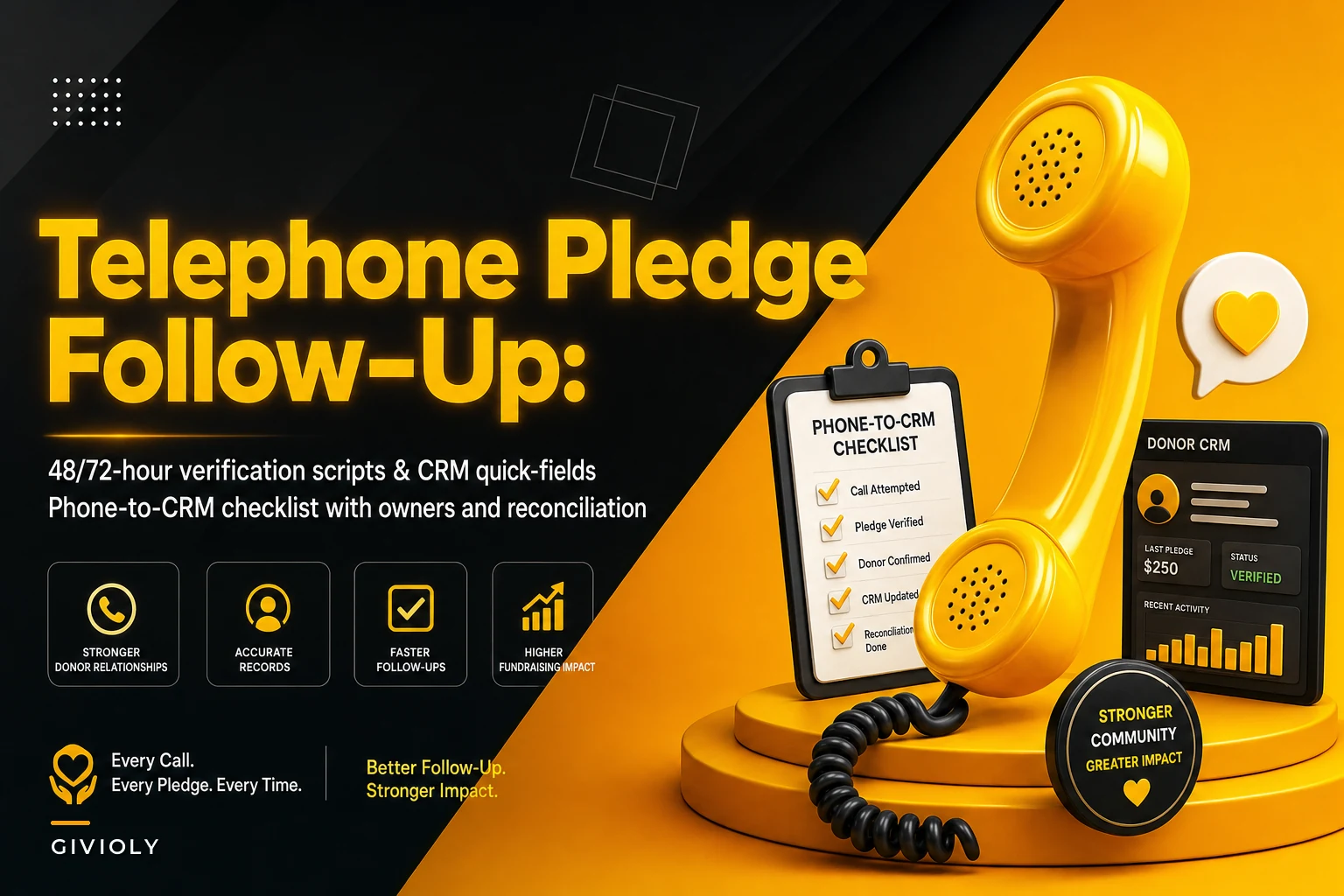
This post is narrow on purpose. It covers the 48–72 hour window right after a verbal pledge — the exact steps to lock it down, the CRM fields you need before the call starts, and a reconciliation routine that ties each pledge back to an actual deposit. If you run phone-a-thons, board call nights, or lapsed-donor recapture calls, this is the operational piece that usually gets skipped.
Why the 48–72 hour window matters more than the call itself
Most teams obsess over the ask and ignore the follow-through. But the pledge isn't real until it's captured accurately and confirmed. Two things decay in those first three days.
First, the caller's memory. A volunteer who made 40 calls in an evening cannot reconstruct the nuance of call #12 by Thursday. The amount might survive, but the terms — payment method, timing, whether it was contingent on a match — don't.
Second, the donor's intent. Enthusiasm is highest right after the conversation. Wait a week to send confirmation and you're competing with buyer's remorse, a credit card statement, or just plain forgetting they said yes. In telephone pledge follow up for nonprofit teams, the difference between a 48-hour confirmation and a 10-day one shows up directly in fulfillment rates.
Pledges confirmed in writing within 72 hours tend to fulfill at a meaningfully higher rate than pledges that sit unconfirmed. The exact spread varies by program, but the direction is consistent across phone campaigns — faster confirmation, better fulfillment.
What breaks down, specifically
The failure isn't usually one big mistake. It's a chain of small ones.
Simplify donor management and fundraising workflows.
Givioly helps you organize campaigns, engage donors, and maximize fundraising impact seamlessly.
- Unified donor profiles
- Real-time donation tracking
- Automated impact reporting
No credit card required
-
The caller captures the amount but not the payment method.
-
Nobody logs when the donor said they'd pay.
-
The pledge lands in the CRM as a note, not a structured record, so it can't be reported on or triggered off of.
-
No confirmation goes out, so the donor never gets a chance to correct "I said monthly, not one-time."
-
Finance can't match the eventual deposit to the pledge because the pledge was never given an ID.
A common scenario looks like this: a mid-sized arts nonprofit runs a spring call night, books roughly $22k in verbal pledges across about 60 donors, and celebrates. Ten weeks later, finance has matched maybe $14k of it. The other $8k isn't necessarily lost — it's unreconciled. Some donors paid but nobody linked the gift to the pledge. Some never got a confirmation and forgot. Nobody can tell which is which, which means nobody knows who to follow up with.
That ambiguity is the real cost. Unfulfilled is a fundraising problem. Unreconciled is an operational one, and it's fixable with structure.
The CRM quick-fields to set up before you dial
You cannot capture what you have no field for. Before any call night, make sure your pledge record has these fields ready. Freeform notes are where pledge terms go to die.
| Field | Type | Why it matters |
|---|---|---|
| Pledge ID | Auto-generated | Gives finance a key to match deposits against |
| Pledge amount | Currency | The number, exactly as stated |
| Amount certainty | Dropdown (firm / approximate) | Flags "around $500" for softer follow-up |
| Payment method stated | Dropdown (card now / invoice / check / bank / undecided) | Drives the confirmation script |
| Payment timing | Date or dropdown (this week / this month / by quarter-end) | Sets the reconciliation clock |
| Split payment? | Yes/No + count | Prevents "why is only half here" confusion |
| Contingency | Text (e.g., "if board match hits") | Some pledges aren't unconditional |
| Caller name | Lookup | Accountability + follow-up questions |
| Call timestamp | Datetime | Starts the 48–72 hour window |
| Confirmation sent? | Yes/No + datetime | The single most-skipped field |
| Confirmation method | Dropdown (email / text / mail) | Matches donor preference |
The two fields people consistently forget are amount certainty and confirmation sent. Amount certainty lets you treat a firm "$1,000" differently from a hopeful "maybe a thousand." Confirmation sent is what makes the whole follow-up routine auditable — if you can't report on who got confirmed, you're guessing.
Make Amount certainty and Confirmation sent required fields.
Freeform notes are where pledge terms go to die.
The short scripts
Keep these tight. The confirmation contact is not a second ask — it's a close. Long, effusive confirmations invite second-guessing.
Same-day / next-day email (fires within 24–48 hours): > Hi [Name] — thank you so much for your pledge of [$amount] during last night's call. Just confirming the details so we have everything right: [$amount], paid by [method], around [timing]. If anything looks off, reply and I'll fix it. Here's the link to complete it now if that's easiest: [link].
48-hour text (for donors who chose "card now" but haven't paid): > Hi [Name], [Org] here — thanks again for your generous pledge! Here's your secure link to complete the [$amount] gift whenever you have a minute: [link]. Reply STOP to opt out.
72-hour caller follow-up call (only for firm pledges over your threshold, e.g., $250+, still unconfirmed): > Hi [Name], this is [caller] from [Org]. We spoke [day] and you mentioned supporting [program] at [$amount] — I just wanted to say thank you and make sure we got the details right. Were you thinking a card gift or would an invoice be easier? Notice the follow-up call assumes the pledge is real and only nails down mechanics. You're removing friction, not re-selling.
The verification routine, step by step
Below is the exact sequence. Assign an owner to each step or it won't happen.
TELEPHONE PLEDGE VERIFICATION FLOW [Call Ends] | v [Within 4 Hours] Callers enter pledges into CRM using quick-fields (Same night — never let sheets sit overnight) | v [Within 24–48 Hours] Confirmation email or text sent to every pledger → Mark "Confirmation Sent" field (hard gate) | v [At 48 Hours] Pull "card now" pledges with no payment recorded → Send payment link text | v [At 72 Hours] Pull firm pledges above threshold — unconfirmed or unpaid → Assign follow-up call to original caller → Flag contingent pledges to separate watch list | v [Day 7] Anything unconfirmed → "Needs Decision" queue (Write off / downgrade certainty / personal call)
-
Within 4 hours of the call ending callers transfer pledges from their sheets into the CRM using the quick-fields above. Do this the same night. Memory is freshest and the batch is small. Never let sheets sit overnight.
-
Within 24–48 hours confirmation email or text goes out to every pledger. Mark the Confirmation sent field. This is a hard gate — no pledge advances without it.
-
At 48 hours pull a list of "card now" pledges with no payment recorded. Send the 48-hour text with the payment link.
-
At 72 hours pull firm pledges above your threshold still unconfirmed or unpaid. Assign the follow-up call to the original caller when possible — the donor already has rapport with them.
-
At 72 hours flag any pledge with a contingency into a separate watch list. These need to be revisited when the contingency resolves, not chased now.
-
Day 7 everything unconfirmed after a week moves to a "needs decision" queue for a fundraiser to review — write it off, downgrade the certainty, or make a personal call.
Each day has a defined action and a defined owner. Most pledge leakage happens because "follow up on pledges" is a vague task nobody owns, rather than six specific, dated actions.
Here's a quick visual of that verification flow.
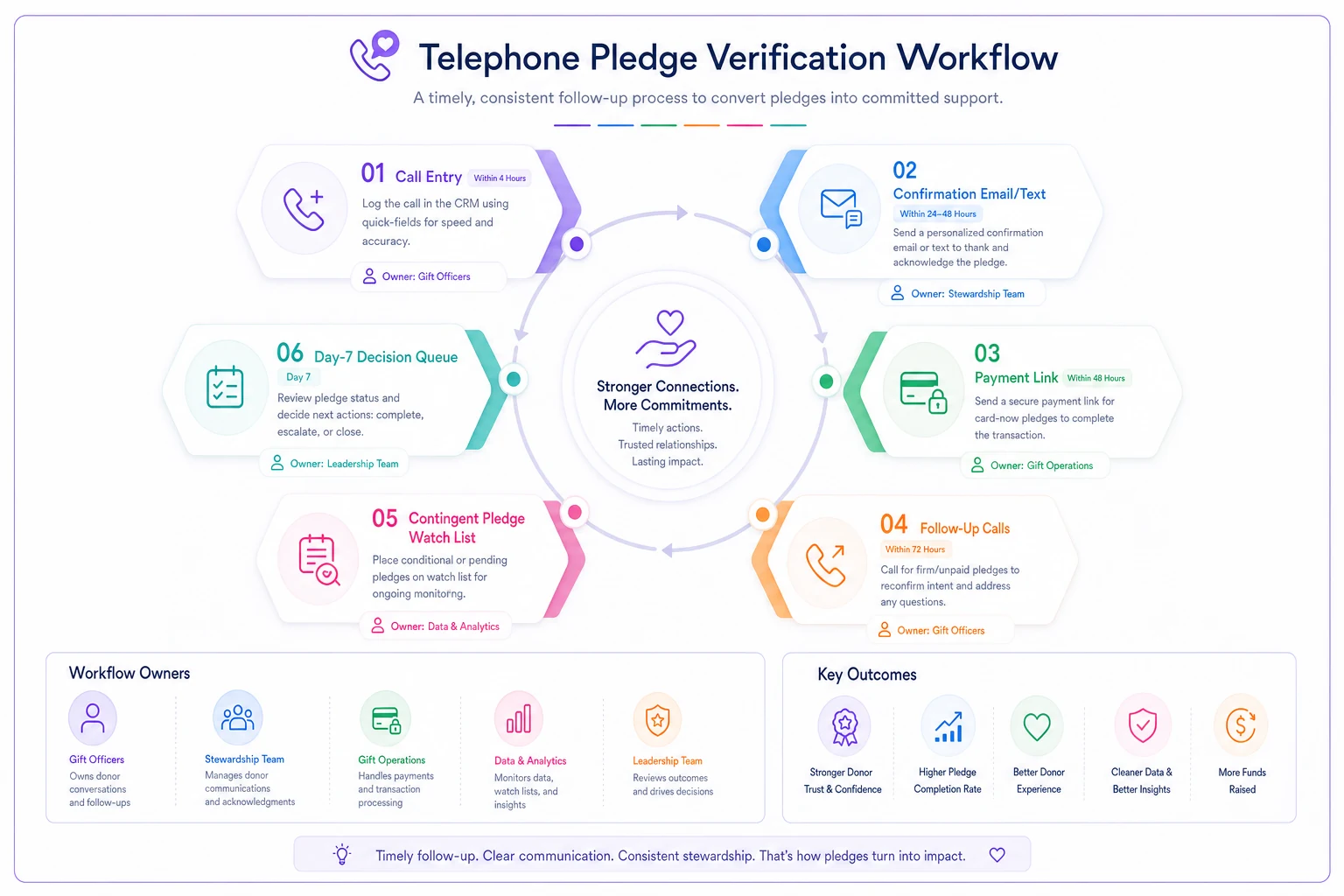
Each day has a defined action and a defined owner. Most pledge leakage happens because "follow up on pledges" is a vague task nobody owns, rather than six specific, dated actions.
Tying pledges to deposits: the reconciliation piece
Confirmation gets the donor to pay. Reconciliation proves they did — and tells you who didn't. This is where the Pledge ID earns its keep.
Every incoming gift — online, check, or ACH — gets matched against open pledges by donor and amount. Exact matches close automatically. Partial matches (donor pledged $500, paid $250) flag as split-payment-in-progress and stay open for the remainder. Gifts with no matching pledge get parked for review, because sometimes a pledger pays under a spouse's name or a slightly different amount.
Run this weekly, not quarterly. A weekly reconciliation cadence keeps the unmatched pile small enough to actually investigate. Let it accumulate for a quarter and you end up in the $8k-unreconciled situation from earlier, where the mystery is too big to untangle.
-
Open — pledged, not yet paid, still inside timing window
-
Partial — some paid, remainder outstanding
-
Fulfilled — matched to deposit, closed
-
Lapsed — timing window passed, no payment, moved to decision queue
-
Contingent — waiting on external condition
If you already run a broader gift-matching process, this slots into it cleanly. The same discipline that powers an audit-ready donation reconciliation workflow applies here — the only addition is the Pledge ID as the matching key. And if your phone campaigns tie into events, the offline-gift logging habits from event donation operations carry over directly to call-night capture.
Where automation quietly helps (and where it doesn't)
Most of this routine is manual discipline, and for a single call night, that's fine. Where it gets painful is repetition and timing — remembering to send the 48-hour text to exactly the right subset, pulling the 72-hour unconfirmed list, matching a week's deposits against open Pledge IDs.
An operational platform with light AI automation can carry the timing and matching load: auto-generating Pledge IDs, firing the confirmation sequence off the call timestamp, and surfacing daily action lists so no one has to build them by hand. The reconciliation matching — comparing incoming deposits to open pledges and flagging mismatches — is exactly the kind of repetitive check that's easy to automate and error-prone to do manually. The judgment calls (write off vs. personal call, how to handle a contingency) stay with your team, where they belong.
The goal isn't to remove people from the process. It's to make sure the time-sensitive, repetitive steps happen on schedule so your fundraisers can focus on conversations that actually need a human.
A real scenario
A regional literacy nonprofit ran board-driven call nights twice a year. Their process was a shared spreadsheet, batch-entered into the CRM the following week, with confirmation emails sent "when someone got to it." Fulfillment on verbal pledges hovered somewhere around 60–65%, and reconciliation was a scramble each quarter because nothing tied gifts back to specific pledges.
They changed three things: same-night CRM entry using structured quick-fields, a confirmation email sent within 48 hours as a hard rule, and a weekly deposit-to-pledge match using a Pledge ID. No new staff, no big software overhaul — just the routine above. Over the next two campaigns, fulfillment climbed into the high 70s, and the quarterly reconciliation scramble basically disappeared because the unmatched pile never grew beyond a handful of gifts. The revenue difference on a roughly $25k call night was real, but the operations director's actual takeaway was that she "stopped dreading the reconciliation email." That's the win people underrate.
When this level of routine makes sense — and when it doesn't
When it's worth it: you run recurring phone campaigns, board call nights, or lapsed-donor recapture calls where verbal pledges are common and the total is meaningful. If you're booking $10k+ in verbal pledges per campaign, the leakage is big enough to justify the structure.
When it's overkill: a tiny one-off call with five donors you know personally doesn't need Pledge IDs and a weekly reconciliation cadence. Just call them, email a link, and move on.
Who should skip this: if your pledges are almost all card-now, completed on the call itself, you've already closed the gap this routine is designed to fix. Focus your energy on the ask quality instead.
Closing thought
The pledge follow-up problem isn't about persuasion. The donor already said yes. It's about whether your operation can carry that "yes" through capture, confirmation, and reconciliation without dropping it.
The 48–72 hour window is small, but it's where the outcome gets decided. Set up the fields before you dial, confirm fast, and match every pledge to a deposit on a weekly rhythm — and the money people already promised you actually shows up.
The 48–72 hour window is small, but it's where the outcome gets decided. Set up the fields before you dial, confirm fast, and match every pledge to a deposit on a weekly rhythm — and the money people already promised you actually shows up.
Ready to elevate your fundraising efforts?
Join 2,000+ nonprofits using Givioly to save time, increase donations, and build lasting donor relationships.