

The morning after a gala is where good fundraising events quietly fall apart. Not during the event — the event usually goes fine. It's the next Tuesday, when the finance person opens a shoebox of paper pledge cards, a spreadsheet three volunteers edited on their phones, and a Square account showing 47 swipes with no names attached, and realizes reconciliation is going to eat the entire week.
Event donation reconciliation for a nonprofit isn't hard because the math is complicated. It's hard because the data gets created by a dozen people, in a rush, in a dark room, with no single source of truth. The auction closes at 9:40pm, the paddle raise happens at 9:15, someone's aunt writes a $500 check at the coat closet, and all of it has to reconcile against your merchant deposits, your event budget, and your CRM within a couple of weeks so acknowledgment letters go out on time.
This post is a runbook. Roles for the day of, a deposit log you can actually use, a template for auction and item reconciliation, a sponsor invoicing checklist, and a post-event CRM tagging routine. The goal is that nobody on your team spends the week after the event playing detective.
Why event reconciliation breaks (and it's almost always the same three reasons)
Before the templates, it's worth naming what actually goes wrong, because if you don't fix the root cause the templates won't save you.
One: no assigned owner for cash and checks. Money moves around during an event. Someone collects paddle raise cards, someone else takes checks at registration, a volunteer handles the wine pull cash box. When three people touch money and nobody signs for it, you get gaps you can never close.
Two: the auction and the payment system don't talk. Your auction software says Table 6 won the vacation package for $3,200. Your credit card processor shows a $3,200 charge. But the name on the card is the winner's spouse, and now your CRM has a gift with no matching auction record. Multiply that by 40 auction items.
Three: pledges get treated like payments. Someone raises their paddle for $1,000. That's a pledge, not money in the bank. If it gets logged as revenue on event night and never collected, your event "raised" $12,000 more than actually hit the account. This shows up months later when the board asks why the numbers don't match.
The pattern underneath all three is the same: information created by many hands, at speed, with no structure to catch it. The fix isn't working harder the next morning. It's building the capture structure before the doors open.
Define your day-of roles before you touch any templates
Templates only work if a specific human owns each one. The single biggest improvement most small teams can make is assigning these five roles and writing the name next to each one a week before the event.
Simplify donor management and fundraising workflows.
Givioly helps you organize campaigns, engage donors, and maximize fundraising impact seamlessly.
- Unified donor profiles
- Real-time donation tracking
- Automated impact reporting
No credit card required
| Role | Owns | Hands off to |
|---|---|---|
| Cash & Check Custodian | All physical money, deposit log, checkout envelope | Finance lead (next business day) |
| Auction Recorder | Winning bids, item numbers, buyer names | Reconciliation lead |
| Payment Processor Lead | Card swipes, mobile bidding platform, failed charges | Finance lead |
| Pledge Tracker | Paddle raise cards, verbal commitments, pledge forms | Development / gift entry |
| Data Entry Lead | Post-event CRM tagging, source coding | Reporting |
A few notes from how this plays out in real rooms:
The Cash & Check Custodian is the most under-appreciated role and the one you cannot skip. This person is the only one who touches the cash box, and every handoff gets a signature. If a volunteer collects check envelopes at registration, they hand them to the custodian and both initial a line. Sounds bureaucratic. It's the difference between a clean audit and an awkward conversation.
Keep the Pledge Tracker completely separate from the Payment Processor Lead. Pledges and payments are different things, and the fastest way to inflate your event total is to let one person log both into the same column. Separating the roles forces the mental separation.
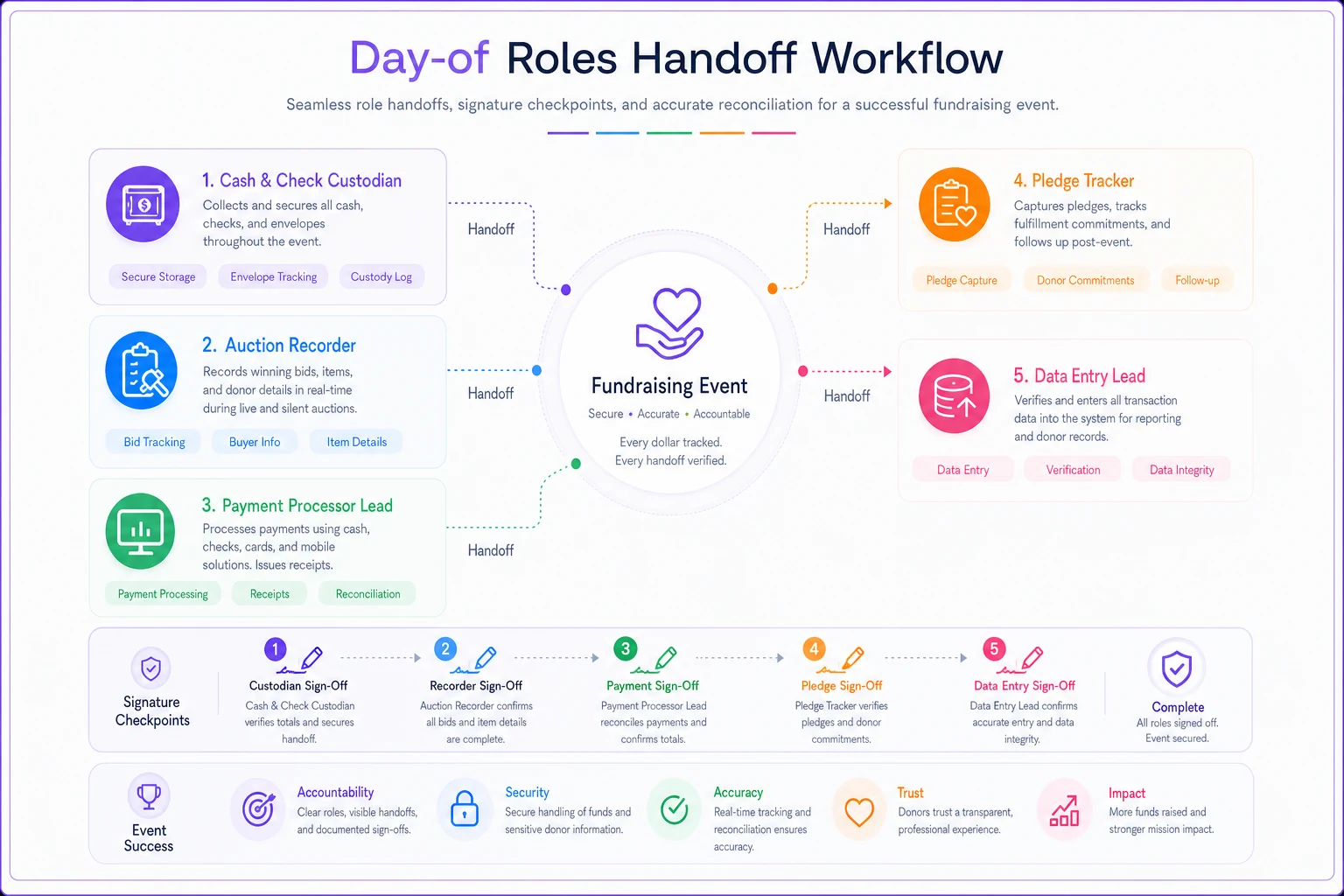
Use this to show volunteers who holds what and where to sign at handoffs.
The offline gift log that actually closes
Most teams' offline gift logs fail because they capture too little. You need enough on event night that a person who wasn't there can reconcile it. Here's the minimum viable set of columns.
-
Sequential entry number (pre-printed 001, 002, 003…)
-
Timestamp
-
Donor name (or "unknown — see card")
-
Amount
-
Type
cash / check / card
-
Check number (if check)
-
Designation
general / paddle raise / auction item # / sponsorship
-
Collected by (initials)
-
Custodian received (initials)
Pre-print sequential numbers on your log sheets.
The sequential entry number matters more than it looks. When entry 023 is missing, you know something walked off between 022 and 024, and you know roughly when. Without sequential numbering, a missing $200 is invisible.
A realistic example of how a single row saves you: at a mid-size gala the custodian logged "entry 041, 9:32pm, unknown donor, $500, check #2231, designation: paddle raise, collected by MR." The check had no legible name. Two days later, gift entry matched check #2231 against the bank's cleared-check image, pulled the account name, and the gift got credited correctly. Without the check number and the sequential log, that $500 becomes an anonymous gift that never gets acknowledged — and that donor never gives again.
If your team is already running a broader reconciliation process for online and offline gifts, this log should feed directly into it rather than living as a separate island. The structure we lay out in the audit-ready donation reconciliation workflow is the downstream home for everything this log captures.
Auction and item reconciliation template
This is where the most money hides. Auction reconciliation fails when the three data points — item, winning bid, and actual payment — never get lined up in one place. Here's the template structure that closes it.
For every auction item you need one row that tracks it from donation to collection:
-
Item number — the physical tag number
-
Item description
-
Fair market value — needed for the donor's tax receipt math
-
Donated by — the source (in-kind donor)
-
Winning bid amount
-
Winner name + bidder number
-
Amount actually collected
-
Payment method + reference
-
Variance (winning bid minus collected)
-
Status paid / pending / no-show
The variance column is the whole point. When the winning bid was $3,200 and collected is $0 with status "pending," that's a real receivable someone has to chase. Small teams routinely lose somewhere between 5–10% of auction revenue to winners who leave before paying and never get followed up with.
One thing that trips people up: the fair market value is not the winning bid. If someone pays $3,200 for a vacation package with a fair market value of $2,000, only $1,200 is tax-deductible for them, and only the FMV counts as an in-kind revenue offset. Getting this wrong means either your donor gets a bad receipt or your books misstate revenue. Because donated auction items are in-kind gifts before they're sold, the valuation and chain-of-custody discipline from tracking and reporting in-kind donations applies directly to columns 3 and 4 here.
A quick worked reconciliation
-
34 items paid at the table
collected total roughly $41k
-
3 items "pending" (winners left early)
$4,800 in receivables
-
1 item marked no-show / withdrawn
Your auction "raised" $45,800 on paper. Your merchant deposit shows $41k. That $4,800 gap isn't an error — it's a to-do list. Two of those three winners pay within a week; one goes dark and you eventually write off $1,600. Final reconciled auction revenue lands closer to $44k. The point is you know that, with names attached, instead of staring at a $4,800 discrepancy with no explanation.
Sponsor invoicing checklist
Sponsorship dollars behave differently from event-night gifts. Sponsors commit in advance, get benefits, and often pay on their own schedule — which means by the time the event happens, half of them still haven't paid and the finance team assumes they have because the logo was on the banner.
-
[ ] Every committed sponsor has an invoice generated (not just a verbal yes)
-
[ ] Invoice amount matches the signed sponsorship level
-
[ ] Benefits delivered are documented (logo placement, table count, program ad)
-
[ ] Payment received OR follow-up date scheduled
-
[ ] Portion of sponsorship that is quid pro quo (table value, meals) is separated from the deductible gift portion
-
[ ] Sponsor is tagged in CRM with the event source code
-
[ ] Thank-you / receipt reflects the correct deductible amount
That quid pro quo line is the one small teams skip and later regret. A $10,000 sponsorship that includes a table for ten with a meal value of $1,500 means the deductible gift is $8,500. Send a receipt for the full $10k and you've created a compliance problem.
Post-event CRM tagging and reporting routine
Everything above is worthless if it lands in your CRM as an undifferentiated pile of gifts. The post-event tagging routine is what turns event night into next year's prospect list.
Run this in the two weeks after the event:
-
Create the event source code first (e.g.,
GALA-2025) before entering a single gift. Every record from the event carries it. -
Tag by role in the event sponsor, auction winner, paddle raise donor, ticket buyer, in-kind donor. These are different behaviors and you want to segment them later.
-
Flag new vs. existing donors. First-time event donors are your highest-priority follow-up group.
-
Enter pledges as pledges, with a collection due date, not as completed gifts.
-
Reconcile the CRM total against the bank before you report anything to the board. The CRM number and the deposit number should tie out to the penny once pledges and receivables are accounted for.
-
Pull the three numbers that matter gross raised, net after event costs, and number of new donors acquired.
The tagging step that pays off most: separating auction winners from paddle-raise donors. A paddle-raise donor gave you money and got nothing but a warm feeling — that's a pure philanthropic act and a strong upgrade prospect. An auction winner paid $3,200 and got a vacation worth $2,000 — their giving motivation is different. Treating them identically in next year's ask is a wasted opportunity.
When this level of structure makes sense (and when it's overkill)
If your event has fewer than 30 attendees, no auction, and a single person handling all the money, most of this is overhead you don't need. A simple log and a bank reconciliation will do.
This runbook earns its keep when you have a live or silent auction, multiple people collecting money, sponsorships, and a paddle raise — basically any event grossing more than roughly $25k–$30k with more than a handful of volunteers touching transactions. That's the threshold where the "where did $4,800 go" problem becomes real.
Teams that should absolutely not improvise are the ones with a board that reviews event financials or an annual audit. In those cases the sequential logs, the custody signatures, and the pledge-versus-payment separation aren't nice-to-haves — they're what your auditor is going to ask for.
A short real scenario
A community arts nonprofit ran an annual gala grossing somewhere around $85k. For years, reconciliation took their part-time bookkeeper close to two weeks, and the board total never quite matched the bank — usually off by a few thousand in either direction, which nobody could ever explain.
The fix wasn't software or more staff. It was assigning the five roles above, printing sequentially numbered log sheets, and separating pledges from payments. The next year, the custodian caught two auction winners who left without paying at the table (about $2,800 in receivables), the pledge total was tracked separately so the board number was honest, and reconciliation closed in about three days instead of two weeks.
Nothing dramatic. No revenue miracle. Just a number that finally tied out and acknowledgment letters that went out on time. For a small team, that's the whole win.
Bottom line
Event donation reconciliation for a nonprofit doesn't break because your team is careless. It breaks because a dozen people create financial data in the same forty-five minutes with no structure to catch it. Assign the roles, number your logs, separate pledges from payments, chase the auction variances, and tag everything with a source code before it hits the CRM. Do that, and the Tuesday after your gala becomes a reconciliation you finish, instead of a mystery you investigate.
Ready to elevate your fundraising efforts?
Join 2,000+ nonprofits using Givioly to save time, increase donations, and build lasting donor relationships.