

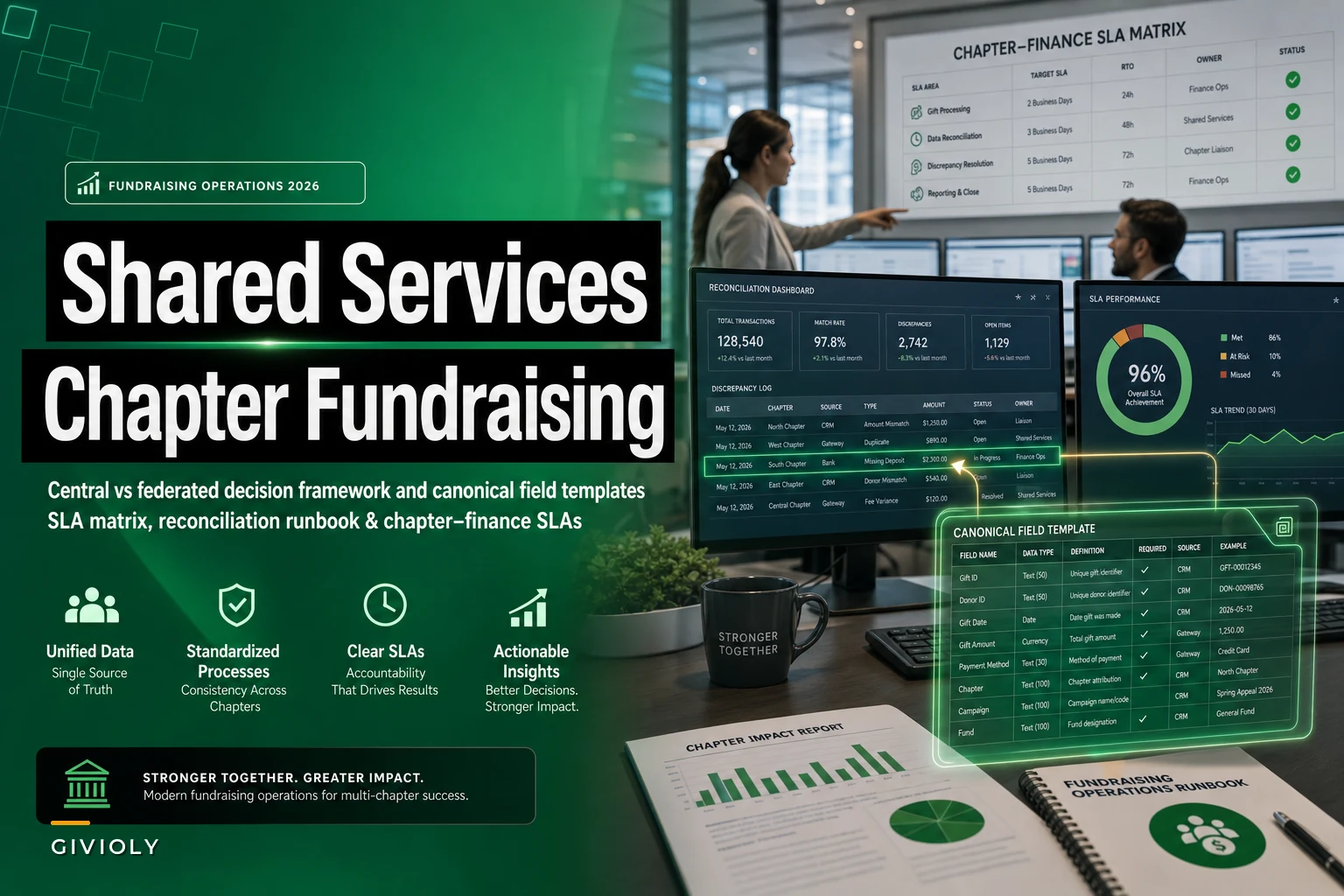

The hardest part of running a federated nonprofit isn't raising money. It's figuring out who owns what. When you've got eight chapters each with their own donor list, their own events, their own bank account, and their own idea of what "pledged" means, the friction shows up in reconciliation every single month. Numbers don't match. A chapter swears they deposited $12,400 from a gala and central finance only sees $9,800. Nobody is lying — they just defined the fields differently and recorded things on different days.
This post is about the operational scaffolding that keeps that from happening: a decision framework for what to centralize vs. leave federated, canonical field templates so everyone speaks the same data language, an SLA matrix between chapters and central finance, and a shared reconciliation runbook. This is the unglamorous machinery of multi-chapter fundraising governance, and it's usually the difference between an org that scales cleanly and one that drowns in spreadsheet archaeology every quarter-end.
Start with the decision that everything else hangs on
Before you draft a single template, you need a defensible answer to one question for every function: does this live at the center, or does it stay with the chapter?
Most orgs get this wrong in one of two directions. Either central tries to own everything — down to approving each chapter's thank-you email copy — and the chapters revolt and go rogue with their own tools. Or central owns nothing meaningful, and you end up with eleven versions of the truth and a finance team that can't close the books.
-
Centralize anything that creates legal or financial exposure for the whole entity. Receipting, tax compliance, the donor database of record, gift acceptance policy. One mistake here contaminates everyone.
-
Federate anything that depends on local relationships and context. Which board member calls which major donor, how the regional gala is themed, local volunteer coordination. Central can't do this well and shouldn't try.
-
Share — not centralize — anything where consistency matters but local execution is required. Reporting formats, field definitions, acknowledgment timelines. The standard is set centrally; the work happens locally.
The distinction people most often miss: shared services and centralized services are not the same thing. Shared means the central team provides a capability chapters opt into because it's genuinely easier than doing it themselves — a receipting engine, a merchant account, a prospect research subscription. Centralized means chapters have no choice. The former earns compliance. The latter breeds workarounds.
A quick decision table
| Function | Default | Why |
|---|---|---|
| Donor database of record | Central | Single source of truth; avoids duplicate/conflicting records |
| Tax receipting & acknowledgment | Central (shared engine) | Compliance risk is org-wide |
| Gift acceptance policy | Central | Non-cash and restricted gifts create liability |
| Major donor cultivation | Federated | Depends on local relationships |
| Event execution | Federated | Local context, local volunteers |
| Field definitions & data schema | Shared standard | Everyone uses it; central defines it |
| Merchant processing | Central (shared) | Better rates, cleaner reconciliation |
| Campaign messaging | Federated within brand guardrails | Local voice matters, brand doesn't break |
| Monthly financial close | Central | One consolidated picture |
The point of the table isn't the specific answers — your org might flip two or three rows. The point is making each decision explicitly, with a reason attached, so that when a chapter director asks "why can't I use my own payment processor," you have an answer that isn't "because I said so."
Why the numbers never match: it starts with the fields
When a chapter's gala report says $12,400 and central sees $9,800, the instinct is to suspect a missing deposit. Nine times out of ten the real culprit is definitional. The chapter counted pledges as revenue. Central counts cash received. The chapter included the full ticket price; central netted out the fair-market value of the dinner. The chapter dated the gift to the event night; central dated it to the day funds cleared.
Simplify donor management and fundraising workflows.
Givioly helps you organize campaigns, engage donors, and maximize fundraising impact seamlessly.
- Unified donor profiles
- Real-time donation tracking
- Automated impact reporting
No credit card required
None of these are errors in the normal sense. They're just two teams measuring different things and calling them by the same name.
What a canonical gift record should pin down
-
Gift date — define it once. Is it the transaction date, the postmark date, or the settlement date? Pick one and never deviate.
-
Gross amount vs. net amount — both fields, both populated, never one standing in for the other.
-
Fair-market value — mandatory for any gift with a benefit (event tickets, auction items, galas).
-
Fund / restriction code — a fixed picklist, not free text. "Scholarship fund," "scholarship," and "Scholarships 2024" are three different strings and will wreck your restricted-funds reporting.
-
Chapter / source code — which chapter originated the gift, in a standard format.
-
Gift type — cash, check, card, ACH, securities, in-kind — from a closed list.
-
Soft credit flags — who gets relationship credit vs. who gets the hard revenue.
-
Pledge vs. payment — a pledge is a commitment; a payment is cash. They live in different fields and never share one.
The single highest-leverage rule here: no free-text fields for anything you'll report on. Free text is where reconciliation goes to die. If you want to be able to roll up restricted funds across eleven chapters, every one of those chapters needs to pick from the exact same dropdown. If building that discipline from scratch feels daunting, the field-mapping discipline covered in our fundraising data governance playbook gives you the RACI structure to assign ownership of each field definition.
The SLA matrix: who owes what, by when
Even with perfect field templates, reconciliation breaks on timing. Central finance can't close the month if three chapters haven't submitted their offline gift logs. Chapters can't trust the consolidated numbers if central takes three weeks to post their deposits.
An SLA matrix between chapters and central finance fixes this by making the handoffs explicit — not aspirational, but with actual dates and consequences. The mistake most orgs make is writing SLAs that only bind one direction. They demand chapters submit by the 5th but never commit central to posting by the 10th. That asymmetry is exactly why chapters stop cooperating; they feel like they're feeding a black box.
| Obligation | Owner | Deadline | Trigger if missed |
|---|---|---|---|
| Submit offline gift log (checks, cash, in-kind) | Chapter | By the 5th business day | Central flags chapter in close report |
| Submit event reconciliation packet | Chapter | 10 business days post-event | Event revenue held from recognition |
| Post and categorize all received gifts | Central | By the 8th business day | Chapter notified; escalation to finance lead |
| Share draft consolidated statement | Central | By the 12th | Chapters get 3 days to dispute |
| Resolve flagged discrepancies | Both | Within 5 business days of flag | Escalation to COO/finance director |
| Issue tax receipts | Central | Within 7 days of posting | Tracked as acknowledgment SLA breach |
Two things make this work in practice. First, every row has a named owner — not "the chapter" but a role (chapter finance liaison). Vague ownership means no ownership. Second, every missed deadline has a defined consequence that isn't punitive but is visible. Holding event revenue from recognition until the packet lands isn't about punishing a chapter; it's about keeping the consolidated numbers honest.
Name specific roles (e.g., 'chapter finance liaison') rather than vague labels so accountability is clear.
One pattern worth flagging: chapters almost always struggle most with the event reconciliation packet, because events are chaotic and the person who ran the gala isn't the person who does the books. Build a longer, realistic SLA for event packets (10 business days, not 2) so you get accurate submissions instead of fast, wrong ones.
A shared reconciliation runbook
The SLA matrix says when. The runbook says how. This is the step-by-step that any chapter liaison and any central finance person can follow identically, so the process survives staff turnover — which in chapter orgs is constant.
A shared monthly reconciliation runbook, at minimum:
-
Pull the chapter source log. Every gift the chapter believes it received that month, in the canonical field format. Cash, check, card, in-kind, pledges-paid.
-
Pull the central system record for that same chapter and period — gifts posted to the database of record and bank settlements.
-
Match on gift ID or canonical key. With consistent fields, most records auto-match. The leftovers are your work.
-
Triage the unmatched into three buckets timing differences (recorded in different months), definitional differences (gross vs. net, pledge vs. payment), and genuine discrepancies (something's actually missing).
-
Resolve timing and definitional items with a note, not a correction. These aren't errors; they're expected. Document why they differ so the next person doesn't re-investigate.
-
Investigate genuine discrepancies against source documents — deposit slips, merchant settlement reports, signed pledge forms.
-
Log every unresolved item on the discrepancy register with owner and due date, feeding straight back into the SLA escalation path.
-
Sign off. Both chapter liaison and central finance confirm the reconciled total before it rolls into the consolidated statement.
A visual of the monthly reconciliation workflow helps make the steps clear.
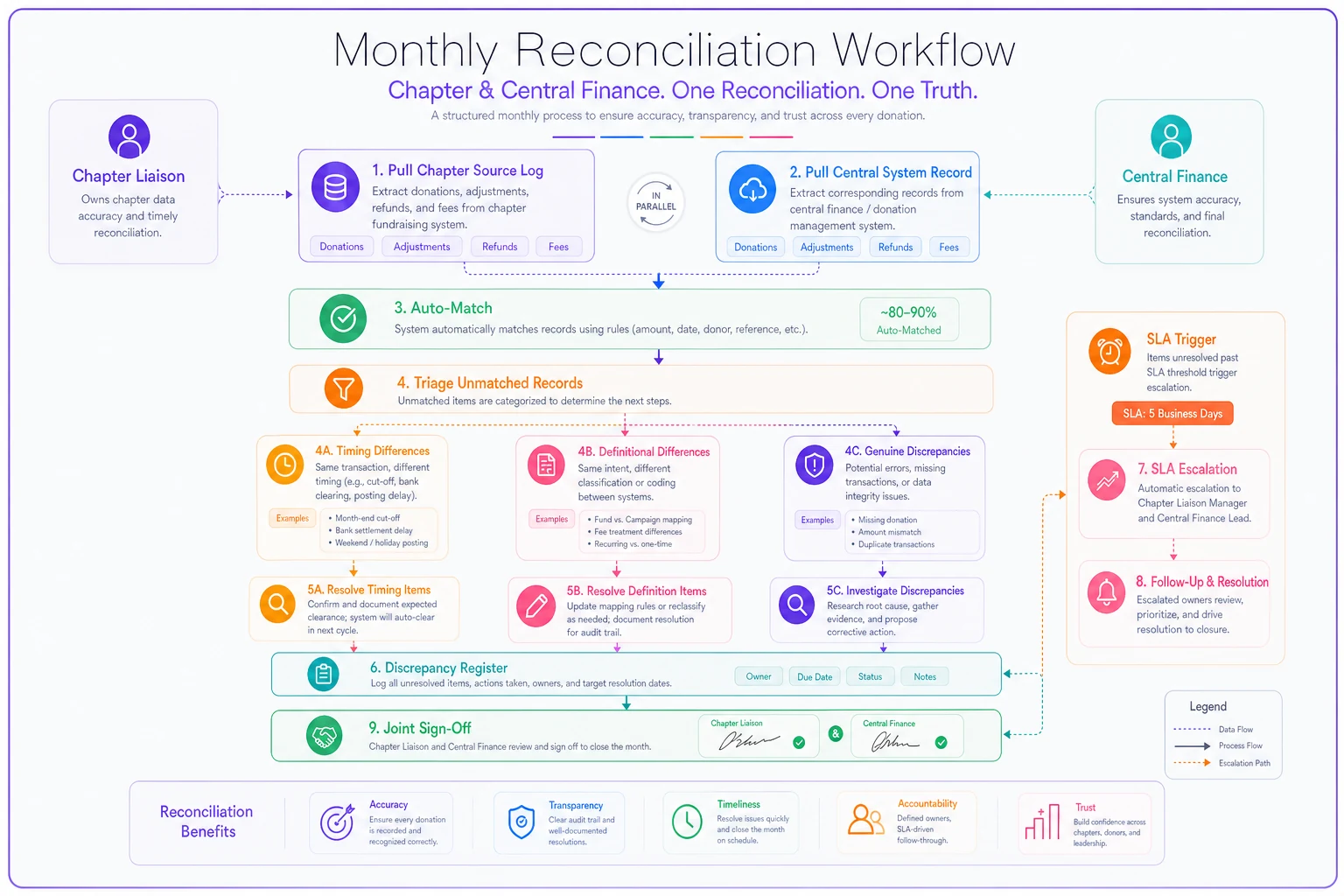
The non-obvious step is #5. Teams waste enormous time "fixing" differences that aren't broken — adjusting a chapter's number to match central when the two are measuring different, equally valid things. The runbook should explicitly separate "reconcile" (explain the difference) from "correct" (fix an actual error). Most of what looks like a reconciliation problem is actually an explanation problem.
For the underlying mechanics of matching online and offline gifts — which is the hardest part when chapters run their own events and payment flows — the templates in our audit-ready donation reconciliation workflow slot directly into steps 1 through 4 here.
A real scenario
A regional youth-services nonprofit with six chapters ran into this at scale. Each chapter used its own spreadsheet, its own fund names, and its own gift-date logic. Month-end close was taking the central finance team close to three weeks, and roughly 15–20% of gifts landed in a "to investigate" pile every cycle. The worst month, a chapter's spring gala showed a gap of about $14k between what the chapter reported and what central could verify — it turned out to be a mix of pledges counted as cash, plus a batch of checks that hadn't been deposited for eleven days.
They didn't buy anything new first. They standardized the gift record into a canonical template with closed picklists for funds and gift type, locked the gift-date definition to settlement date, and put a two-directional SLA matrix in place. Within two close cycles, the "to investigate" pile dropped to under 5%, and close time came down from roughly three weeks to about eight business days. The gala-sized surprises stopped entirely — not because the gaps disappeared, but because they now got caught and explained within days instead of surfacing at quarter-end.
Nothing about that was high-tech. It was definitions, deadlines, and a runbook.
When centralizing is the wrong call
Standardization has a limit, and pushing past it costs you more than the messiness it solves.
-
You have three or more chapters producing consolidated financials.
-
Compliance exposure is genuinely org-wide (one EIN, shared tax status).
-
Chapters are spending real time reinventing the same processes.
When it's a bad idea:
-
Chapters are legally separate entities with their own boards and filings — then you're coordinating, not centralizing, and the SLA matrix matters far more than shared field templates.
-
You'd be centralizing relationship work. No central team cultivates a local major donor better than the local director.
-
The central team doesn't have the capacity to actually deliver the SLA it's imposing. An SLA central can't honor is worse than no SLA — it destroys trust faster than disorganization does.
Who should not do this yet: a two-chapter org where the "central finance team" is one person also running a chapter. At that size the overhead of formal matrices and runbooks outweighs the benefit. Get the canonical field template in place first — that one artifact pays for itself at any size — and add the SLA and runbook machinery when you cross into three or four chapters.
Where tooling helps — and where it doesn't
A shared database of record and a reconciliation workflow that enforces the canonical fields will save a chapter org more time than almost any other investment. Modern platforms can auto-match the bulk of records and flag only the exceptions for human review. That's genuinely useful — it turns reconciliation from a full-week slog into a focused review of the handful of items that actually need attention.
But the tooling is downstream of the decisions. If your fund codes aren't standardized, no system will reconcile them for you. If your SLAs aren't agreed, no dashboard will make the deadlines real. Software enforces discipline you've already defined; it doesn't manufacture it. Get the decision framework, the field template, the SLA matrix, and the runbook settled on paper first. Then the platform just makes them run faster.
That sequence — governance first, automation second — is what separates chapter orgs that scale cleanly from the ones stuck doing spreadsheet forensics every quarter.
The numbers match when everyone agrees in advance what the numbers mean.
Ready to elevate your fundraising efforts?
Join 2,000+ nonprofits using Givioly to save time, increase donations, and build lasting donor relationships.