


Most small development teams handle their first few securities gifts by accident. Someone's board member wants to give appreciated Apple stock, a staffer forwards the email to whoever seems most likely to know what to do, and three weeks later everyone's trying to remember whether the shares actually landed in the brokerage account or if the donor got a receipt with the wrong value on it.
That's the real problem with securities donations intake for nonprofits: it's rare enough that no one owns it, but high-value enough that mistakes are expensive. A single mishandled stock gift can mean a delayed acknowledgment letter to a five-figure donor, a valuation error that shows up in your audit, or an awkward call six weeks later asking the donor to resend paperwork they thought they already completed.
This isn't a piece about tax law or IRS forms in the abstract. It's about the operational plumbing — the intake form, the checkpoints, the documentation you actually need, who signs off on what, and how the record moves cleanly into your CRM without ad-hoc follow-ups every single time.
Why non-cash gifts break the normal workflow
Your cash and card gifts move through a predictable path. Donation comes in, it hits the processor, it syncs to the CRM, reconciliation catches anything weird. Everyone knows their role because it happens hundreds of times a month.
Non-cash gifts break that muscle memory. A stock transfer might touch your gift officer, your finance lead, your brokerage, and the donor's broker — none of whom are looking at the same system. The timing is unpredictable. The valuation isn't a fixed number the way a $500 credit card gift is; it depends on the mean of the high and low trading price on the date the shares hit your account, which nobody knows until after it happens.
A typical breakdown looks like this: the donor's advisor initiates a DTC transfer, the shares show up in the org's brokerage account under a generic label, and no one connects those shares back to the donor because the transfer didn't carry a name. Finance sees "1,200 shares of MSFT" appear and has no idea who to thank. Meanwhile the donor is wondering why they haven't heard anything.
The fix isn't more diligence from individuals. It's a defined pipeline so the gift can't fall between roles.
Start with a real intake form (not an email thread)
The moment someone says "I'd like to give stock" or "I have a vehicle to donate," a structured intake should trigger. Not a reply-all. A form with defined fields that starts the clock.
Simplify donor management and fundraising workflows.
Givioly helps you organize campaigns, engage donors, and maximize fundraising impact seamlessly.
- Unified donor profiles
- Real-time donation tracking
- Automated impact reporting
No credit card required
Here's what a practical securities and non-cash intake form should capture up front:
-
Donor name and CRM record ID (link it immediately so the gift never becomes anonymous)
-
Gift type — publicly traded securities, mutual fund shares, privately held stock, cryptocurrency, real property, vehicle, artwork, or other tangible
-
Expected asset description — ticker symbol and share count, or a description of the physical asset
-
Estimated value and basis of estimate — donor's stated value vs. your own rough check
-
Transfer method — DTC electronic transfer, physical certificate, wire, wallet address, deed transfer
-
Expected transfer date and the donor's broker/advisor contact
-
Restrictions or designations — is this for a specific program or restricted fund?
-
Intended acknowledgment recipient (sometimes the donor-advised fund or estate, not the individual)
The single most useful field on that form is transfer method, because it determines everything downstream. A DTC transfer and a physical stock certificate follow completely different paths, and privately held shares require an entirely separate approval track because you may need a qualified appraisal and a board decision about whether to even accept them.
The single most useful field on that form is transfer method, because it determines everything downstream.
One thing small teams consistently miss: the intake form should exist before you have brokerage instructions ready to send. When a donor is ready to give, you have maybe a day or two of goodwill before momentum fades. If your gift officer has to go hunt down the brokerage DTC number and account name from finance, that's a delay the donor feels.
Valuation checkpoints: three moments, not one
Valuation is where non-cash gifts generate the most quiet errors, because people treat it as a single number captured once. In reality there are three distinct checkpoints, and conflating them is what produces the receipts your auditor flags.
| Checkpoint | When it happens | What value you record | Common mistake |
|---|---|---|---|
| Intake estimate | At the moment of the ask | Donor's rough estimate, flagged as unofficial | Recording it as the gift value in CRM |
| Settlement valuation | Day shares/asset actually arrive | Mean of high/low trade price on receipt date for public securities | Using the donor's estimate instead |
| Acknowledgment value | On the receipt/letter | For securities: the settlement value. For property: description only, no dollar amount | Putting a dollar value on the receipt for tangible property |
That last row trips up more teams than any other. For gifts of tangible property and privately held assets, your acknowledgment describes the gift but does not state a dollar value — the donor and their appraiser are responsible for the deducted amount. Putting a number on that letter creates a problem for both of you.
For publicly traded stock, the discipline is straightforward: don't let anyone record a value until the shares settle. The intake estimate is a planning figure. The number that hits your books and your acknowledgment is the settlement valuation, calculated the day the shares actually land. Lock that rule into your process and a big chunk of your valuation errors disappear.
Required documentation by gift type
Documentation requirements diverge sharply depending on what's being given. Small teams get burned when they apply their stock-gift routine to a car or a piece of real estate.
-
Publicly traded securities brokerage transfer confirmation, settlement statement showing receipt date, calculated fair market value worksheet
-
Mutual fund shares same as securities, but expect a slower settlement — fund shares often take longer to transfer than listed stock
-
Privately held/restricted stock qualified appraisal (donor's responsibility if over threshold), board acceptance decision, any gift acceptance committee sign-off
-
Cryptocurrency wallet transaction record, date and time of receipt, USD value at receipt, and your liquidation record if you sell immediately
-
Real property deed, title search, environmental review consideration, board approval, and a plan for holding costs
-
Vehicles title transfer, and specific acknowledgment language tied to how you use or sell the vehicle
-
Tangible personal property (art, equipment) condition description, any donor-provided appraisal, related-use determination
The pattern worth internalizing: the more illiquid and unusual the asset, the earlier you need an acceptance decision — not just a processing routine. A gift acceptance policy that says "we accept publicly traded securities but review everything else case by case" prevents the situation where someone enthusiastically accepts a timeshare or a partial interest in a rental property that costs more to hold than it's worth.
Approval RACI: who actually decides
The reason non-cash gifts stall is almost always unclear ownership. A RACI — responsible, accountable, consulted, informed — sorts that out so nobody's waiting on a decision that no one thinks is theirs to make.
-
Gift officer — Responsible for intake, donor communication, and triggering the pipeline. Accountable for the relationship, not the accounting.
-
Finance lead — Accountable for settlement valuation, recording the gift, and reconciliation. Consulted on whether unusual assets can be handled operationally.
-
Executive director or gift acceptance committee — Accountable for accepting or declining anything outside the "publicly traded securities" fast lane. Consulted on restrictions and designations.
-
Board (or a designated committee) — Consulted/accountable on real property, privately held interests, and any gift with ongoing liability.
The one clarification that saves the most confusion: separate relationship accountability from accounting accountability. The gift officer owns the donor. Finance owns the number. When those two blur, you get either a warm thank-you with the wrong value or a correct receipt that reads like it came from a collections agency.
For the fast lane — a standard DTC stock transfer to your existing brokerage account — the RACI should let the gift officer and finance lead complete the whole thing without executive sign-off. Reserve approvals for the genuinely unusual. If everything requires the ED's signature, the ED becomes the bottleneck and simple gifts end up waiting behind complicated ones.
CRM field mappings so the record stays clean
This is where a lot of the downstream reporting pain originates. Non-cash gifts get shoved into the same fields as cash gifts, and later nobody can pull a clean report of "all securities gifts this fiscal year" because the data was never structured for it.
-
Gift type / payment method — a distinct value for each non-cash category, never lumped into "other"
-
Asset description — free text or structured field for ticker + shares
-
Intake estimate value — stored separately from the recorded value
-
Settlement / recorded value — the number that flows to your financials
-
Receipt date — the settlement date, which drives your valuation
-
Acknowledgment sent date — so nothing sits un-thanked
-
Restriction/designation code — tied to the same schema you use for restricted funds
-
Liquidation status and proceeds — did you hold or sell, and for how much
That last field matters because the gift value and the eventual sale proceeds are two different numbers, and mixing them is a reconciliation nightmare. You record the gift at fair market value on the receipt date; if you later sell the stock for a bit more or less, that's a separate transaction. If your restricted-fund coding is consistent with the rest of your books, this ties in cleanly with a proper grant and restricted funds tracking workflow, which keeps designated gifts from leaking into general operating reports.
Consistent field mapping is also what makes month-end reconciliation survivable. When securities gifts carry a distinct method, a real settlement value, and a receipt date, they slot straight into an audit-ready donation reconciliation workflow instead of showing up as mystery deposits your finance lead has to chase.
The workflow, start to finish
Put together, the whole pipeline looks like this:
Donor signals intent → gift officer opens the intake form and links the CRM record → the form routes to the correct track based on transfer method (fast lane for public securities, acceptance review for everything else) → brokerage instructions go to the donor same day → shares or asset arrive → finance calculates settlement value and records the gift with the proper field mapping → acknowledgment goes out within your standard window → gift enters normal reconciliation → if applicable, liquidation is recorded as a separate line.
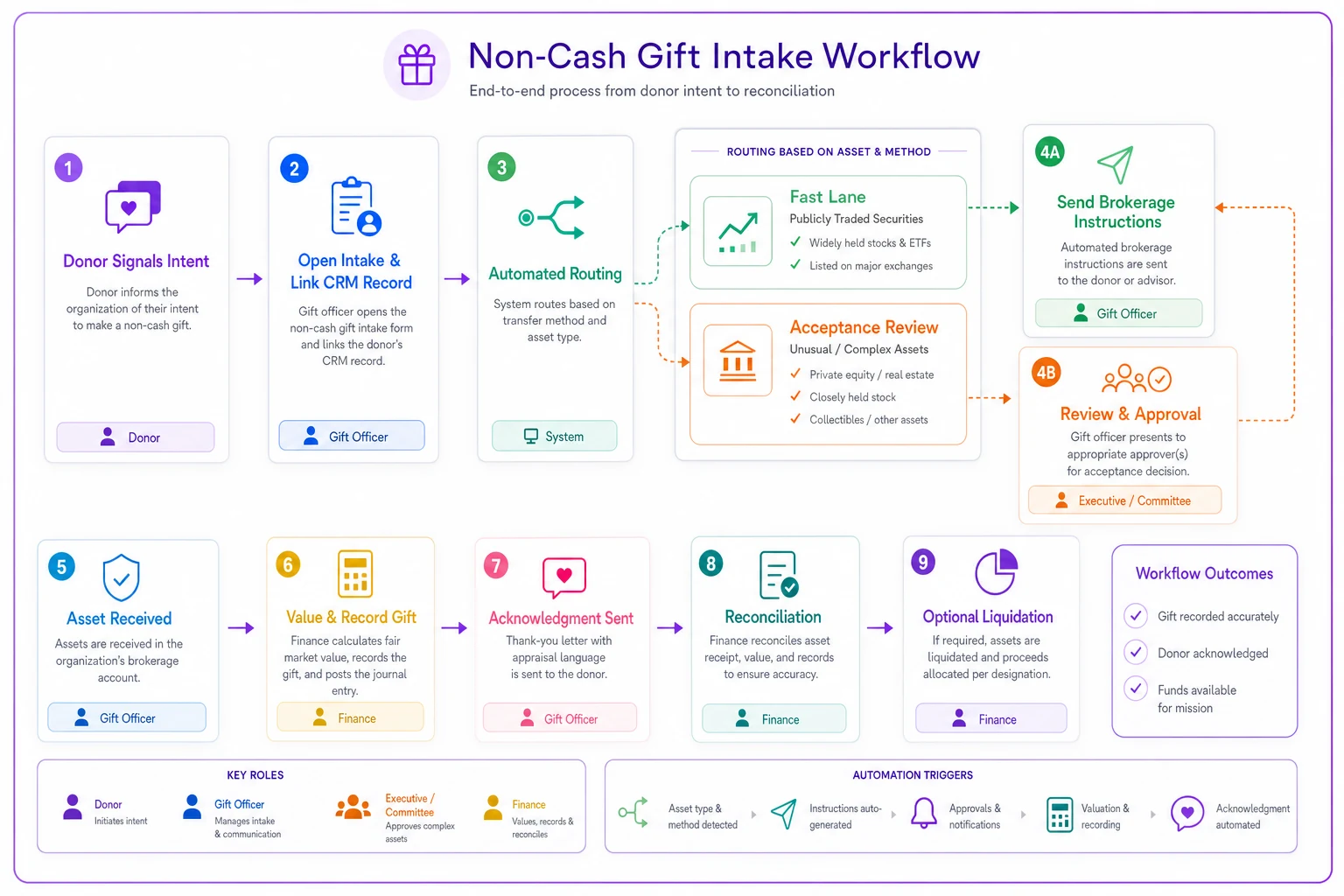
Every handoff has an owner and a trigger. There's no step where the gift depends on someone remembering to follow up. When the shares land, finance already knows whose gift it is because the intake linked the donor at the start.
Where a shared workflow tool earns its keep is right here — not because you need automation for something that happens ten times a year, but because the intake form, the routing, the checklist, and the CRM fields live in one place instead of scattered across email, a spreadsheet, and someone's memory. When the process survives staff turnover, that's the difference between a repeatable pipeline and starting from scratch every time your development coordinator changes.
When to build this out — and when not to bother
When it makes sense: You're receiving more than a handful of securities or non-cash gifts a year, or you have a board and major-donor base likely to give appreciated assets. Once you've had one gift go sideways — a delayed thank-you to a $40k stock donor, or a valuation your auditor questioned — the intake pipeline pays for itself immediately.
When it's overkill: If you genuinely receive one stock gift every couple of years, a documented one-page checklist and a saved email template with your brokerage instructions may be enough. Don't build a committee process for something that happens biennially.
Who should not just wing it: Any org actively cultivating major donors or planned gifts. The moment your fundraising strategy includes asking for appreciated securities, the intake pipeline stops being optional — because the donors most likely to give stock are precisely the ones who notice a sloppy, slow acknowledgment.
A quick real scenario
A regional arts nonprofit with a two-person development team was averaging six or seven securities gifts a year, all handled through email threads. Two problems kept recurring: acknowledgment letters went out two to three weeks late because no one connected the arriving shares to a donor, and on at least one occasion they recorded a gift at the donor's estimate rather than the settlement value — a difference of a few thousand dollars that surfaced during their audit.
They built a single intake form, mapped distinct CRM fields for securities, and wrote a two-track RACI: fast lane for standard stock transfers, acceptance review for anything unusual. Nothing fancy. The next fiscal year, acknowledgments went out within their normal three-to-five-day window, the settlement-value rule eliminated the valuation mismatch, and reconciliation stopped generating mystery deposits. Same volume of gifts, roughly a fifth of the scrambling.
The takeaway
Securities and non-cash gifts don't need a heavy compliance apparatus.
They need one thing small teams usually skip: a defined path with owners at every handoff, so a high-value gift can't get stuck between the person who cultivated it and the person who has to book it. Build the intake form, lock the three valuation checkpoints, assign the RACI, and map your CRM fields once. After that, the gifts move on their own — no ad-hoc follow-ups required.
Ready to elevate your fundraising efforts?
Join 2,000+ nonprofits using Givioly to save time, increase donations, and build lasting donor relationships.