


Why new fundraising hires are still guessing at month three
A pattern that shows up constantly in small and mid-sized development shops: a new gift processor or database coordinator starts, gets a login, a couple of Loom walkthroughs, and a "shadow whoever's around" plan. Six weeks later they're technically working — entering gifts, pulling lists, sending acknowledgments — but nobody actually knows if they're doing it correctly. Then a report comes back wrong, a soft credit gets missed, a major donor gets a duplicate receipt, and suddenly you're auditing three weeks of work trying to figure out where the drift started.
That's not a training problem in the "they didn't try hard enough" sense. It's a system problem. Fundraising operations onboarding isn't just teaching software — it's teaching judgment about data, money, and donor trust. And judgment doesn't transfer through a screen recording. It transfers through structured practice tied to milestones you can actually verify.
The real cost of unstructured ramp-up
Sloppy onboarding usually hides inside other line items — it almost never shows up as "onboarding cost."
Simplify donor management and fundraising workflows.
Givioly helps you organize campaigns, engage donors, and maximize fundraising impact seamlessly.
- Unified donor profiles
- Real-time donation tracking
- Automated impact reporting
No credit card required
A typical example: a mid-sized org brings on a development associate to handle gift entry and stewardship coordination. No formal curriculum. Around month two, they start batching gifts their own way and mis-tag a chunk of event revenue as general operating instead of restricted. Nobody catches it until the finance reconciliation at quarter-end. Now you've got roughly 40–60 gifts to re-code, a grumpy finance director, and a board report that already went out with the wrong restricted-funds number. Call it two full days of cleanup, plus the credibility hit.
None of that shows up as an onboarding failure. It shows up as a data-quality problem, a reconciliation delay, a stewardship error. The root cause is that nobody defined what "competent at gift coding" actually meant, or bothered to check for it before handing over the keys.
-
Gift processors who ramp poorly create silent data debt — wrong fund codes, missing soft credits, inconsistent naming — that surfaces months later in reporting.
-
Prospect researchers who ramp poorly waste gift officers' time chasing bad-fit prospects.
-
Annual giving coordinators who ramp poorly send the wrong segment the wrong ask and quietly depress response rates.
-
Database/ops managers who ramp poorly let bad conventions calcify into "how we've always done it."
Fundraising work is deeply interconnected. An under-trained person in one seat degrades the output of everyone downstream.
Why this breaks the same way at almost every org
Onboarding gets owned by whoever's least busy, not whoever knows the system. The new hire learns from a peer who themselves picked up habits informally. Errors get inherited generation to generation.
"Trained" means "was present during an explanation." There's no check of whether the person can actually reproduce the work correctly, alone, under normal conditions.
Milestones are calendar-based, not competency-based. "You've been here 30 days, so you should have this down." Time in seat is not the same as capability.
There's no tie between onboarding and the data. This is the big one. If your onboarding never touches your actual data-quality standards — the ones you (hopefully) laid out in your fundraising data governance policy — then you're training people to be productive without training them to be correct.
A lot of orgs have decent governance docs sitting in a shared drive that nobody references during ramp-up. Onboarding is exactly where governance should become muscle memory. If it's not connected there, the policy stays theoretical.
The shape of a role-based curriculum
Before getting into the 30/60/90 detail, one principle worth establishing: onboarding should be built per role, but share a common core.
Everyone — regardless of seat — needs the same foundation: how your CRM is structured, your naming conventions, your fund/campaign/appeal taxonomy, donor privacy and consent rules, and the non-negotiables around money handling. That's usually the first week or two.
| Role | 30-day competency | 60-day competency | 90-day certification bar |
|---|---|---|---|
| Gift Processor | Enters a clean single gift with correct fund/appeal coding | Runs a full batch + reconciles to the deposit | Owns daily gift entry with <1% coding error on a sample audit |
| Prospect Researcher | Builds a basic capacity/affinity profile | Produces a triaged prospect list gift officers accept | Delivers research that meets rating-consistency check across reviewers |
| Annual Giving Coord. | Pulls a correct segment list from defined criteria | Builds + QCs an appeal end-to-end | Launches an appeal with segmentation and tracking verified |
| Database/Ops | Documents one existing workflow accurately | Runs a monthly data-hygiene audit | Can onboard the next person in their function |
Notice the 90-day bars are outcome statements you can actually check — not "understands the system." That's the whole point.
The 30/60/90 structure, and what each phase actually proves
Here's a visual overview of the onboarding progression.
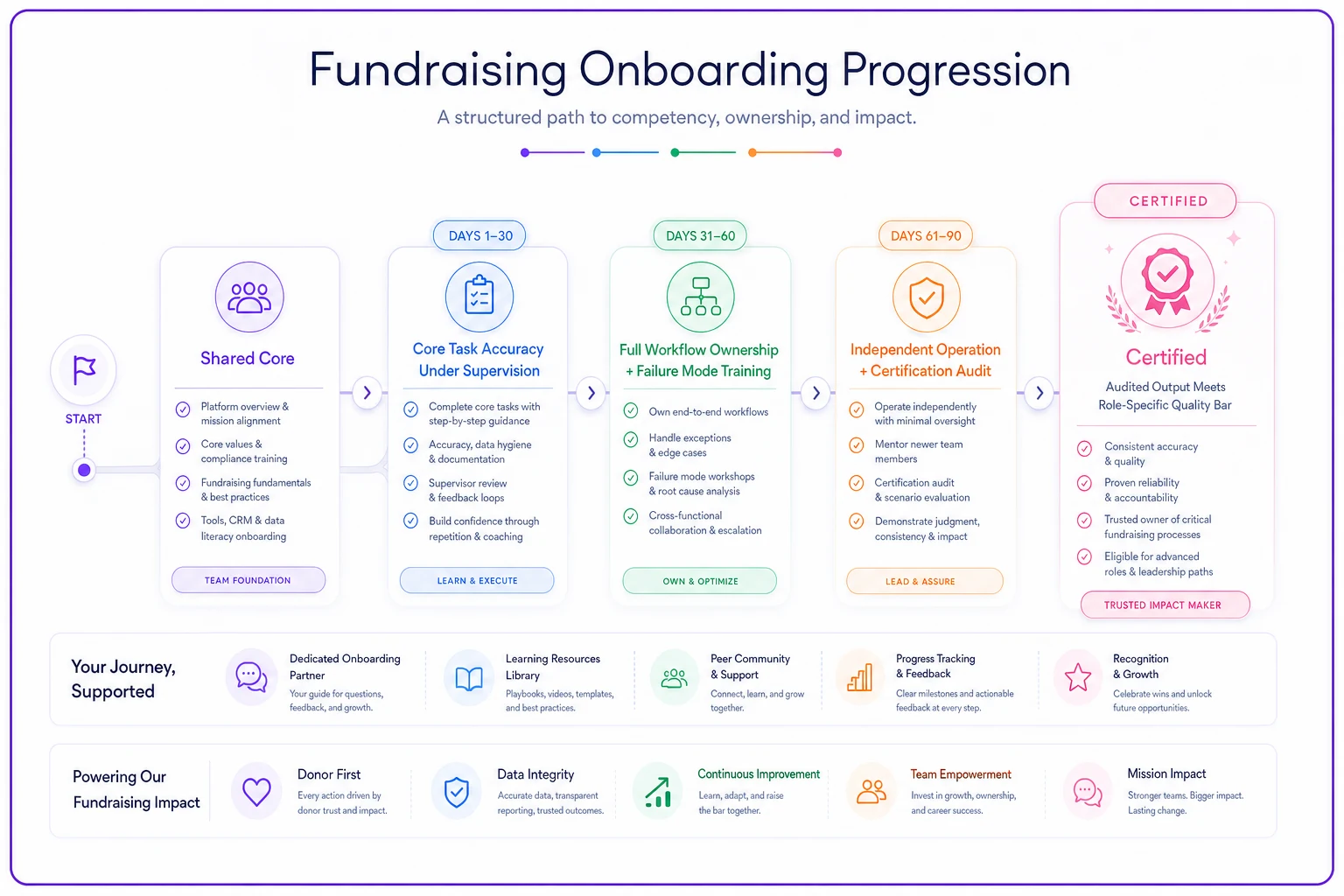
First 30 days: correctness under supervision
The goal here is narrow — can this person do the core repeated task of their role correctly, one at a time, with someone checking?
For a gift processor, that's a single gift entered with the right constituent match (not a duplicate), the right fund and appeal code, correct soft-credit handling, and a triggered acknowledgment. Not 200 gifts. One, done right, ten times in a row.
The mistake most orgs make is pushing volume too early. Speed before accuracy bakes in errors that are expensive to un-teach. The first 30 days should feel almost slow. You're building the correct pattern before you scale the reps.
Hands-on exercise example: give the new hire a set of 15 realistic "gift scenarios" from a sandbox or anonymized set — including the messy ones (a check with an old address, a gift that should be split across two funds, a matching-gift company match, a memorial gift). Have them process all 15. Review each against an answer key. The messy cases reveal whether they actually understand the rules or just the happy path. That distinction matters.
31–60 days: full workflow ownership
Now the person moves from "single unit done right" to "runs the whole process, including the parts that go wrong." A gift processor runs a complete daily batch and reconciles it to the actual deposit. A researcher produces a full prospect list that gift officers will actually use. A coordinator builds an entire appeal from segment pull to scheduled send.
This phase is where you introduce the failure modes deliberately. What happens when the batch doesn't balance? When a duplicate constituent shows up mid-batch? When the payment processor total doesn't match the CRM total by $18.50? A competent person isn't someone who never hits these — it's someone who knows the resolution path.
Understanding the whole workflow also means understanding the handoffs. This is a good point to walk the new hire through your operational donor lifecycle system, so they see how their piece feeds the next stage — where their gift entry becomes someone else's stewardship trigger, or their research becomes a gift officer's next move. People do noticeably better work when they can see the downstream consequence of getting it wrong.
61–90 days: independent operation and certification
By 90 days the bar is independence with verified quality. The person runs their function without hand-holding, and you've confirmed their output holds up under audit.
The certification isn't a ceremony. It's a real check: pull a random sample of their recent work and audit it against your standards. For a gift processor, that might mean pulling 30–40 entries from the past two weeks and checking coding accuracy, duplicate rate, and acknowledgment timing. If the error rate is under your threshold, they certify. If not, you extend and re-coach the specific gap — you don't just pass them because 90 days elapsed.
The calendar is a prompt, not a finish line.
Tying certification to data quality, not attendance
This is the part that separates real onboarding from theater. A certification sign-off should require evidence tied to operational reality — not a manager's gut feeling about how someone seems.
-
Coding accuracy — a random sample of their entries audited at or above your accuracy threshold (many teams use 98–99% on fund/appeal coding).
-
Duplicate discipline — zero new duplicate constituents created in their audited sample, or a documented reason for any exception.
-
Reconciliation — they've independently balanced at least three batches to the deposit with no unexplained variance.
-
Acknowledgment timing — gifts they processed hit your acknowledgment SLA.
-
Judgment cases — they correctly handled at least a few genuinely ambiguous gifts (splits, memorials, employer matches) and can explain why.
The person signing off should be someone who owns data quality, not the new hire's peer buddy. And the sign-off gets recorded — date, sample checked, results — so if something drifts later you can trace whether it started before or after certification.
Worth flagging: the moment you tie certification to a real audit sample, your standards get more honest. A lot of orgs think they have a 1% error threshold until they actually sample the work of their existing veterans and find it's more like 4%. Uncomfortable, but useful — it means your onboarding has been quietly passing everyone regardless of actual quality.
A quick competency checklist you can adapt
Regardless of role, a certification packet should be able to answer yes to most of these:
-
Can they do the core task correctly without prompts?
-
Can they resolve the top 3–4 things that commonly go wrong?
-
Do they follow naming and coding conventions consistently — not just when watched?
-
Do they know when to escalate vs. decide on their own?
-
Can they explain why a rule exists, not just that it exists?
-
Has their real output been audited against a sample?
-
Do they understand who consumes their work downstream?
-
If they left tomorrow, could someone reconstruct what they'd been doing from their documentation?
That last one is underrated. If a new hire can't leave a clean trail, you've onboarded a single point of failure.
Where software fits — quietly
None of this requires fancy tooling. Plenty of well-run shops track onboarding in a spreadsheet and a shared doc. But there are a couple of places where the manual version genuinely strains as you grow.
The certification audits are the obvious one. Manually pulling a random sample of someone's entries and checking coding accuracy across 30–40 records is tedious, and tedious things get skipped. AI-powered operational platforms that can flag coding anomalies, surface likely duplicates, or auto-sample recent entries against your rules make the verification step realistic to actually do every time — which is the difference between certification being real and being a rubber stamp.
Use tooling to auto-sample recent entries against your coding rules so audits don't get skipped when things get busy.
The other place is keeping the curriculum, the milestones, and the sign-offs from living in three disconnected places. When onboarding checklists, competency status, and underlying data-quality metrics sit in one workflow system, a manager can look at "is this person ready to certify" and see actual evidence attached, instead of trusting a gut feeling. Less about automation replacing judgment, more about putting the evidence in front of the person exercising it.
Use tooling for the parts humans reliably skip — the sampling, the anomaly flagging, the record-keeping. Keep the judgment human.
When a formal 30/60/90 curriculum makes sense — and when it doesn't
When it makes sense: you're hiring into ops-heavy roles (gift processing, database, research, annual giving), you've had data-quality problems you've traced back to inconsistent practices, or you're growing fast enough that "learn from whoever's around" is spreading bad habits.
When it's overkill: a two-person shop where the founder does everything and the second hire is a generalist you'll train hands-on daily anyway. A lightweight checklist beats a formal certification process in that situation. Don't build a 90-day competency framework for a role with one occupant and no successor planned.
Who should not do this yet: orgs that don't actually have documented standards to certify against. If your fund coding rules, naming conventions, and acknowledgment SLAs live only in one veteran's head, fix that first. You can't certify people against standards that don't exist on paper — you'll just be formalizing one person's undocumented opinions.
A short real scenario
A regional arts nonprofit — around $2.1M annual revenue, four-person development team — kept hitting the same wall every quarter-end: gift coding errors that finance had to unwind, and a rotating cast of new associates who each did things slightly differently. Onboarding was a login and a "ask me if you're stuck."
They rebuilt it as a role-based 30/60/90 for the gift-processing seat. Shared-core week on the CRM and conventions, then supervised single-gift accuracy, then full batch ownership with reconciliation, then a certification audit on a real sample before going independent.
The change wasn't dramatic on day one. But by the second quarter-end after the new hire certified, the finance reconciliation went from a multi-day untangling exercise to something that mostly balanced on the first pass. Coding errors on the sampled audit dropped from somewhere in the mid-single-digit percent range to under about 1.5%. Just as importantly, when the next associate started, the certified one could actually train them from the documented curriculum instead of improvising — so the improvement held through turnover instead of resetting with it.
Nothing exotic happened. They just stopped confusing "has been here 90 days" with "is competent and verified."
The takeaway
Fundraising operations onboarding is really about protecting the integrity of your donor data and money handling while the team grows and changes. Calendar-based, informal ramp-up quietly manufactures the data-quality problems you'll spend the next year cleaning up.
Role-based curricula with genuine competency milestones — and certification sign-offs tied to actual audited output — turn onboarding from a hope into a control. Build the shared core, branch by role, make each phase prove something concrete, and refuse to certify anyone against standards you haven't written down or evidence you haven't checked. Do that consistently, and every new hire raises the floor of your operation instead of introducing a new source of drift.
Fundraising operations onboarding is really about protecting the integrity of your donor data and money handling while the team grows and changes. Calendar-based, informal ramp-up quietly manufactures the data-quality problems you'll spend the next year cleaning up.
Role-based curricula with genuine competency milestones — and certification sign-offs tied to actual audited output — turn onboarding from a hope into a control. Build the shared core, branch by role, make each phase prove something concrete, and refuse to certify anyone against standards you haven't written down or evidence you haven't checked. Do that consistently, and every new hire raises the floor of your operation instead of introducing a new source of drift.
Ready to elevate your fundraising efforts?
Join 2,000+ nonprofits using Givioly to save time, increase donations, and build lasting donor relationships.