

Most nonprofits build their donor systems backwards. They start with the CRM, add some campaigns, throw in quarterly reports, then wonder why major donors slip through cracks while staff burn out chasing the wrong metrics.
A mid-sized education nonprofit I worked with had $2.3M in annual giving, three development staff, and absolutely no idea why their major donor conversion rate tanked from 12% to 4% in eighteen months. The development director was convinced they needed better donor scoring. The board wanted more touchpoints. The ops team kept building dashboards nobody looked at.
The actual problem? They had no operational donor lifecycle system. Just a collection of disconnected activities that different people did when they remembered to do them.
After mapping their actual donor flow, donors were sitting untouched for 47 days between first gift and acknowledgment call. Major donor prospects got identical email sequences as $25 annual donors. The development associate spent 60% of her time manually checking if donors qualified for different programs instead of actually cultivating relationships.
This isn't a staffing problem or a technology problem. It's a systems problem that compounds as you scale past 500 active donors.
Why traditional donor management breaks down operationally
The standard nonprofit playbook treats donors like a funnel: awareness, interest, first gift, repeat, major, planned. Clean and logical on paper. Completely divorced from how donor relationships actually develop.
Real donor journeys are messier. Someone gives $100 at a gala because their friend invited them. Six months later they volunteer at an event. They increase to $250 the next year. Then nothing for two years. Then suddenly they're interested in funding a specific program at $10,000 annually.
Traditional systems can't handle this because they're built on two flawed assumptions. First, that donors progress linearly through predictable stages. Second, that the same team member manages the entire relationship.
Organizations around 500-1,500 donors see relationships fragment across teams. The events coordinator knows about gala attendance. The volunteer manager tracks service hours. The major gifts officer has cultivation notes. The database admin processes gifts. The communications team sends newsletters. Nobody owns the complete donor experience.
This fragmentation creates three operational failures that kill donor retention.
The handoff problem manifests when donors cross invisible thresholds. A $500 donor becomes a $1,000 donor and suddenly they're supposed to get quarterly phone calls from major gifts. But major gifts doesn't know they exist for six weeks because the annual fund team hasn't updated the pipeline. Meanwhile, the donor gets three automated renewal emails that make them feel like a transaction.
The metric mismatch shows up in how teams measure success. Annual fund counts donors retained. Major gifts counts dollars raised. Events counts attendance. Marketing counts email opens. These metrics actively discourage the collaboration required for donor development. Why would annual fund hand off their best donors if it hurts their retention numbers?
Context loss happens every time a donor moves between teams. That personal note about their daughter starting college? Gone. The fact they prefer phone calls to emails? Lost. Their specific interest in youth programs? Buried in notes nobody reads.
Building a repeatable donor lifecycle system that actually scales
A functional donor lifecycle system isn't about perfect categories or comprehensive tracking. It's about creating explicit operational boundaries with clear ownership and measurable transitions.
Simplify donor management and fundraising workflows.
Givioly helps you organize campaigns, engage donors, and maximize fundraising impact seamlessly.
- Unified donor profiles
- Real-time donation tracking
- Automated impact reporting
No credit card required
Start by mapping donor stages based on behavior clusters, not giving amounts.
Discovery stage: First interaction through second gift. Owner: Donor acquisition team. Success metric: Second gift rate within 90 days. Handoff trigger: Second gift processed or 120 days elapsed.
Activation stage: Third gift through consistent giving pattern. Owner: Annual fund team. Success metric: Three gifts within 12 months. Handoff trigger: Either $1,500+ cumulative giving or demonstrated program interest through event attendance/volunteering.
Cultivation stage: Qualified prospect through major gift ask. Owner: Major gifts team. Success metric: Meaningful engagement every 45 days. Handoff trigger: First major gift or explicit decline.
Partnership stage: Major donor through planned giving consideration. Owner: Senior development. Success metric: Annual retention at giving level. Handoff trigger: Estate planning interest or five years of major giving.
Each stage has one owner, one primary metric, and one explicit handoff trigger. No ambiguity about who does what when.
Document a single handoff trigger for each stage so automation and accountability align.
The stages themselves matter less than the operational clarity. A smaller nonprofit might combine activation and cultivation. A larger one might split discovery into "event attendee" and "digital acquisition" paths. The structure adapts to your team and donor base.
Stage-level KPIs that drive the right behaviors
Generic KPIs like "donor retention rate" or "average gift size" tell you what happened, not what to do about it. Stage-specific KPIs create accountability and reveal exactly where your donor lifecycle system breaks.
For Discovery stage, track:
-
Days from first gift to acknowledgment (target
under 3)
-
Second gift rate at 30/60/90 days (minimum
15% at 90 days)
-
Cost per retained donor (not just cost per acquisition)
These metrics immediately surface operational problems. If acknowledgment takes 8 days average, you know gift processing is the bottleneck. If second gift rate is 6%, your welcome sequence fails to engage.
For Activation stage, measure:
-
Months to third gift (target
under 8)
-
Upgrade rate from under $100 to over $100 (minimum
20% annually)
-
Multi-channel engagement rate (giving + volunteering or events)
This tells you whether donors are building habits or just responding to appeals. A donor who gives quarterly and volunteers is worth ten donors who give once annually.
Cultivation stage focuses on:
-
Contact-to-meaningful-conversation ratio (target
1 in 3)
-
Months between meaningful engagements (maximum
2)
-
Ask-to-close rate for qualified prospects (minimum
40%)
Bad cultivation shows up as lots of "check-in" calls that go nowhere. Good cultivation builds toward specific asks with clear value propositions.
Partnership stage tracks:
-
Retention rate at level (minimum
85%)
-
Engagement beyond giving (board, committees, advocacy)
-
Introduction-to-new-prospect ratio (target
2 annually)
Partners shouldn't just give money. They should become force multipliers for your mission.
Designing handoff protocols that preserve donor relationships
The moment a donor transitions between stages is when most nonprofits lose them. Not because teams don't care, but because nobody designed the handoff protocol.
An effective handoff protocol has five components: trigger, notification, context transfer, warm introduction, and confirmation loop.
Here's what this looks like for an activation-to-cultivation handoff:
-
Trigger hits
Donor makes third gift of $500, putting them over $1,500 cumulative.
-
Notification sent
System alerts both annual fund and major gifts within 24 hours. Not just an email nobody reads – an actual task in their workflow.
-
Context transferred
Annual fund provides:
-
Warm introduction
Annual fund team member who built the relationship makes the introduction. "I wanted to personally introduce you to Sarah, who handles our leadership giving program. You mentioned interest in our research initiatives, which is her specialty."
-
Confirmation loop
Major gifts confirms receipt and first contact within 72 hours. Annual fund retains view-only access to ensure continuity.
-
Communication preferences (hates email, loves text)
-
Giving drivers (lost parent to disease you research)
-
Engagement history (attended two events, brought friends)
-
Relationship notes (works in pharma, potential corporate connection)
Without this protocol, that donor gets a cold call from a stranger asking for money. With it, they experience a thoughtful elevation of their relationship.
The operational challenge is making these handoffs systematic, not exceptional. This is where workflow automation becomes critical – not to replace human relationship building, but to ensure the operational mechanics happen consistently.
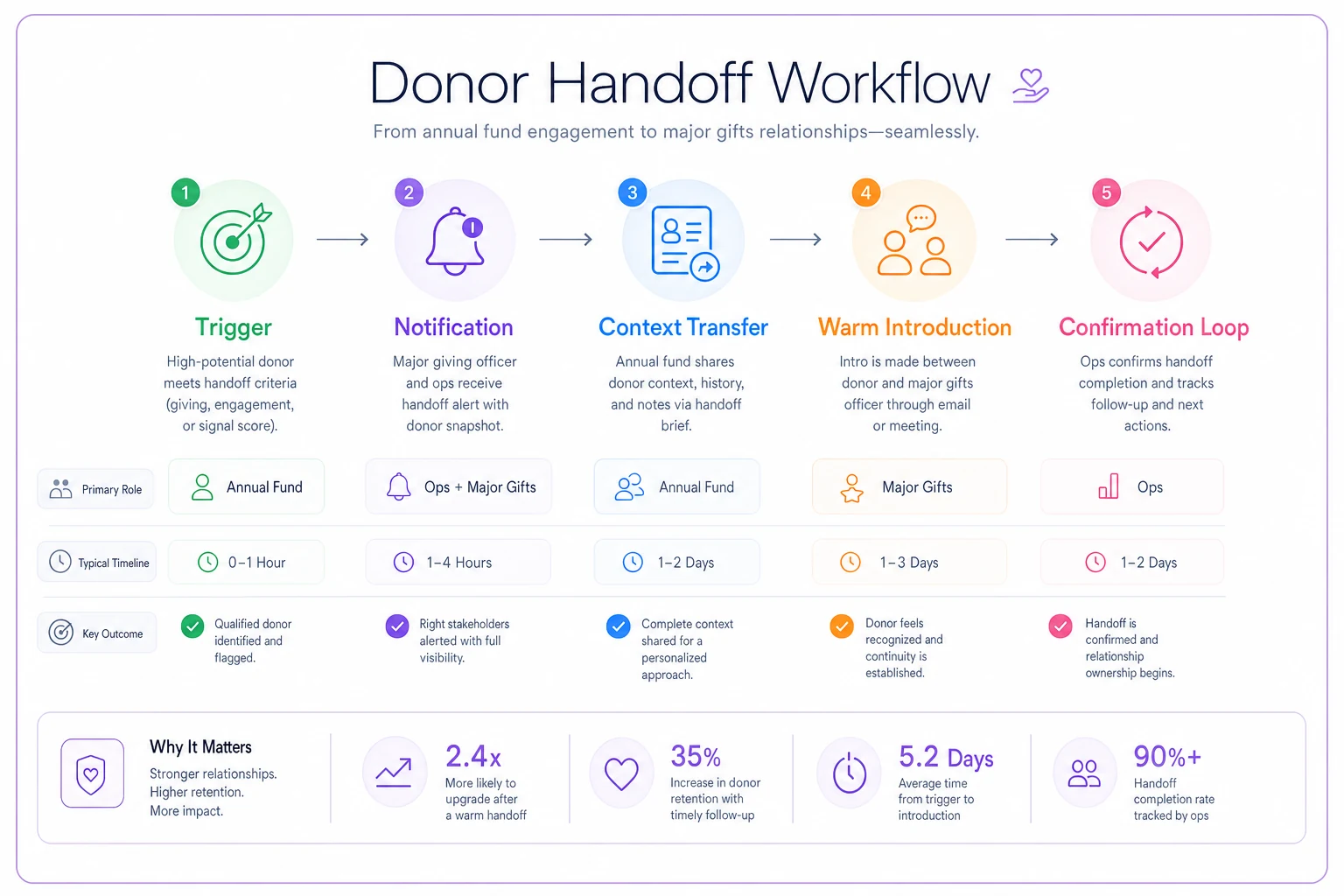
This diagram maps the handoff steps, responsible roles, and expected timelines so you can spot gaps in the process quickly.
Building your responsibility matrix without organizational chaos
A responsibility matrix clarifies who does what at each stage and transition point. Most nonprofits skip this and end up with three people doing the same task while critical work falls through cracks.
| Activity | Discovery | Activation | Cultivation | Partnership |
|---|---|---|---|---|
| Gift acknowledgment | Ops team (24hr) | Ops team (24hr) | Development (48hr) | Exec team (24hr) |
| Thank you calls | Volunteer callers | Annual fund | Major gifts | CEO/Board |
| Event invitations | Marketing (all) | Marketing (all) | Personal from MGO | Personal from exec |
| Impact reports | Quarterly email | Quarterly mail | Personal briefing | Board presentation |
| Renewal asks | Email series | Personal letter | Face-to-face | Peer ask |
| Database updates | Ops team | Annual fund | Major gifts | Major gifts |
| Relationship notes | Annual fund | Annual fund | Major gifts | Senior team |
Different activities transfer ownership at different times. Gift acknowledgment stays with ops throughout. Relationship notes transfer with the donor. Event invitations become personalized at higher levels.
This matrix prevents the classic nonprofit problem where major donors get six duplicate invitations because nobody knows who's supposed to invite them.
Common failure points and operational fixes
Even with stages, KPIs, handoffs and clear responsibilities, donor lifecycle systems break in predictable ways.
Failure 1: The frozen prospect A donor gets flagged for cultivation but sits untouched for months because the major gifts officer is "waiting for the right moment" to engage. Fix: Maximum idle time of 30 days. If no meaningful contact in 30 days, donor automatically returns to previous stage. This forces action or honest assessment of capacity.
Failure 2: The ping-pong donor Donor bounces between teams because they give irregularly. One year they qualify for major gifts, next year they don't, then they do again. Fix: Sticky stage progression. Once a donor reaches a stage, they stay there for minimum 18 months regardless of giving. This provides relationship stability.
Failure 3: The vanishing context New team member takes over a portfolio and spends six months rebuilding relationships because predecessor's knowledge walked out the door. Fix: Structured transition protocols. Every donor file must include: last three interactions, giving drivers, communication preferences, and relationship red flags. Update quarterly, not just at transition.
Failure 4: The metric gaming Annual fund keeps donors just below major gift threshold to maintain their metrics. Major gifts cherry-picks only sure wins to boost close rates. Fix: Shared success metrics. Annual fund gets credit for successful cultivation transitions. Major gifts shares responsibility for overall donor retention. Both teams win when donors progress.
Technology and automation in donor lifecycle management
The right operational software transforms donor lifecycle management from a theoretical framework into daily practice. Not by replacing relationship building, but by handling the mechanical work that prevents relationship building.
Consider what happens without systematic workflow automation. Your development associate spends Monday morning manually checking who needs acknowledgment calls, updating spreadsheets, and sending handoff emails. By the time they start actual donor cultivation, it's Wednesday.
Modern donor lifecycle platforms handle these operational mechanics automatically. When a donor crosses a threshold, the system triggers the handoff protocol. When a major donor goes 45 days without contact, their relationship manager gets an alert. When someone registers for an event, their giving history and communication preferences appear in the registration report.
This isn't about having more data or fancier dashboards. It's about embedding your donor lifecycle system into daily workflows so it actually gets executed.
Effective implementations treat the software as an operational backbone, not a reporting tool. Every stage transition, every KPI calculation, every handoff notification runs through automated workflows. This ensures consistency regardless of who's on vacation or how busy things get during year-end campaigns.
Making donor lifecycle systems work for your nonprofit
A functional donor lifecycle system starts with honest assessment of your current operations. Map where donors actually get stuck, not where you think they should flow. Identify which handoffs consistently fail. Figure out which metrics your team actually uses versus which ones just generate pretty charts.
Then build incrementally. Start with clear stages and single owners. Add KPIs that drive specific behaviors. Design one clean handoff protocol and replicate it across transitions.
Create a simple responsibility matrix that fits on one page.
Most importantly, treat your donor lifecycle system as operations infrastructure, not fundraising strategy. Strategy is deciding to focus on major gifts. Operations is ensuring every qualified prospect gets contacted within 72 hours of identification.
The nonprofits that scale successfully past 1,000 donors don't have better strategies or bigger teams. They have operational systems that ensure consistent donor experiences regardless of organizational growth. They know exactly who owns each relationship, what triggers each transition, and how to preserve context across handoffs.
Your donor lifecycle system should run predictably whether you have 500 donors or 5,000. Not perfectly – donors are humans with complex motivations – but predictably enough that team members know their role, donors experience intentional cultivation, and relationships deepen systematically rather than accidentally.
Build the system now, while you can still see all the moving parts. Because once you can't, it's usually too late to fix what's broken.
Ready to elevate your fundraising efforts?
Join 2,000+ nonprofits using Givioly to save time, increase donations, and build lasting donor relationships.