



Here's the moment that trips up almost every development-finance handoff: your appeal mailed on March 3 with a reply-by date of April 15. Gifts keep landing through late April because people hold the reply envelope on their fridge for three weeks. Meanwhile your fiscal reporting cutoff is March 31. So now you've got a single appeal whose revenue is split across two months, two batches of soft credits, and at least one donor who gave online and mailed a check "just in case."
When someone finally asks "how much did the spring appeal raise?" you get three different numbers depending on who you ask. The CRM says one thing, the general ledger says another, and the board report says a third. None of them are technically wrong. They're just measuring different windows against different rules.
This piece is about closing a single appeal cleanly. Not your whole month-end. Not your audit. Just the discipline of tying one appeal's gifts to the ledger so the campaign total, the deposit total, and the donor acknowledgments all agree. That's the whole job.
The core problem: appeal windows and accounting periods don't share a calendar
An appeal has a life of its own. It has a drop date, a reply-by date, and a long tail of stragglers. Accounting has fiscal periods with hard cut-offs. These two timelines overlap awkwardly, and nobody owns the overlap.
What we've seen across a lot of small shops is that the CRM tracks gifts by appeal code, while the ledger tracks money by deposit date. Those are not the same dimension. A $500 check received March 28 but deposited April 2 shows up in March in your fundraising report and April in your bank reconciliation. Multiply that across a few hundred gifts and the two systems drift apart by thousands of dollars — not because of fraud or error, but because they're answering different questions.
The fix isn't to force them to match. It's to build a close checklist that explains the difference every single time, with a documented bridge between the appeal total and the ledger total. When the auditor asks why the appeal raised $47,300 but the GL shows $44,900 posted in the period, you want a one-page reconciliation that says: $2,400 received in-window but deposited next period, plus a $0 variance after that adjustment. Done.
Lock the appeal before you close it
The first operational mistake is trying to reconcile a moving target. If gifts are still being coded to the appeal while you're reconciling, you'll never tie out. So the close starts with freezing the appeal scope.
Simplify donor management and fundraising workflows.
Givioly helps you organize campaigns, engage donors, and maximize fundraising impact seamlessly.
- Unified donor profiles
- Real-time donation tracking
- Automated impact reporting
No credit card required
A practical freeze has three parts:
-
Window definition. Write down the exact dates you're counting. A typical rule: gifts with a gift date between the drop date and 30 days after the reply-by date count to this appeal's "primary window." Anything after that is the tail and gets its own bucket.
-
Code lock. As of your close date, no new gifts get the primary appeal code without a note from finance. Late gifts get a "spring-appeal-tail" code so they're trackable but don't disturb the closed total.
-
Channel consolidation. Pull online, mailed-check, phone, and any event-adjacent gifts into one view. The donor who gave $100 online and mailed a $100 check is one of the most common double-counts, and you only catch it when you look at all channels against one donor record.
Most appeal totals are wrong not because of missing gifts but because of duplicate or mis-windowed gifts. Freezing scope first turns a chaotic reconciliation into a bounded one.
The three-way tie-out that actually matters
Every clean appeal close answers three questions and proves they agree:
-
What did the CRM say we raised? (appeal total by gift date)
-
What hit the bank? (deposit total)
-
What posted to the GL? (revenue by account and period)
These will almost never be equal on the first pass, and that's fine. The point is to walk from one to the next with named adjustments.
| Line | Amount | Notes |
|---|---|---|
| CRM appeal total (primary window) | $47,300 | 214 gifts, gift date March 3 – May 15 |
| Less: gifts received in-window, deposited next period | ($2,400) | 9 checks received by cutoff, banked after |
| Plus: prior-period gifts deposited this period | $600 | 2 Feb checks found in March deposit |
| Expected deposits this period | $45,500 | |
| Actual bank deposits (appeal-tagged) | $45,500 | matches — variance $0 |
| GL revenue posted (unrestricted – appeal) | $45,500 | ties to deposits |
The column that saves you is Notes. A tie-out without explanations is just two numbers next to each other. A tie-out with the nine specific checks that crossed the period boundary is something an auditor signs off on in minutes. If you've already built an audit-ready donation reconciliation workflow, this appeal-level tie-out slots right on top of it — same discipline, narrower scope.
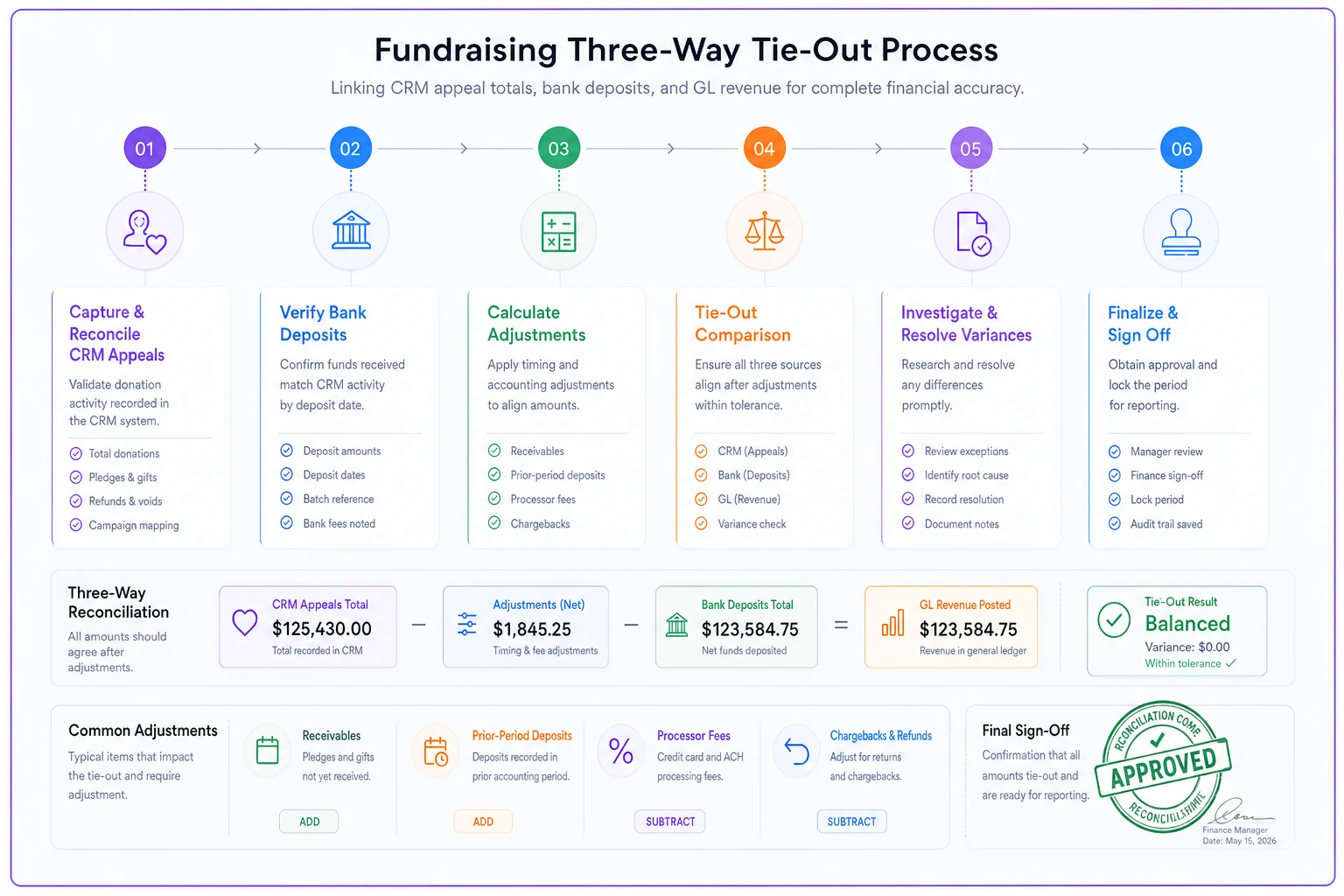
This diagram shows the step-by-step tie-out process.
Sample journal entries for the awkward cases
Most appeal gifts post cleanly: debit cash, credit contribution revenue. The ones that cause close-week headaches are the edge cases. Here's how to handle the three that come up most often.
Standard cash/check gift batch: Dr Cash (Operating) 12,450 Cr Contribution Revenue – Spring Appeal 12,450 (Batch #SA-04, 58 gifts, deposited 4/08)
Gift received in-window but deposited after period cutoff — this is the one people fumble. The donor intent and gift date are in-period, but the cash isn't. Record a receivable so the revenue lands in the right period: Dr Pledges/Gifts Receivable 2,400 Cr Contribution Revenue – Spring Appeal 2,400 (9 checks dated by 3/31, deposited 4/02) Then on deposit: Dr Cash 2,400 Cr Pledges/Gifts Receivable 2,400
Processor fees on online appeal gifts — don't let the net deposit quietly understate your appeal total. If $5,100 of gifts came in online and the processor took $150, record gross revenue and the fee separately: Dr Cash 4,950 Dr Credit Card / Processing Fees 150 Cr Contribution Revenue – Spring Appeal 5,100
The common mistake is booking only the $4,950 net. Then your CRM (which shows gross $5,100) will never tie to your GL, and you'll burn an hour hunting a $150 "discrepancy" that was the fee all along.
Deposit tie-outs: match batches, not totals
A single period total hides too much. The reconciliation that holds up matches batch by batch against bank deposits. Each CRM batch should map to exactly one bank deposit, with the same count and the same dollar amount.
A workable deposit tie-out log looks like this:
-
Batch ID (e.g., SA-04)
-
Gift count in the batch
-
CRM batch total
-
Bank deposit date
-
Bank deposit amount
-
Variance (should be zero; if not, one line explaining why)
-
Reconciler initials
When a batch total doesn't match a deposit, it's almost always a count problem, not a dollar problem. A check got left out of the physical deposit, or one got entered twice in the CRM. Reconciling on count first finds these faster than staring at dollar differences.
Shops that run offline-gift-heavy appeals — direct mail, phone — benefit from the same offline logging rigor used in event donation operations, where every physical gift gets logged at point of receipt before it ever reaches a batch. Same principle applies here.
The sign-off form that ends the arguments
The reason appeal totals get re-litigated in November is that nobody ever formally closed the spring appeal. There was no moment where a person said "this is final" and put their name on it. Without that, every future report is an opinion.
A one-page reconciliation sign-off form fixes this. Keep it boring and specific:
-
Spring Appeal — Finance Close Sign-Off
-
Appeal code and name
-
Primary window dates
-
Final CRM appeal total
$
-
Total deposits reconciled
$
-
GL revenue posted this period
$
-
Remaining in-window receivables
$
-
Tail gifts coded separately (count / $)
-
Known open items
-
Prepared by / date
-
Reviewed by (finance) / date
-
Approved by (development lead) / date
Two signatures matter here — finance confirms the money ties, development confirms the appeal total is what goes to the board and into donor-facing campaign reporting. Once both sign, that total is locked. Late gifts flow to the tail bucket and get reported as "spring appeal, post-close gifts" rather than silently inflating a number people already quoted to someone.
When to split an appeal into two reporting lines
Not every appeal should close as one clean number. If your reply window genuinely straddles a fiscal year-end — say the appeal mails in June and gifts land through July — forcing it into one period creates more distortion than it removes.
When a single close makes sense: the entire primary window sits inside one fiscal period, the tail is small (under roughly 5% of total), and donor reports treat it as one campaign.
When to split it: the window crosses year-end, the organization reports on a fiscal-year basis, or a material chunk of gifts — somewhere in the 15–20% range — lands in the second period. In that case, close the appeal twice, once for each fiscal period, and present a combined "campaign-to-date" total separately from the two period-specific revenue figures. Your board sees the campaign number; your audit sees clean period cuts.
Who should not overthink this: an all-volunteer shop raising a few thousand dollars from one letter doesn't need receivables and dual closes. A simple batch-to-deposit match and one sign-off is plenty. The machinery scales to the stakes.
A real scenario
A regional literacy nonprofit — roughly $900k annual revenue, two-person development team, outsourced bookkeeping — ran a spring appeal that "raised about $52k" according to the CRM. The bookkeeper's GL showed closer to $48k for the quarter. For two years nobody reconciled the gap; the board report just used the CRM number and the financials used the GL, and the two documents quietly disagreed.
When they finally built a proper close, the gap resolved almost entirely into three buckets: about $2,600 in checks received before quarter-end but deposited after, roughly $900 in processing fees that had been netted out, and a $500 duplicate where one donor's online-and-check pair had been counted twice. After the tie-out, the remaining variance sat under $100 — a couple of small timing items they documented and moved on from.
The outcome wasn't a bigger number. It was that the spring appeal now had one total that finance and development both signed. The following year's close took the team a little over an hour instead of the vague, never-finished slog it had been before. And when the auditor asked about appeal revenue, they handed over a one-page tie-out and were done.
The takeaway
Closing an appeal isn't about making your CRM and your ledger show the same number — they usually shouldn't, because they measure different things. It's about building a short, repeatable bridge between the appeal window and the accounting period, naming every adjustment, and getting two people to sign that the campaign total is final.
Freeze the scope, run the three-way tie-out, post the awkward journal entries correctly, match deposits batch-by-batch, and sign off. Do that once per appeal and the "how much did we actually raise?" argument stops happening — because the answer is already written down, reconciled, and approved.
Closing an appeal isn't about making your CRM and your ledger show the same number — they usually shouldn't, because they measure different things. It's about building a short, repeatable bridge between the appeal window and the accounting period, naming every adjustment, and getting two people to sign that the campaign total is final.
Ready to elevate your fundraising efforts?
Join 2,000+ nonprofits using Givioly to save time, increase donations, and build lasting donor relationships.