
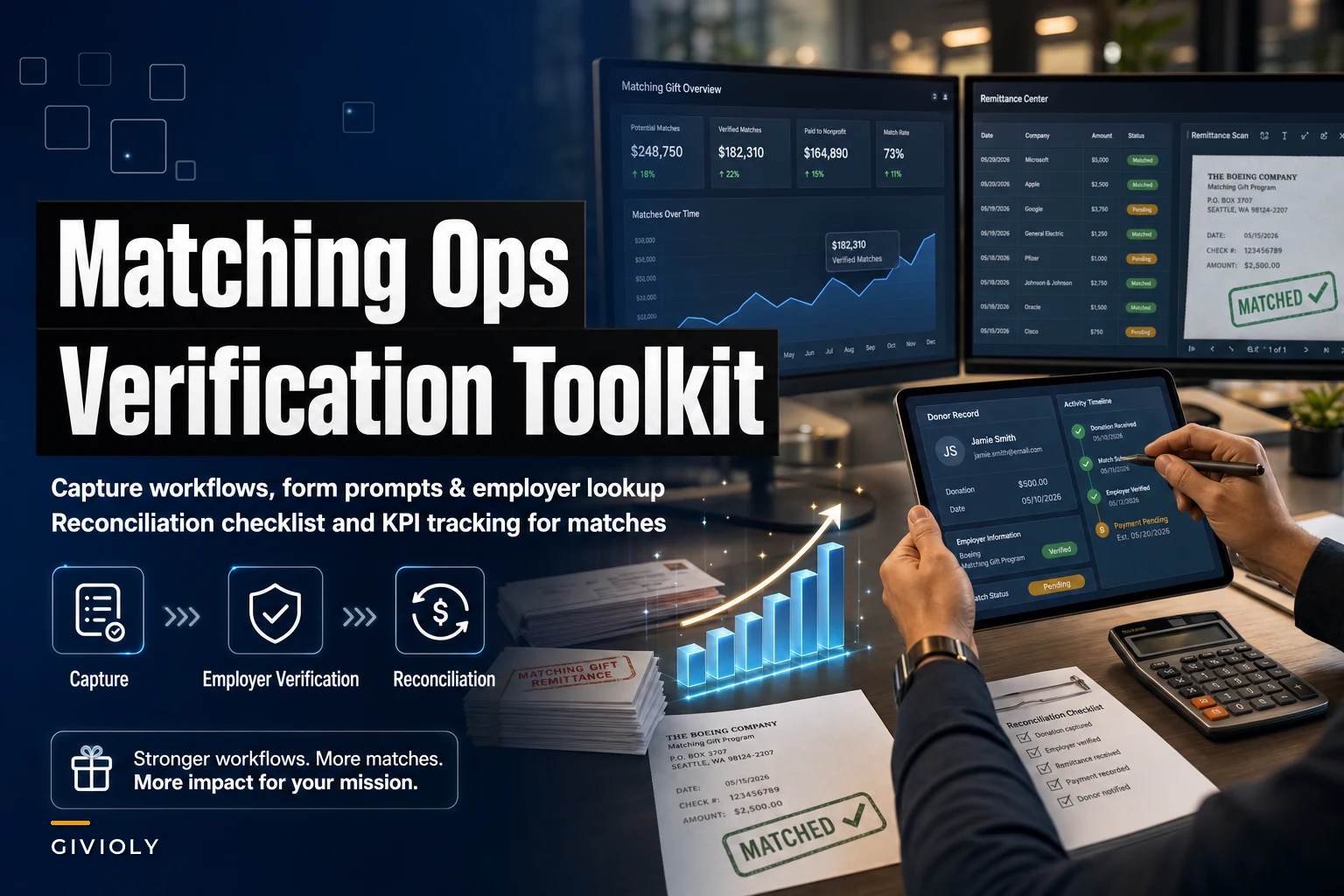

Most nonprofits treat matching gifts like free money that shows up on its own. It doesn't. Corporate match programs put an estimated $2–3 billion a year on the table that never gets claimed, and a big chunk of that gap isn't donor apathy — it's operational. The gift got captured wrong, the employer never got verified, or the match sat in "pending" purgatory until the corporate deadline passed.
If your matching gift operations rely on a donor remembering to submit a form on their employer's portal, you've already lost most of it. The nonprofits that actually collect matches build a capture-and-verification workflow that assumes the donor will do nothing after the initial gift. That's the whole game.
Below is where these programs break — roughly in the order they break — and what fixing them actually looks like at the field and process level.
The three failure points, roughly in order of how much money they cost you
Before getting into fixes, it helps to see where the leakage actually happens. Across nonprofits that run matching programs badly (which is most of them), the losses cluster in three places:
| Failure point | What actually happens | Rough share of lost matches |
|---|---|---|
| Capture | Donor never told you they're match-eligible; employer field is blank or garbage | ~40–50% |
| Employer lookup / eligibility | You have an employer name but never confirmed the program, ratio, or deadline | ~25–30% |
| Verification & follow-through | Match was initiated but never confirmed, never invoiced, never reconciled | ~20–30% |
Almost everyone puts their energy into the last bucket — chasing pending matches — when the biggest hole is at the very front. If you don't capture employer data at the moment of the gift, everything downstream is guesswork.
Where capture quietly fails
Here's the pattern. A donor gives $250 online. Your form has an optional field labeled "Employer (optional)." Maybe 15% of donors fill it in. Of those, half type something unusable — "self," "retired," "IBM" when it's actually a subsidiary that matches under a different name, or a personal LLC with no program at all.
Simplify donor management and fundraising workflows.
Givioly helps you organize campaigns, engage donors, and maximize fundraising impact seamlessly.
- Unified donor profiles
- Real-time donation tracking
- Automated impact reporting
No credit card required
So even a form that technically "captures" employer data ends up with maybe 7–8% of your donors having clean, matchable employer info. And you built your whole matching program on top of that.
-
Replace the free-text employer box with a search-and-select field backed by a matching-gift company database. The donor starts typing "Gene..." and sees "Genentech — matches 1:1, up to $10,000/yr." Now they know there's money on the table, and you get a clean, normalized company record instead of a typo.
-
Add a short prompt right after the donation confirmation, not buried in the form: "Your employer may double this gift. Check here →." The post-gift moment is when the donor is warm and proud of what they just did. That's your best conversion window, and almost nobody uses it.
-
On paper and event gifts, add a single line to your offline gift log
Employer + "match-eligible? Y/N/unknown." If your event and offline capture is loose, matches vanish before they ever enter the system. This ties directly into how you log offline gifts in general, which we covered in the audit-ready donation reconciliation workflow.
Showing the employer's ratio and cap during capture — via search-and-select — materially increases donor follow-through.
One thing worth sitting with: donors are far more likely to complete the match step when you tell them their specific employer's ratio and cap than when you give them a generic "ask your HR department" nudge. Specificity converts. Vagueness gets ignored.
The employer lookup step everyone skips
Say you did the capture part well. You now have 300 gifts with clean employer names. The next failure is assuming a clean employer name equals a match opportunity. It doesn't.
You still have to confirm, for each employer:
-
Batch by employer, not by donor. If 12 donors work at the same hospital system, you research that program once, not twelve times. Group first.
-
Pull program details from a maintained database rather than searching from scratch each time. Ratios and caps change; a stale internal note from two years ago will cost you.
-
Record the deadline as a hard date field, and back-date a task 30 and 60 days before it. Deadlines are the single most common reason initiated matches die.
-
Flag "employer unknown / no program found" as its own status so it doesn't sit mixed in with live opportunities. Worth re-checking periodically — companies add programs.
This is one area where automation genuinely earns its keep. AI-assisted lookup can take a normalized employer name, match it against a program database, and pre-fill the ratio, cap, and deadline into your record — turning a 300-row research slog into a review-and-confirm task. You're not removing human judgment; you're removing the part where someone has to google 300 companies by hand. The team's job shifts to confirming edge cases — subsidiaries, ambiguous names — instead of doing raw data entry.
The verification tracking fields you're probably missing
Once a match is in motion, most nonprofits track it in one column called "match status" with values like "pending" and "received." That's not enough resolution to manage anything.
-
Match eligible? (Y / N / unknown)
-
Employer (normalized) — linked to a company record, not free text
-
Match ratio and annual cap
-
Expected match amount (calculated from the original gift + ratio, capped)
-
Submission method (donor portal / employer HR / third-party platform)
-
Who initiates (donor-submitted vs. org-submitted)
-
Match status (eligible → requested → confirmed by employer → invoiced → paid)
-
Employer deadline
-
Verification date and verified by
-
Linked original gift ID (so the match reconciles back to the source donation)
That "expected match amount" field is the quiet hero. Without it, you have no way to measure the gap between what you should collect and what you actually collect. And that gap is your entire KPI story.
The other field people skip is linked original gift ID. When a corporate match check arrives — often months later, often as a lump sum covering several employees — you need to trace it back to specific gifts. Without that link, the match either gets miscoded as a general corporate donation or double-counted against the original gift. Both wreck your reconciliation.
Reconciliation: matching what was claimed to what actually landed
This is where the whole thing either holds together or falls apart, and it gets the least attention because it happens weeks after the excitement of the original gift.
The core reconciliation question is simple: for every match we expected, did the money arrive, and did it land coded correctly? Answering that requires you to reconcile three things that rarely line up on their own — your expected-match records, the actual deposits, and the corporate remittance detail (the list the company sends showing which employees' gifts the lump check covers).
-
Pull all matches in "requested" or "confirmed" status older than 60 days — chase or write them off
-
Match each incoming corporate check against its remittance detail
-
Tie each remittance line back to a linked original gift ID
-
Compare received amount vs. expected amount per match; investigate variances over a set threshold
-
Reclass any match miscoded as a general corporate gift
-
Update status to "paid" and stamp verification date + verified by
-
Flag matches past employer deadline with no payment as "lost — deadline" (so they leave your active pipeline but stay in your loss analysis)
Here's a simple monthly matching-gift reconciliation workflow.
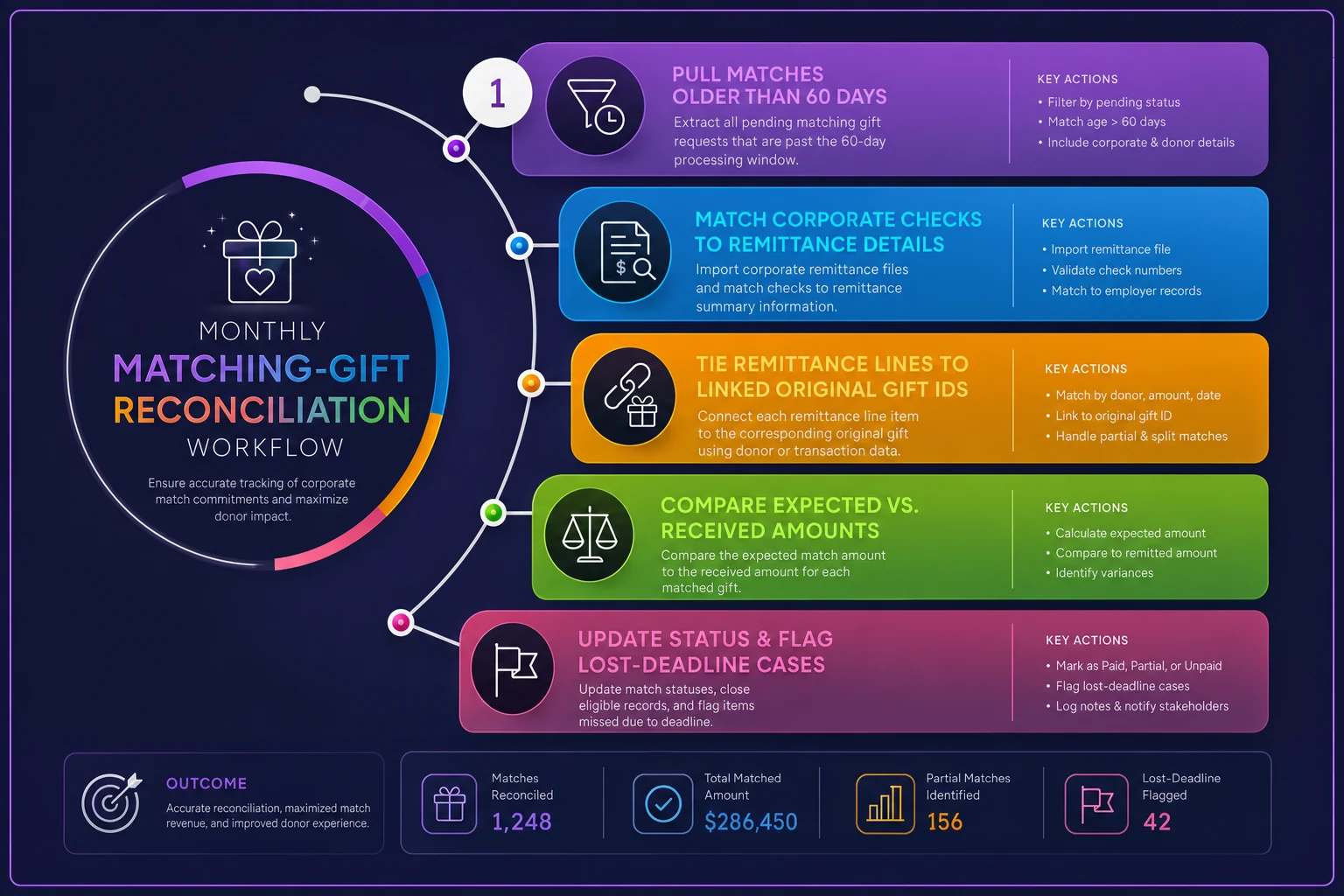
That last point matters more than it seems. If lost matches just disappear from your tracking, you'll never learn why you lost them. Keeping a "lost — reason" status turns leakage into a diagnosable pattern instead of an invisible drain.
If your broader deposit-to-record reconciliation is shaky, matching gifts will expose it fast — match payments arrive lumped and delayed. The general reconciliation discipline in the audit-ready reconciliation workflow is the foundation this sits on top of.
The one KPI that tells you if your program actually works
Most matching gift "reporting" is a single number: total matches received this year. That number feels good and tells you almost nothing, because it has no denominator.
> Match capture rate = (Matches actually received) ÷ (Matches expected from eligible gifts)
-
Eligible-but-never-requested rate → your capture and initiation problem
-
Requested-but-never-confirmed rate → your employer follow-up problem
-
Confirmed-but-never-paid rate → your reconciliation and deadline problem
Watching those three sub-rates over a few months tells you where to spend effort. A team drowning in "never-requested" gifts needs better forms and post-gift prompts. A team with high "never-confirmed" needs deadline-based task automation. Same program, completely different fixes depending on where the leak is.
A real scenario
A mid-sized regional food bank was running a matching program that looked fine on paper — they'd collected a little over $50k in matches the prior year and treated it as a success. Their donation form had the standard optional employer field, and staff manually chased matches when they happened to notice them.
When they finally added an expected-match field and back-filled it against their eligible gifts, the picture changed. Expected matches for the year came out somewhere around $115k–$130k. Their capture rate was sitting near 40%.
The fixes weren't dramatic. They swapped the free-text employer box for a search-and-select field with visible ratios, added a post-donation match prompt on the confirmation page, and set up deadline-based reminders 60 and 30 days out. They also grouped their lookup work by employer so the research stopped being one-off googling. Automated employer lookup pre-filled ratios and caps so staff were confirming instead of researching from scratch.
Over the following year, captured matches landed in the low $80k range. Not the full theoretical $130k — a chunk of employers had no program, and some donors ignored every nudge. But moving from roughly 40% to around 65% capture on a six-figure opportunity was a real gain, done mostly by fixing capture and follow-through rather than adding headcount.
When to invest in this — and when not to
Building out full matching gift operations makes sense when you have enough eligible-donor volume to justify the setup. If you're processing a few thousand gifts a year with a reasonable share of corporate-employed donors, the return is obvious.
It's a bad use of time when your donor base skews heavily toward retirees, small-business owners, and self-employed people — populations with few active corporate match programs. Running a heavy lookup-and-verification process against a base where 90% of donors have no match-eligible employer is just overhead. Do a quick sample first: pull 100 recent donors, check how many work at companies with real programs. If it's under 10%, keep it lightweight.
Nobody should build this on top of a broken capture layer either. If your donation forms and offline logs don't reliably record employer data, fix that before you invest in verification and reconciliation tooling — you'd be building a collection system for data you never collected. The same discipline that makes recurring-gift programs work at scale, covered in scaling monthly giving programs, applies here: the automation only pays off once the intake underneath it is clean.
The short version
Matching gift operations fail at the front, not the back. Teams obsess over chasing pending matches while the real money leaks at capture — blank employer fields, generic nudges, and lookups that never get done.
The operational fix is pretty straightforward once you see it: add a search-and-select employer field, prompt donors right after they give, group and automate your employer lookups, track each match through its real lifecycle with linked gift IDs, and reconcile expected against received every month. None of that requires new staff. It requires a process that doesn't assume donors will do the work for you.
Do that, and you get a number most nonprofits never bother to calculate: your true match capture rate. Once you can see it, you can move it — and moving it from 40% to 65% on a six-figure opportunity is one of the highest-return operational fixes available to a fundraising team, without asking a single donor for another dollar.
Ready to elevate your fundraising efforts?
Join 2,000+ nonprofits using Givioly to save time, increase donations, and build lasting donor relationships.