


Most nonprofits launch monthly giving programs by creating a donation page, adding a recurring checkbox, sending a welcome email, then wondering why their monthly donor base plateaus after six months. The real problem isn't attracting monthly donors—it's the operational infrastructure that determines whether you're building sustainable revenue or just collecting one-time donations that happen to recur.
The pattern is clear: organizations that successfully scale monthly giving programs treat it like subscription revenue, not passive donations. They build systematic workflows for onboarding, engagement cadences, upgrade triggers, and retention tracking. The difference between a program stuck at 200 monthly donors and one that grows to 2,000 comes down to operational discipline, not fundraising creativity.
Why monthly giving programs stall out (hint: it's not about the ask)
Monthly giving programs fail in predictable ways. Organizations treat monthly donors like regular donors who just give more frequently. They dump them into the same communication streams, same acknowledgment processes, same engagement tactics. Monthly donors get bombarded with appeals designed for one-time givers, feel undervalued, then quietly cancel around month four.
The second failure point happens at scale. When you have 50 monthly donors, personal touches work—handwritten notes, phone calls, remembering birthdays. But what happens at 500? Without automated workflows and clear operational triggers, your team drowns in manual tasks while donor experience deteriorates. One nonprofit had their monthly program implode because their development coordinator spent 20 hours a week just processing failed credit card notifications manually.
The technical debt compounds quickly. Payment failures pile up. Upgrade opportunities get missed. Retention metrics become guesswork. Your monthly program becomes a leaky bucket where new donors barely offset cancellations. The program that should be your most predictable revenue stream becomes your most frustrating operational headache.
Building the onboarding sequence that reduces 60-day churn
The first 60 days determine whether a monthly donor stays for years or cancels before their third payment. Most organizations send one welcome email then treat monthly donors exactly like everyone else. Monthly donors need a completely different onboarding experience that reinforces their decision, demonstrates impact quickly, and creates emotional investment before buyer's remorse kicks in.
Simplify donor management and fundraising workflows.
Givioly helps you organize campaigns, engage donors, and maximize fundraising impact seamlessly.
- Unified donor profiles
- Real-time donation tracking
- Automated impact reporting
No credit card required
Start with immediate confirmation that goes beyond transaction details. Within 10 minutes of signup, trigger an automated email that celebrates their decision to become a sustaining supporter. Not a receipt—that comes separately. This message should explain what happens next, when they'll hear from you, and what their first month of giving accomplishes. Include a clear timeline: "Over the next four weeks, we'll share three quick updates showing exactly how monthly supporters like you power our daily work."
Day 3 needs impact proof, not another thank you. Send a brief story or statistic that connects directly to their monthly amount. If someone gives $25 monthly, show what $25 does this week specifically. "Your first $25 just provided emergency shelter for two families tonight" hits differently than "Thank you for your generous monthly support." Make it tangible, immediate, and connected to their actual gift amount.
Week 2 introduces insider access. Monthly donors want to feel like insiders, not ATMs. Send content they can't get elsewhere—behind-the-scenes photos, early program updates, or exclusive data about your operations. One food bank sent monthly donors a "warehouse webcam" link where they could watch volunteers sorting donations in real-time. Engagement jumped significantly because donors felt genuinely connected to daily operations.
Week 3 delivers social proof. Share how many other monthly donors joined that month, spotlight a longtime monthly supporter's story, or show aggregate monthly donor impact. People want confirmation they made a smart decision. "You're one of 47 new monthly supporters this month" or "Monthly donors like you provided 3,400 meals last week" reinforces their choice through community validation.
The 30-day mark requires personal touch, even if automated. Trigger a video message from your ED or program director—record once, use for months. Keep it under 90 seconds. Thank them personally, share one specific thing monthly donors make possible, and preview something exciting coming up. This isn't an appeal; it's relationship building.
Day 45 introduces the first soft engagement ask. Not money—participation. Ask them to complete a two-question survey about why they became a monthly donor, or invite them to a virtual monthly donor meetup. You're building engagement habits before the novelty wears off.
Separate the confirmation email from the receipt and send it within 10 minutes to reduce donor confusion and reinforce the decision.
Day 60 closes the loop with a mini impact report. Show cumulative impact from their first two months. Include data visualization if possible—even a simple chart showing "your two months of giving" creates tangible evidence of impact. This timing matters because it arrives just before month three, when many monthly donors reconsider their commitment.
Upgrade triggers that actually convert without damaging retention
The math on monthly donor upgrades is compelling—moving someone from $20 to $30 monthly adds $120 annual revenue with zero acquisition cost. But ham-fisted upgrade asks destroy donor trust and trigger cancellations. Build systematic triggers based on engagement signals, not arbitrary timelines.
Payment anniversary dates create natural upgrade moments. After 6 months of consistent giving, trigger an automated upgrade ask that celebrates their commitment first. "You've powered our work for six straight months" followed by "Some monthly supporters choose to increase their impact at this milestone" feels organic, not pushy. Include specific upgrade amounts—don't make them guess. If someone gives $25 monthly, suggest $30, $35, or $40, showing exactly what each increase accomplishes.
Engagement spikes signal upgrade readiness. When a monthly donor opens five consecutive emails, clicks through to impact stories, or engages with social posts, they're demonstrating deeper investment. Build automated triggers that identify these engagement patterns then deploy targeted upgrade asks. One program saw strong upgrade conversion by targeting only monthly donors who'd engaged with three or more impact stories in the previous month.
Create campaign-specific upgrade opportunities. Instead of generic "please give more" appeals, tie upgrades to specific moments. "This month only, we're inviting monthly donors to add $5 to help us launch our summer feeding program" gives reason and urgency. The temporary nature reduces commitment fear while the specific use case provides clarity.
The retention metrics that actually predict churn
Most nonprofits track monthly donor retention wrong. They calculate annual retention rates, celebrate solid retention, then ignore the monthly warning signs that precede cancellations. Real retention management requires operational metrics that trigger interventions before donors leave, not post-mortem analysis.
Payment failure rate tells you more than cancellation rate. Track what percentage of monthly payments fail each month, broken down by failure reason. Expired cards, insufficient funds, and bank declines require different operational responses. When payment failures spike above 15%, you've got a systemic problem. One nonprofit discovered their payment processor was incorrectly coding transactions, triggering widespread bank declines. They only found it by tracking failure patterns, not waiting for cancellations.
Email engagement decay predicts cancellation 60-90 days out. Monthly donors who stop opening emails don't suddenly cancel—they gradually disengage. Build a simple engagement scoring system: opened last email (3 points), opened one of last three (2 points), clicked any link last 30 days (5 points). When scores drop below threshold, trigger re-engagement campaigns immediately.
The 4-month cliff is real and predictable. Roughly 30% of monthly donor churn happens between months 3-6. Track cohort retention by signup month, not aggregate retention. January monthly donors might retain at 85% while July donors retain at 65%. Understanding cohort patterns lets you adjust onboarding and engagement tactics seasonally.
Gift frequency changes signal problems. When someone switches from monthly to quarterly, or asks to skip a month, they're one step from cancellation. These aren't retention wins—they're warning flares. Build workflows that treat frequency reductions as retention emergencies requiring immediate personal outreach.
Automation workflows that scale without losing the personal touch
You can't personally manage 1,000 monthly donors the way you managed 100. But full automation feels transactional and destroys the relationship that keeps monthly donors engaged. The solution is strategic automation that handles routine tasks while preserving human touchpoints where they matter most.
Start with payment processing automation that actually works. Failed payment workflows should trigger immediately, not wait for batch processing. First failure: friendly automated reminder with quick update link. Second failure: automated email plus SMS if opted in. Third failure: trigger for personal phone call. Fourth failure: automated pause (not cancellation) with reactivation link. This cascade approach can recover a significant percentage of failed payments compared to manual processes.
Birthday and anniversary automation creates delight without effort. Track signup anniversaries and birthdays (if collected) then trigger personalized messages. Not mass emails with merge tags—use conditional content based on giving level, tenure, and engagement. A twelve-month anniversary message for a $100 monthly donor should look completely different than one for a $15 donor at the same milestone.
Build engagement-based communication streams, not time-based ones. Instead of sending all monthly donors the same monthly newsletter, create dynamic segments based on behavior. Highly engaged monthly donors get exclusive content and upgrade asks. Low engagement donors get re-engagement campaigns and impact proof. New monthly donors get onboarding sequences. Same operational calendar, completely different donor experiences.
Predictive intervention workflows make the biggest difference. When your system identifies churn signals—declined payment, no email opens for 60 days, website visit to cancellation page—it triggers interventions automatically. Not generic "we miss you" messages, but specific outreach addressing likely concerns. Payment issues get payment help. Engagement drops get impact stories. Cancellation page visits get immediate phone call triggers.
Here's a visual of how those automation workflows flow from onboarding to intervention.
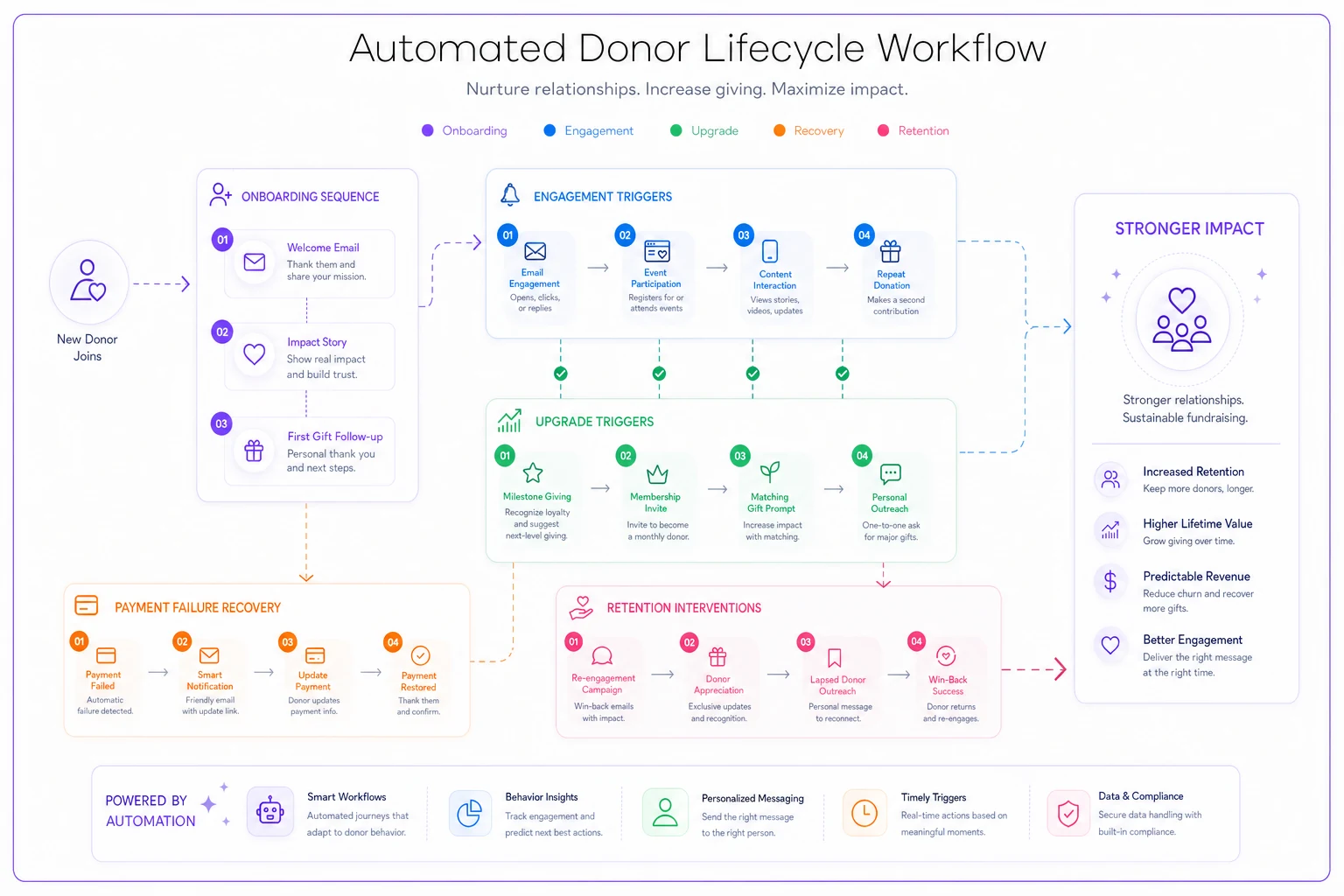
The cascade handles routine issues automatically while flagging exceptions for human follow-up.
The upgrade ask cadence that grows revenue without donor fatigue
Traditional upgrade strategies treat all monthly donors identically—annual upgrade asks based on calendar timing. Monthly donors demonstrate upgrade readiness through behavior patterns, not arbitrary dates. Building systematic upgrade triggers based on actual engagement signals increases conversion while reducing cancellation risk.
The six-month momentum upgrade works because donors have proven commitment without experiencing fatigue. Track monthly donors who hit six consecutive payments with zero failures, then trigger an upgrade ask positioned around momentum: "Your six months of consistent support has provided stability we can count on. Some supporters choose this milestone to deepen their impact..." Include three specific upgrade amounts with concrete impact differences.
High engagement triggers catch donors at peak emotional investment. When monthly donors engage with multiple impact stories, share your content, or attend virtual events, they're signaling deeper connection. Build automated triggers that identify these engagement clusters: opened 3+ emails in 10 days, clicked through to program pages, watched impact videos. Deploy upgrade asks within 48 hours of engagement spikes while emotional connection remains high.
Campaign-specific upgrades feel purposeful, not greedy. During seasonal campaigns or emergency responses, invite monthly donors to temporarily or permanently increase their gift for specific purposes. "Add $10 to your monthly gift through summer to help us feed 50 additional kids" gives clear purpose and timeline. Make the temporary option prominent—it reduces resistance while often converting to permanent increases.
Build mandatory cooling periods between upgrade asks (minimum 4 months), suppress donors who recently upgraded (6-month minimum), and exclude anyone showing churn signals. Nothing triggers cancellations faster than aggressive upgrade asks to struggling donors.
Building stewardship touchpoints that don't overwhelm small teams
Monthly donors need consistent touchpoints to stay engaged but overwhelming them with communication triggers cancellations. Most nonprofits either under-communicate (monthly donors feel forgotten) or over-communicate (monthly donors feel harassed). The solution requires systematic touchpoints that feel personal without requiring actual personalization at scale.
Create a foundational communication rhythm that runs automatically. Monthly donors should receive something every month, but not always an ask or formal update.
| Month | Touchpoint |
|---|---|
| Month 1 | impact story |
| Month 2 | program insider update |
| Month 3 | monthly donor spotlight |
| Month 4 | exclusive data or infographic |
| Month 5 | video message from field |
| Month 6 | upgrade opportunity |
This creates predictable touchpoints without staleness.
Layer in triggered communications based on behavior. When monthly donors hit giving milestones ($500 cumulative, $1,000 cumulative), trigger automated but personal acknowledgments. When they engage with specific program content, follow up with related updates. When they share your content, send a thank you. These behavioral triggers make communication feel responsive, not scheduled.
The quarterly phone call program scales through strategic selection. You can't call every monthly donor quarterly, but you can systematically call segments. Quarter 1: call monthly donors who upgraded in the previous quarter. Quarter 2: call donors at one-year anniversary. Quarter 3: call top 20% by giving amount. Quarter 4: call anyone showing churn signals. Rotate through segments so everyone gets personal touch annually without overwhelming staff.
Build "insider access" moments that cost nothing but create value. Monthly donors want to feel special, not just appreciated. Give them early access to annual reports, first registration for events, or exclusive monthly donor Facebook groups. One nonprofit created a monthly "ask the ED anything" Zoom for monthly donors only. Costs 30 minutes monthly, creates massive loyalty.
When upgrade asks backfire: reading the operational signals
Not every monthly donor should get upgrade asks. Push the wrong donor at the wrong time and you'll trigger cancellations, not increases. Building operational guardrails that prevent badly-timed upgrade asks protects your base while growing revenue from ready donors.
Payment struggles signal financial stress, not upgrade readiness. Any donor with payment failure in the last 90 days gets excluded from upgrade asks for minimum six months. Track cumulative payment issues—donors with multiple failures across time are fighting to maintain current levels, not candidates for increases. Push too hard and you'll lose them entirely.
Engagement decline means relationship repair, not revenue pushes. Monthly donors who haven't opened an email in 60 days need re-engagement, not upgrade asks. Build systematic suppression that excludes low-engagement donors from upgrade campaigns. Focus on rebuilding connection first, revenue second.
Tenure matters differently than you think. New monthly donors (under 3 months) shouldn't get upgrade asks regardless of engagement—they're still adjusting to the commitment. Very long-term donors (5+ years) often resist upgrades because they've found their comfortable level. Focus upgrade efforts on the 6-month to 3-year sweet spot where commitment is proven but habits aren't fixed.
Service contacts reveal satisfaction issues. Any monthly donor who's contacted you with concerns, complaints, or questions in the last 60 days gets excluded from upgrade asks. They're telling you something needs attention. Address their concerns first, then revisit revenue opportunities later.
Sample automation sequences that actually work
Here's exactly how effective monthly giving automation workflows operate in practice:
Failed Payment Recovery Sequence:
-
Hour 0
Payment fails
-
Hour 1
Automated email with direct update link (not a login required)
-
Day 3
Second email with different messaging angle plus SMS if available
-
Day 7
Phone call trigger to staff with talk track provided
-
Day 10
Final automated email warning of pending pause
-
Day 14
Account paused (not cancelled) with reactivation link
-
Day 30
Re-engagement email with impact reminder
-
Day 60
Final reactivation attempt before archival
Milestone Anniversary Workflow:
-
Day -7
System identifies upcoming anniversary
-
Day 0
Personalized anniversary email with cumulative impact
-
Day 2
Social media team notified to thank publicly (if donor agrees)
-
Day 7
Physical mail triggered (only for 1-year and above)
-
Day 14
Soft upgrade ask if engagement scores high
-
Day 30
Add to "anniversary segment" for special December campaign
Churn Prevention Trigger:
-
Signal detected
3 consecutive unopened emails
-
Day 1
Switch to re-engagement email template
-
Day 7
Text message if opted in: "We miss connecting with you"
-
Day 14
Phone call trigger with "checking in" script
-
Day 21
Email from ED or program director
-
Day 30
Direct mail postcard with program photos
-
Day 45
Final personal outreach attempt
-
Day 60
Move to quarterly communication only
The discipline comes from building these as templates once, then letting them run systematically. No manual monitoring, no wondering what to do when issues arise. The workflow handles 90% of situations automatically while flagging the 10% that need human intervention.
The reality check: who shouldn't build elaborate monthly giving operations
Not every nonprofit should invest in complex monthly giving infrastructure. If you have fewer than 100 monthly donors and aren't actively investing in acquisition, elaborate automation workflows won't magically grow your program. Start with basic email acknowledgments and quarterly impact reports until you hit critical mass.
Organizations without dedicated database management shouldn't attempt complex automation. Bad data plus automation equals automated disasters. One nonprofit accidentally sent upgrade asks to donors who'd already cancelled because their database didn't sync properly. Clean up your data infrastructure before building elaborate workflows.
If your leadership doesn't understand subscription revenue economics, pause before building. Monthly giving programs require patience—acquisition costs are higher, initial amounts are lower, but lifetime value exceeds one-time donors by 3-5x. Leadership pushing for immediate returns will undermine the program before it matures.
Small teams without technical capacity should start simple. Use your donation platform's built-in recurring features, create template emails for common situations, and track basic metrics in a spreadsheet. Perfect manual processes first, then automate what works. Trying to build complex automation without proven processes wastes resources and creates operational chaos.
Scaling a monthly giving program isn't about finding the perfect ask or magical messaging. It's about building operational infrastructure that systematically onboards, engages, upgrades, and retains donors at scale. The nonprofits growing from 200 to 2,000 monthly donors understand this fundamental truth: sustainable recurring revenue requires sustainable operational systems.
Ready to elevate your fundraising efforts?
Join 2,000+ nonprofits using Givioly to save time, increase donations, and build lasting donor relationships.