
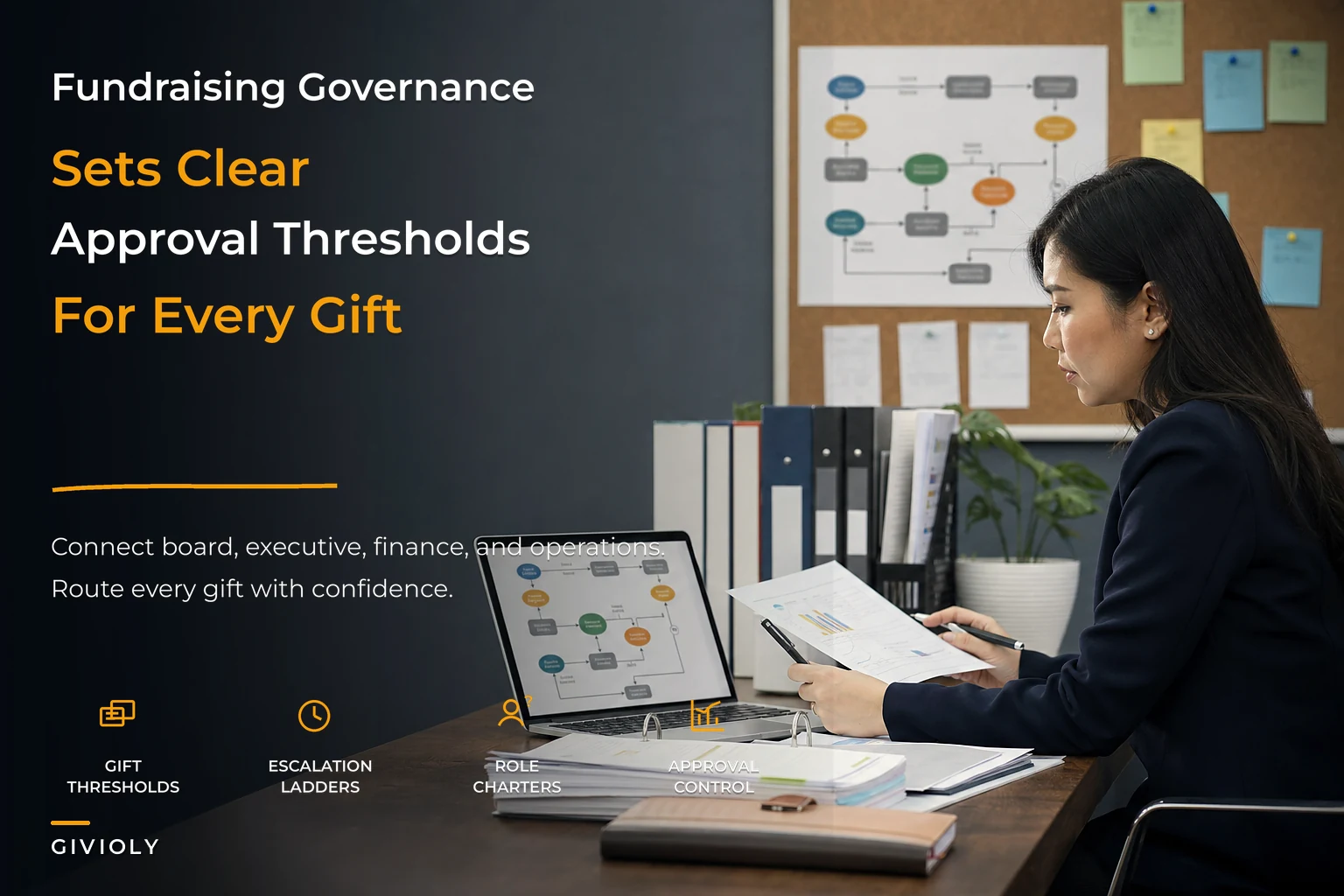

Most nonprofit governance documents are written once, filed somewhere, and never looked at again until something goes wrong. A major gift arrives with strings nobody noticed. A naming-rights agreement gets signed by a development director who didn't have authority to sign it. A restricted grant gets spent on the wrong program line because the approval chain lived in someone's head instead of on paper.
The problem is almost never that leadership doesn't care. It's that the fundraising governance model — the actual wiring connecting the board, executive team, finance, and development operation — is incomplete. Gaps exist between who decides, who approves, who executes, and who gets told. And those gaps don't show up when you're small. They show up the year you grow.
This is a blueprint for that wiring. Not governance theory — practical artifacts you can drop into a policy binder: committee charters, approval matrices, escalation ladders, and role descriptions that hold up when a $250k planned gift lands in your inbox on a Friday afternoon.
Where governance breaks (and why it's usually a seam, not a part)
Governance failures in fundraising rarely happen inside a single function. The board does its job. Finance does its job. The development team does its job. The failure happens between them — in the handoff, the approval, the thing someone assumed was someone else's responsibility.
-
The approval vacuum. A gift is large enough to carry risk but not large enough to feel like it "needs the board." So nobody formally approves it. It just happens.
-
The authority mismatch. Someone signs something they shouldn't, usually because the real approval threshold was never written down — only understood.
-
The silent restriction. A donor attaches conditions in an email, the gift officer accepts them verbally, and finance never learns the money is restricted until audit season.
-
The escalation that never escalated. A problem that should have gone up the chain stays trapped at the staff level because nobody knew what counted as escalate-worthy.
These seams tear quietly. Take a mid-sized arts nonprofit with a roughly $4M annual budget that accepts a $180k gift to "support education programming." Development books it as general education support. The donor meant a specific after-school initiative that the org was already planning to sunset. Eighteen months later the donor asks for an impact report on a program that no longer exists. Now it's a relationship problem, a compliance problem, and a board problem — all because one approval seam had no artifact behind it.
Governance is the practice of making those seams explicit. Everything below is about turning assumptions into documents.
The four layers and what each one actually owns
Before charters and matrices, it helps to be direct about who owns what. Governance gets muddy when layers overlap or leave gaps.
Simplify donor management and fundraising workflows.
Givioly helps you organize campaigns, engage donors, and maximize fundraising impact seamlessly.
- Unified donor profiles
- Real-time donation tracking
- Automated impact reporting
No credit card required
| Layer | Owns | Does NOT own |
|---|---|---|
| Board | Policy, risk appetite, gift acceptance policy, largest approvals, CEO/ED oversight | Day-to-day gift processing, operational workflows |
| Executive (ED/CEO) | Strategy execution, mid-tier approvals, committee coordination, escalation triage | Line-level reconciliation, routine donor stewardship |
| Finance | Recording, restriction tracking, reconciliation, compliance reporting, controls | Donor relationships, solicitation strategy |
| Fundraising / Development | Solicitation, cultivation, pledges, gift intake, donor-facing commitments | Final sign-off on high-risk gifts, financial recording |
The single most common structural mistake is letting development make binding commitments that finance and the board never ratified. The second most common is the reverse — finance controls so tight that gift officers wait three weeks for sign-off on routine decisions. Good governance sits in the middle: clear authority at each level, fast movement within thresholds, escalation only when thresholds are crossed.
None of this works without accurate underlying records. If finance can't see which gifts are restricted or which pledges are at risk, the whole model runs on bad inputs. A governance model and a strong data foundation are inseparable — the governance artifacts assume you can trust what's in the system. If you haven't locked down ownership of your data definitions and audit trail, the fundraising data governance playbook is the companion piece to everything here.
Committee charters that aren't just decoration
A committee charter is useless if it only lists a mission statement and a meeting cadence. The charters that actually govern specify decision rights — what the committee can decide alone, what it recommends to the full board, and what it merely reviews.
For a fundraising governance model, you typically want at minimum a Development Committee and some form of Finance/Audit Committee, with a Gift Acceptance function living in one of them or standing alone as the organization grows.
Development Committee Charter (template)
-
- Purpose Oversee fundraising strategy, campaign readiness, and major gift acceptance within delegated thresholds.
-
- Authority
-
- May decide
Acceptance of outright cash gifts up to $[threshold]; approval of annual fundraising plan; approval of new fundraising vendors below $[threshold].
-
- Recommends to board
Gift acceptance policy changes; campaign goals above $[threshold]; naming agreements.
-
- Reviews only
Quarterly pipeline reports; donor stewardship metrics.
-
- Composition Minimum 3 board members, including one with a finance background; ED and chief development officer as non-voting staff liaisons.
-
- Cadence Monthly during active campaigns, quarterly otherwise.
-
- Reporting line Reports to full board; coordinates with Finance Committee on all gifts with restrictions or deferred components.
-
- Escalation trigger Any gift carrying conditions outside existing policy, reputational risk, or valuation uncertainty (non-cash gifts) escalates to full board within [X] days.
The part people skip is that last line. A charter without an escalation trigger assumes every decision fits neatly inside the committee's authority. They don't. The whole point is defining what jumps the fence.
One pattern worth noting: committees fail more often from over-scoping than under-scoping. A committee asked to oversee strategy, vet every vendor, review every major donor, and approve every grant proposal will do none of it well. Narrow the charter to decisions that carry real risk and let staff handle the rest.
Approval thresholds: the matrix that prevents most bad days
If you build only one governance artifact this quarter, build the approval matrix. It resolves the most arguments and prevents the most quiet disasters.
An approval matrix maps dollar amounts and risk categories to required approvers. The trick is that money isn't the only axis. A $5k cash gift is routine. A $5k gift of restricted cryptocurrency from an anonymous donor is not. Your matrix needs to account for both size and complexity.
| Gift / commitment type | Up to $10k | $10k–$50k | $50k–$250k | Over $250k |
|---|---|---|---|---|
| Unrestricted cash | Gift officer | Dev director | ED | Board |
| Restricted cash | Dev director | ED | Dev Committee | Board |
| Multi-year pledge | Dev director | ED | Dev Committee | Board |
| Non-cash / in-kind | ED | Dev Committee | Dev Committee + Finance | Board |
| Naming / recognition rights | ED | Dev Committee | Board | Board |
| Gifts with unusual conditions | ED + Finance | Dev Committee | Board | Board |
Two things worth noting. First, complexity pulls the approval level up even at lower dollar amounts — a $12k in-kind gift needs more scrutiny than a $40k cash gift. Second, anything with unusual conditions escalates fast, because conditions are where restriction errors and reputational problems hide.
The mistake organizations make is building the matrix and never enforcing the thresholds in actual workflow. The matrix says a $60k restricted gift needs Development Committee sign-off, but the gift officer — trying to be responsive — confirms acceptance before the committee meets. Now you're un-accepting a gift or honoring a commitment nobody approved. Neither is good.
This is where the governance model has to live inside your systems, not just your binder. When approval thresholds are wired into your gift-intake workflow — so a gift above a certain amount or flagged with a restriction can't move to "accepted" without the right sign-off recorded — the matrix stops being aspirational. Operational platforms with workflow automation let you encode these thresholds as routing rules with a timestamped record of who approved what. That's not about adding bureaucracy. It's about making the right path the easy path and leaving an audit trail without anyone manually building one.
Wire approval thresholds into your gift-intake workflow to make the right path the easy path.
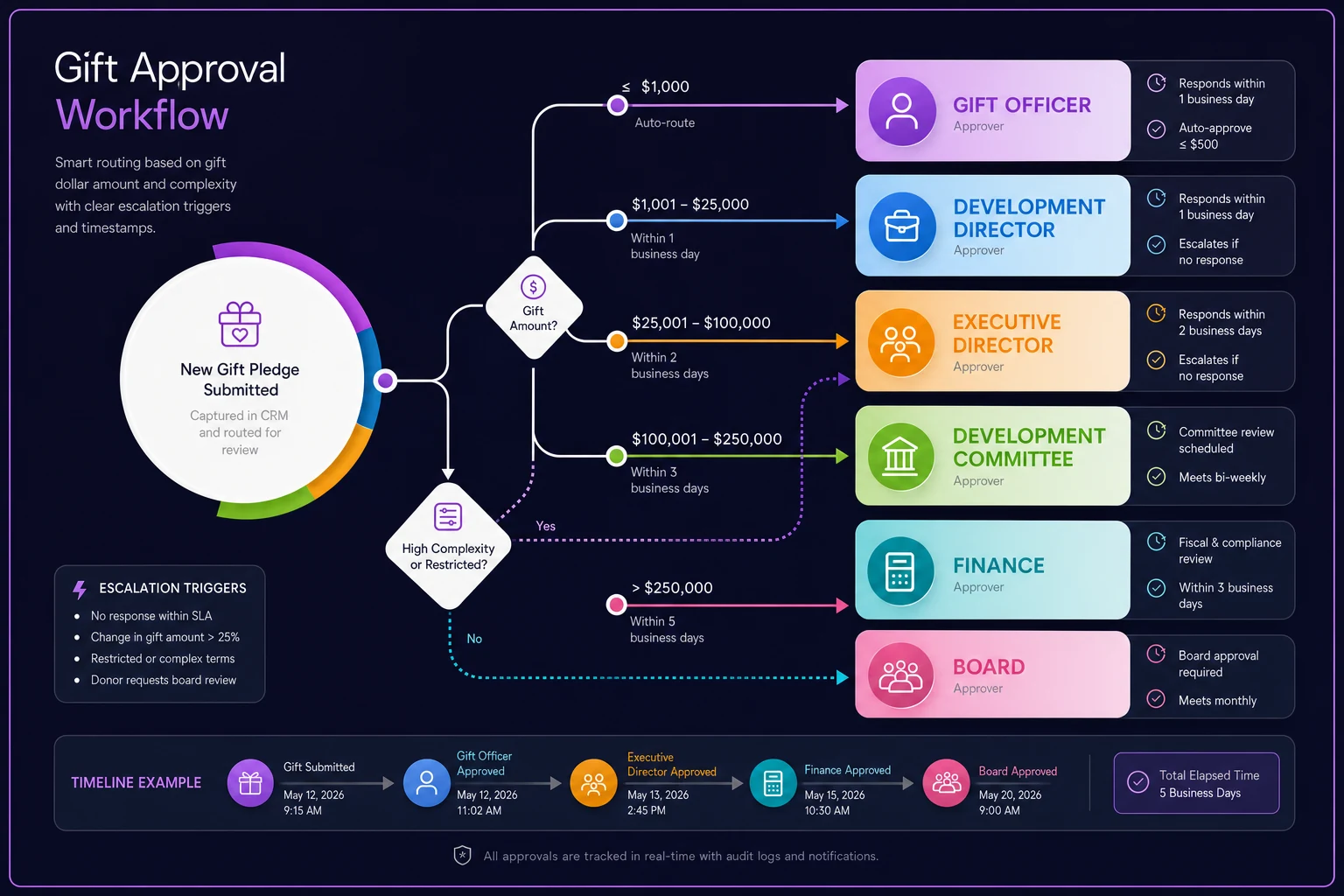
This diagram shows how gifts route through approvals based on amount and complexity.
The escalation ladder: knowing what goes up, and how fast
Approval thresholds handle expected decisions. The escalation ladder handles the ones you didn't plan for — the donor who threatens to pull a pledge, the gift tied to a controversial source, the pattern of declined credit cards signaling a reforecasting problem.
-
Level 1 — Operational (resolve within 48 hours) Routine issues handled by staff. Failed recurring payments, data discrepancies, standard donor complaints. Logged, not escalated.
-
Level 2 — Managerial (resolve within 1 week) Issues affecting a donor relationship or a reporting deadline. Disputed gift amounts, restriction ambiguity, vendor performance problems. Goes to Dev Director or Finance Manager.
-
Level 3 — Executive (resolve within [X] days) Issues with financial, legal, or reputational exposure. Potential gift reversal above a set amount, restriction conflicts, compliance gaps. Goes to ED, who decides whether it rises further.
-
Level 4 — Board/Committee (next meeting or emergency session) Material risk to the organization. Large gift reversals, donor litigation threats, acceptance of a gift that implicates the org's reputation, significant fund misallocation. Goes to the appropriate committee chair or full board.
The failure mode here is almost always Level 2 getting stuck. Staff know something's off but it doesn't feel big enough to bother the ED, so it sits. By the time it surfaces, the restriction was already violated or the donor already walked. The fix is making escalation a normal, non-punitive act — people escalate more readily when it isn't treated as admitting failure.
Your fundraising risk register and escalation ladder should reference each other directly. The risk register tells you what could go wrong; the escalation ladder tells you what to do when it does. Organizations that maintain one without the other end up either cataloging risks they never act on, or reacting to problems they never anticipated.
Role descriptions that actually prevent gaps
Job descriptions and governance role descriptions are different documents. A job description tells someone what they do day to day. A governance role description tells everyone else what that person can decide, approve, and be held accountable for.
The gap between these two is where responsibility evaporates. "I thought finance tracked restrictions." "I thought development confirmed the acceptance." "I thought the committee signed off." Every one of those statements points to a missing governance role description.
-
- Decision authority (tied to the approval matrix)
-
- Approval rights and limits
-
- Escalation obligations (what this role must escalate, not may)
-
- Reporting responsibilities (to whom, how often)
-
- Conflict-of-interest boundaries
A Chief Development Officer governance role description, for example, would specify: may accept unrestricted gifts up to the matrix threshold; must escalate any gift with conditions outside policy; is accountable for reporting pipeline health quarterly to the Development Committee; may not approve vendor contracts above a set amount without finance co-sign.
That last point connects to procurement. If your development team selects fundraising vendors, the governance model needs to define who approves those contracts and at what thresholds — same discipline you'd apply to gifts. The vendor selection and SLA playbook pairs naturally here, because an approval matrix that governs gifts but ignores spending is only doing half the job.
What changes when the model is actually in place
Consider a regional health nonprofit, annual revenue in the $6M–$7M range, development team of five. Before building a governance model, approvals were informal — the ED signed off on "big" gifts, but "big" was never defined. Restriction tracking lived in a spreadsheet one person maintained. There was a board development committee, but its charter was two sentences long and it mostly reviewed reports after the fact.
The breaking point: a $220k gift came in restricted to a capital project that had been quietly deprioritized. Because no approval threshold required committee review and no escalation trigger flagged the restriction conflict, the gift was accepted and partially spent on operating costs before anyone caught it. Unwinding it took months, a correction with the donor, and an uncomfortable audit note.
After the cleanup, they built the actual artifacts: a two-page committee charter with decision rights, an approval matrix keyed to both dollar amount and gift complexity, a four-level escalation ladder, and governance role descriptions for the five key seats. They wired dollar thresholds into their gift-intake workflow so restricted gifts above $50k couldn't be marked accepted without a recorded committee sign-off.
The measurable change wasn't dramatic in the way a revenue chart is dramatic. Over the following year: zero restriction-handling errors reaching audit, major gift decisions moving faster because people knew exactly who decided what, and a board spending committee time on strategy instead of cleaning up operational messes. The qualitative shift mattered more than any single metric — leadership stopped being surprised by its own fundraising.
When a full governance model makes sense — and when it's overkill
Not every organization needs all four layers formalized.
This makes sense when:
-
You're accepting gifts complex enough to carry restriction or valuation risk (planned gifts, securities, real estate, in-kind of meaningful value).
-
Your annual revenue has grown past the point where one or two people hold all the institutional knowledge.
-
You've had at least one "how did that happen" moment around an approval or restriction.
-
You're entering a campaign where large, conditional gifts are expected.
This is overkill when:
-
You're a sub-$500k organization with a handful of straightforward cash gifts and no staff — a lightweight gift acceptance policy and clear ED authority is enough.
-
You'd be building charters for committees that don't functionally exist.
Who should NOT do this: Organizations trying to use governance artifacts to fix a trust or culture problem. If your board doesn't trust your ED, or your finance and development teams are openly at odds, a new approval matrix won't fix it — it'll just become another document to argue over. Governance encodes trust; it doesn't manufacture it.
Building it without drowning in paperwork
The reason most governance models stay theoretical is that building all of this at once feels enormous. A practical sequence:
-
Start with the approval matrix. It resolves the most immediate risk and forces conversations about where authority actually sits.
-
Write the escalation ladder next. Short, four levels, with triggers and timeframes.
-
Formalize one or two committee charters — whichever committees actually meet and make decisions.
-
Draft governance role descriptions for the three to five seats that hold real authority.
-
Wire the thresholds into your workflow so the model enforces itself instead of relying on memory.
-
Review annually, and after any incident, treat the gap as a reason to update an artifact.
The goal isn't a thick binder. It's a thin set of documents that everyone actually knows and uses, backed by workflows that make following the model easier than circumventing it.
A fundraising governance model earns its keep in the moments you can't predict — the surprise gift, the awkward restriction, the donor who changes the terms at the last minute. When those moments arrive, the organizations that handle them well aren't the ones with the best intentions. They're the ones who decided, in advance and on paper, who gets to say yes.
Ready to elevate your fundraising efforts?
Join 2,000+ nonprofits using Givioly to save time, increase donations, and build lasting donor relationships.