


Two months ago, a food bank director called me in a panic. Their auditor had just flagged $180,000 worth of in-kind donations as "unverifiable." Not missing. Not stolen. Just... unverifiable. The donations existed—pallets of food, donated services, equipment—but their paper trail looked like someone threw confetti in a hurricane.
This wasn't incompetence. Their team worked incredibly hard tracking in-kind donations. But somewhere between receiving a truckload of canned goods and reporting it to their board, the operational workflow broke down completely.
Why tracking in-kind donations turns into operational chaos
Most nonprofits treat in-kind donations like an afterthought. Cash comes first, then maybe pledges, and somewhere at the bottom sits that donated office furniture or pro bono legal services.
The food bank's problem started simple enough. Different departments valued donations differently. The warehouse team counted cases of soup. The programs team counted meals served. Finance counted wholesale value. Development counted retail value for donor acknowledgments.
By month-end, nobody could reconcile anything. One pallet of donated protein bars showed up as:
-
480 units in the warehouse system
-
960 servings in program reports
-
$1,200 wholesale value in accounting
-
$2,880 retail value on the donor's receipt
Four different numbers. All technically correct. None matching.
This happens because nonprofits typically bolt together disconnected processes instead of building an actual operational workflow. The warehouse uses one system, development uses another, finance uses spreadsheets, and programs track things on paper. When audit time comes, you're trying to reconcile data that was never meant to work together.
Building chain-of-custody documentation that actually works
Chain-of-custody sounds fancy but it's really just tracking who touched what, when. The food bank thought they had this covered with their receiving logs. They didn't.
Simplify donor management and fundraising workflows.
Givioly helps you organize campaigns, engage donors, and maximize fundraising impact seamlessly.
- Unified donor profiles
- Real-time donation tracking
- Automated impact reporting
No credit card required
Their receiving log showed:
-
Date received
-
Donor name
-
Item description
-
Signature
Seems complete, right? Except it missed the operational reality of how donations actually move through a nonprofit.
When that protein bar pallet arrived, here's what happened: The driver dropped it at the loading dock. A volunteer moved it to temporary storage. Two days later, warehouse staff sorted it. Some went to the emergency pantry. Some went to the mobile food program. Some stayed in reserve inventory. Each movement happened without documentation.
By the time finance tried to reconcile, those protein bars had been split across three programs, partially distributed, and nobody could trace the original donation to its final use.
The four-point custody tracker
Here's a simple visual of the custody workflow.
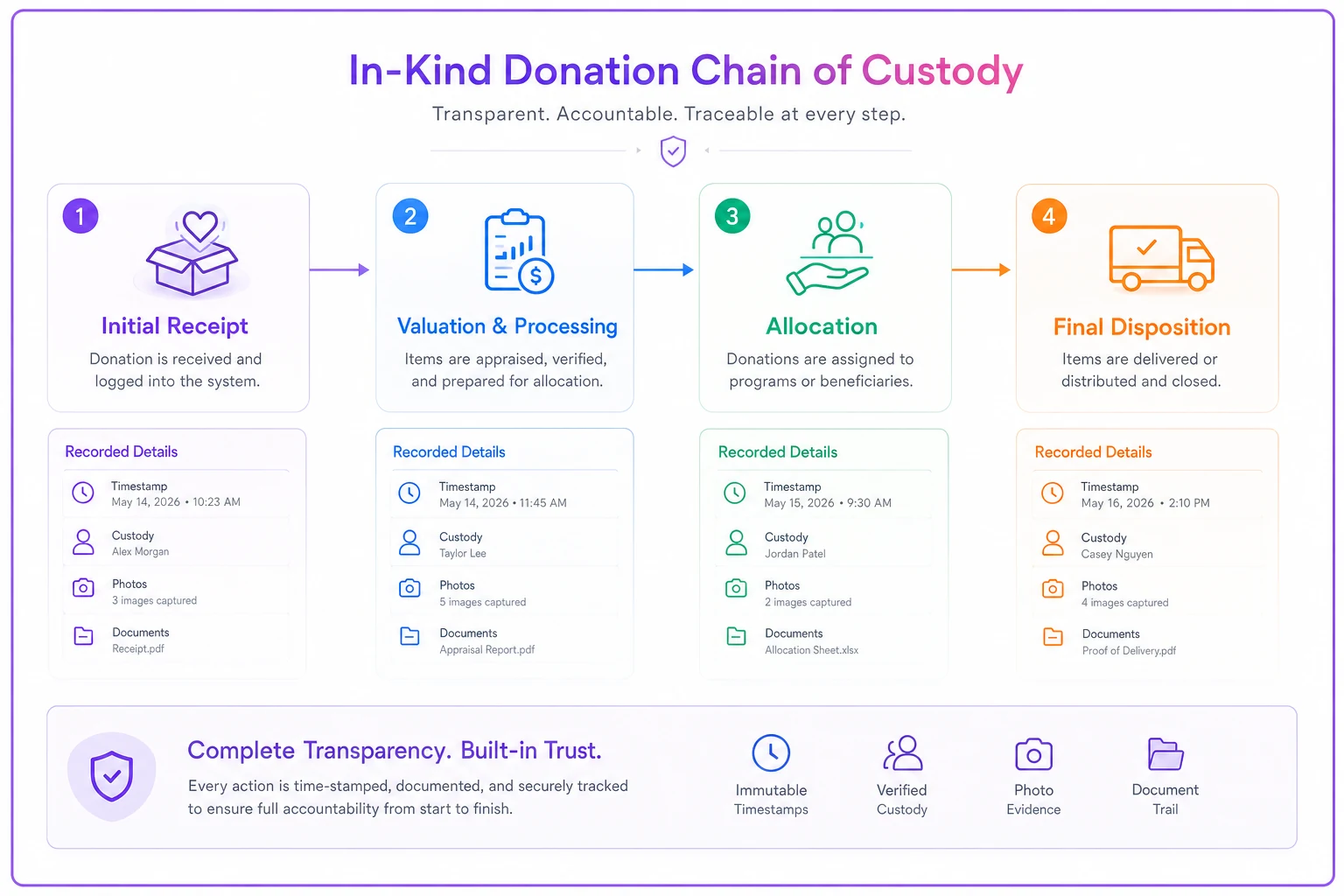
Point 1: Initial Receipt Document the moment anything arrives. Not later. Not after sorting. The actual moment. Include:
-
Exact time and date
-
Who physically received it
-
Immediate storage location
-
Photo of condition
-
Donor's stated value (if any)
Point 2: Valuation and Processing Within 24 hours, assign official value and process into inventory:
-
Internal valuation method used
-
Supporting documentation (comparable sales, wholesale prices, hourly rates)
-
Processing location
-
Who performed valuation
-
System entry confirmation
Point 3: Allocation When items move to programs:
-
Quantity moved
-
Destination program/location
-
Purpose code (direct service, fundraising, operations)
-
Partial or complete transfer
-
New custody owner
Point 4: Final Disposition How items ultimately left your control:
-
Distribution to clients
-
Use in programs
-
Disposal/expiration
-
Transfer to other organizations
Each point needs a timestamp and name. No exceptions.
Valuation methods that survive scrutiny
Valuing in-kind donations incorrectly can destroy your credibility faster than almost any other mistake. The IRS has specific rules. Auditors have expectations. Donors have opinions. And they rarely align.
Let me show you how valuation actually breaks down for different donation types:
| Donation Type | Common Mistake | Proper Valuation Method | Documentation Needed |
|---|---|---|---|
| Professional services | Using donor's retail rate | Hourly rate for similar local services | Written scope, time logs, comparable quotes |
| Used clothing | Thrift store prices | Condition-based pricing guides | Item count by category, condition assessment |
| Food products | Retail grocery prices | Wholesale or feeding program values | Product codes, weight/unit counts, USDA guides |
| Event space | Venue's published rates | Actual rental value for your specific use | Rental agreement, comparable venues, actual usage |
| Volunteer time | Minimum wage | Skill-appropriate wages | Role descriptions, time tracking, wage surveys |
The food bank's mistake was using retail values for everything because it made their impact look bigger. Until the auditor asked for supporting documentation.
The "Tuesday Test" for valuations
Could someone else reproduce your valuation on a random Tuesday six months from now?
-
What legal work was performed
-
Why $300/hour was appropriate
-
Who did the work and when
-
How you tracked the hours
Better documentation looks like: "Estate planning services provided by Johnson Law Firm between March 3-15. 40 hours logged on attached timesheet, signed by Jessica Johnson, JD. Hourly rate based on average of three local firms for similar services (quotes attached): $280, $300, $320. Used middle value of $300."
Monthly reconciliation that prevents year-end disasters
The nonprofit sector waits until year-end to reconcile in-kind donations. By then, the volunteer who received that computer donation in February has moved to another state, nobody remembers why you valued those consulting services at that specific rate, and half your documentation lives in someone's personal email.
Monthly reconciliation isn't about perfection. It's about catching problems while you can still fix them.
The three-column reconciliation
Column 1: What Came In Everything received, pulled directly from your receiving logs. No filtering, no adjustments. Raw data.
Column 2: What Got Processed Everything formally valued and entered into your systems. Should match Column 1, but it never does perfectly.
Column 3: What Got Used Everything distributed, consumed, or allocated to programs.
The gaps between columns tell you exactly where your process breaks:
-
Column 1 > Column 2
You're receiving faster than processing
-
Column 2 > Column 3
Inventory building up or data entry errors
-
Column 3 > Column 2
You're distributing things not properly recorded
The food bank discovered they had $30,000 worth of donations sitting in their warehouse that never got formally processed. Not lost—just sitting in operational limbo between receiving and official inventory.
The Friday afternoon cleanup ritual
Pick the last Friday of each month. Block two hours. No exceptions.
-
Review every in-kind donation from that month
-
Does initial receipt match final documentation?
-
Can you trace custody from arrival to use?
-
Do all valuations have supporting docs?
-
Are program allocations recorded?
Fix discrepancies immediately. Not next week. Not after the board meeting. That same Friday.
Put the Friday cleanup on everyone's calendars and protect that time.
This ritual catches small problems before they compound. The food bank started this after their audit scare. Within three months, their reconciliation time dropped from days to hours.
Technology coordination without expensive overhauls
Most nonprofits can't afford to replace everything at once. You're stuck with that donor database from 2015, the accounting system your board member's cousin set up, and spreadsheets held together with formulas nobody understands anymore.
You don't need to replace everything. You need connection points.
The food bank used four different systems that couldn't talk to each other. Instead of replacing them all, we built simple bridges:
Bridge 1: Donation ID Numbers Every in-kind donation gets a unique ID at receipt: YEAR-MONTH-TYPE-SEQUENTIAL
Example: 2024-03-FOOD-047
Bridge 2: Central Status Tracker One spreadsheet (yes, a spreadsheet) tracking just the status of each donation:
-
ID number
-
Current location/status
-
Last update
-
Next required action
-
Responsible person
Updated daily. Accessible to everyone. No complex formulas—just a simple status board.
Bridge 3: Document Repository Create one folder per donation ID. Everything goes there:
-
Initial receipt
-
Photos
-
Valuation documents
-
Movement logs
-
Final disposition
When auditors ask about donation 2024-03-FOOD-047, everything's in one place.
This isn't elegant. But it works without requiring new software, extensive training, or board approval for technology spending.
When small improvements compound into big results
Six months later, the food bank's operations transformed. Not through some massive technology overhaul or consultant-driven reorganization. Just through small, consistent operational improvements.
Their next audit? Zero findings on in-kind donations.
But the real win was operational. Program staff stopped hoarding donations because they trusted the tracking system. Development could instantly pull accurate donation reports for grant applications. Finance cut month-end closing from 8 days to 3 days.
The warehouse manager told me: "We're not working harder. We're just not re-doing everything three times anymore."
That's what good operations feel like. Not revolutionary. Just smoother.
The reality of building sustainable tracking systems
Building a sustainable system for tracking in-kind donations requires accepting some uncomfortable truths.
First, your volunteers will turn over. That amazing retired accountant who perfected your valuation process will eventually stop volunteering. Your system needs to survive without any single person.
Second, donation patterns change. The food bank used to get mostly canned goods. Now they get more fresh produce, which requires different handling, valuation, and tracking. Your system needs flexibility without losing structure.
Third, perfect documentation is a fantasy. You'll have donations where the driver just drops stuff and leaves. Volunteers who forget to log transfers. Valuations based on "this seems about right." Your system needs to handle imperfection without falling apart.
AI-powered operational platforms start making sense here—not as a magic solution but as a consistency layer. Automated reminders when donations sit unprocessed. Flagging when valuations seem off. Catching when chain-of-custody breaks. The technology handles the repetitive checking while your team focuses on actually serving your mission.
But whether you use advanced software or sticky notes, the principles remain the same: create clear custody chains, document valuations properly, reconcile monthly, and build bridges between your existing systems.
Making this actually stick in your organization
Changing how an entire organization tracks donations isn't a technical challenge. It's a cultural one.
The food bank's breakthrough came when they stopped treating in-kind tracking as a compliance burden and started seeing it as operational intelligence. When you know exactly what donations you have, where they are, and how they're being used, you make better decisions.
Start small. Pick one type of in-kind donation—maybe food, or professional services, or whatever causes you the most headaches. Implement the four-point custody tracker just for that category. Get one clean month of reconciliation. Then expand.
Don't announce a grand new tracking initiative. Just start doing it. When people see the monthly reconciliation catching problems early, when the audit goes smoothly, when grant reports suddenly become easier to write—that's when buy-in happens.
The food bank director called me last month with an update. They'd just received a surprise donation of a refrigerated truck. Two years ago, this would have sent them into documentation panic. This time? Received, valued, and integrated into their fleet within 48 hours. Full chain-of-custody. Proper valuation documentation. Already reconciled.
"It just... worked," she said.
That's not magic. That's operations. And with the right workflow, nonprofit organizations of any size can get there.
Ready to elevate your fundraising efforts?
Join 2,000+ nonprofits using Givioly to save time, increase donations, and build lasting donor relationships.