


When a disaster hits and your cause suddenly trends, the money doesn't arrive the way your accounting system expects it. It shows up on platforms you've never used, routed through processors you didn't set up, in batches that don't match any campaign code in your chart of accounts. A finance team that runs tight monthly closes can suddenly find itself staring at $40k sitting in a clearing account with no idea which GL code it belongs to, who the donors are, or whether any of it is restricted.
This runbook covers the first 30 days of that chaos — specifically, how to get emergency inflows tagged, provisionally coded, and reconciled before your auditors or your board start asking questions you can't answer.
The specific problem: money arrives faster than your coding can
Here's the exact failure mode worth naming.
A mid-sized relief nonprofit has a clean setup for its normal channels — website donations, recurring gifts, a couple of P2P events. Everything maps to known GL codes. Then a flood or wildfire pushes your organization into the news. Within 48 hours you've got inflows from:
-
A celebrity's Instagram fundraiser routing through Meta/PayPal Giving Fund
-
A corporate match campaign running on Benevity
-
A GoFundMe someone started "for" you without asking
-
A TikTok livestream donation that lands via a processor you've never reconciled
None of these have a campaign code. None of them map cleanly. And the payout timing is all over the place — some platforms hold funds 15–45 days, some batch weekly, some send a lump sum with a spreadsheet attached three weeks later.
The real problem isn't the volume. It's that your coding logic assumes you know the source before the money moves. In an emergency, the money moves first.
Why provisional coding beats waiting
The instinct of a careful finance person is to hold everything in a suspense account until you know exactly where it belongs. That instinct is wrong during a surge.
Simplify donor management and fundraising workflows.
Givioly helps you organize campaigns, engage donors, and maximize fundraising impact seamlessly.
- Unified donor profiles
- Real-time donation tracking
- Automated impact reporting
No credit card required
If you park everything in one undifferentiated clearing account for three weeks, you lose the ability to reconcile incrementally. By the time payout files arrive, you've got $60k–$80k of mixed inflows and no breadcrumbs. Now you're reverse-engineering source attribution from PayPal transaction IDs at 11pm before close.
The better approach is immediate tag mapping with temporary GL codes — code it provisionally the moment it lands, flag it as provisional, and resolve it on a scheduled cadence. You trade a little upfront tagging work for a reconciliation process that doesn't collapse under volume.
What actually works: a small set of temporary GL codes specifically reserved for emergency inflows, each tied to a platform and a restriction assumption, with a hard rule that nothing provisional survives past 30 days without being resolved or escalated.
The temporary GL code structure
Don't create a code per donor or per campaign in the moment — you'll never clean it up. Create a small, reusable set of emergency holding codes that you can map confidently and resolve later.
| Temp GL Code | Purpose | Default Restriction Assumption | Resolution Target |
|---|---|---|---|
| 1910-EMG-PENDING | Unidentified emergency inflow, source unknown | Treat as restricted to disaster until proven otherwise | 7 days |
| 1911-PLAT-PAYPAL | PayPal Giving Fund / Meta inflows awaiting payout file | Restricted – disaster campaign | 30 days (payout cycle) |
| 1912-PLAT-BENEVITY | Corporate/matching platform inflows | Restricted unless match terms say otherwise | 30 days |
| 1913-PLAT-P2P | Third-party fundraisers (GoFundMe, personal pages) | Restricted – disaster | 30 days |
| 4910-EMG-REV-PROV | Provisional revenue recognition holding | Mirrors asset restriction | Resolved at reclass |
Two things make this work. First, the default restriction assumption is conservative — you assume emergency money is restricted to the disaster until the facts prove otherwise. It's far easier to release a restriction you over-applied than to claw back money you spent as unrestricted and then discover a donor designated it.
Second, each code carries an explicit resolution target, so provisional entries have an expiration date baked in.
Immediate tag mapping: what to capture at intake
The moment an emergency inflow is identified, it needs a tag record. This isn't accounting yet — it's the metadata layer that makes accounting possible later.
A minimum viable tag record:
-
Platform source (PayPal GF, Benevity, GoFundMe, direct processor)
-
Date landed vs. expected payout date
-
Gross vs. net (platform fees matter enormously here — some net out 2–5%, some don't)
-
Restriction flag (disaster-restricted / unrestricted / unknown)
-
Matching flag (is this a corporate match that needs employer verification later?)
-
Donor-identifiable? (yes/no — many P2P and platform gifts arrive anonymized)
-
Temp GL code assigned
-
Provisional recognition status
The field that gets forgotten most often is the gross-vs-net flag. A platform might show you $50,000 raised but only remit $47,300 after fees. If you recognized revenue at gross without tracking the fee, your reconciliation never ties out. During a normal month you'd probably catch this. During a surge with six platforms running simultaneously, you won't — unless you capture it at intake.
Prioritize capturing gross-vs-net at intake to avoid fee reconciliation surprises.
If you're building this on top of an existing reconciliation process, it should slot directly into the structure you already use for matched and unmatched gifts. The same discipline from an audit-ready donation reconciliation workflow applies here — you're just adding an emergency-specific tagging layer on top.
Here's a simple workflow for tagging to reconciliation.
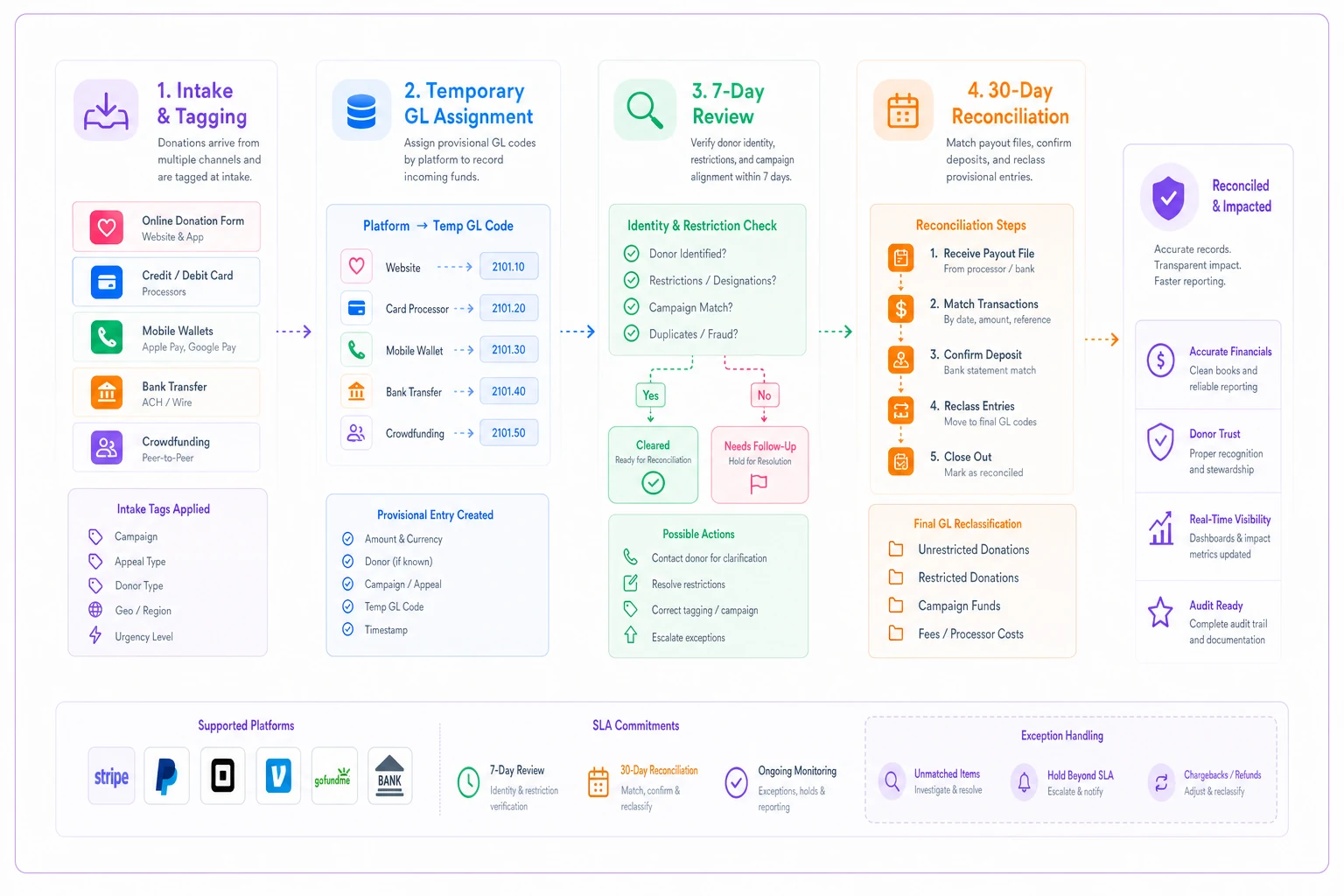
Use this as a reference when you set up intake forms and reconciliation steps.
The 7-day and 30-day validation cadence
The whole runbook hinges on two review checkpoints. Not daily (you don't have the staff during a crisis), not monthly (too slow to catch problems while payout files are still fresh).
Day 7 review — identity and restriction
-
Do we know what this actually is? Source confirmed, platform identified, payout timing understood.
-
Is our restriction assumption still correct? If a corporate match agreement or a platform's terms say the money is unrestricted, you reclass now instead of carrying a wrong assumption for a month.
Anything still sitting in 1910-EMG-PENDING after 7 days gets escalated. Unidentified money a week after it landed is a red flag — it usually means a platform payout file is missing or a processor wasn't configured to send detail.
Day 30 review — recognition and reconciliation
-
Match platform payout files to the temp GL entries
-
Reclass provisional revenue to permanent restricted/unrestricted codes
-
Confirm net-of-fee amounts tie to actual bank deposits
-
Clear temporary GL codes back toward zero
-
Flag anything still unresolved for a named owner with a deadline
The 30-day mark matters because it usually aligns with your month-end close and with most platform payout cycles finally completing. Money that landed in week one has had time to actually hit your bank.
Reconciliation checklist for emergency inflows
Run this at both the 7-day and 30-day checkpoints. It's deliberately short so it actually gets done during a busy period.
-
Every emergency inflow has a temp GL code and a tag record
-
Gross and net amounts captured; fee variance documented
-
Restriction assumption confirmed or corrected against platform/match terms
-
Payout file obtained for each platform (or escalation logged if missing)
-
Bank deposits matched to expected payouts by platform batch
-
Nothing in
1910-EMG-PENDINGolder than 7 days -
Provisional revenue reclassed where source is confirmed
-
Anonymized/donor-unidentifiable gifts flagged for acknowledgment handling
-
Non-cash or securities inflows routed to the proper intake path, not jammed into cash codes
-
Unresolved items assigned to a named owner with a date
That last item about non-cash matters more than people expect. Emergency surges sometimes bring stock gifts, crypto, or in-kind pledges mixed into the noise. Those don't belong in your temporary cash holding codes at all — route them through your securities and non-cash gift intake checklist so they get valued and recorded correctly instead of distorting your cash reconciliation.
A real scenario: the three-week payout gap
A disaster-relief organization with a two-person finance team saw its typical monthly online inflow of roughly $30k jump to around $240k over 11 days after a hurricane. The money came through five channels, and three of them had payout holds of 15–40 days.
The first instinct was to dump everything into a single clearing account and sort it out at month-end. That lasted about four days before it became unmanageable — they couldn't tell which deposits corresponded to which platform, and two payout files arrived with no campaign reference at all.
Switching to temporary platform-specific GL codes plus a tag record at intake changed things considerably. At the day-7 review they caught that roughly $18k of the "donations" were actually a corporate match that was unrestricted, not disaster-restricted — which, had it gone unnoticed, would have understated their flexible funds for a full month. At day 30, reconciliation tied out to within a few hundred dollars (a fee variance they'd documented at intake), instead of the multi-week scramble they'd braced for.
The outcome wasn't dramatic in dollar terms. It was dramatic in control — they went into their close knowing where every chunk of money sat, instead of guessing.
When this runbook makes sense — and when it doesn't
When it's worth standing up: You're an organization that could plausibly receive a disaster or news-driven surge — relief work, animal welfare, anything that goes viral during a crisis. If you can imagine a 5x–10x inflow spike landing on platforms you don't normally use, pre-building this saves you during the one week you can least afford to improvise.
When it's overkill: If your giving is steady, channel-predictable, and you've never had a surprise third-party inflow, you don't need dedicated emergency GL codes sitting in your chart of accounts. Build the tag-record habit, but don't over-engineer.
Who should not try to wing this live: Single-person finance shops that have never reconciled platform payout files. If that's you, the time to set up the temp codes and the two-checkpoint cadence is before the surge, as a dormant procedure. Learning the mapping while $200k floods in is how misstatements happen.
Where automation earns its place
Most of this is judgment work that shouldn't be automated — restriction assumptions, escalation decisions, matching platform terms. But the mechanical parts drown small teams during a surge, and that's where an AI-assisted reconciliation layer genuinely helps.
Auto-tagging inflows by platform signature, flagging gross-vs-net mismatches, surfacing anything in the pending code past its 7-day deadline, matching payout files to expected deposits — these are exactly the kinds of repetitive, volume-sensitive tasks that software handles better than an exhausted two-person team at close. The goal isn't to hand coding decisions to software. It's to let the system carry the tracking burden so your people can spend their attention on the handful of judgment calls that actually need a human.
Bottom line
Emergency donation accounting breaks down when your coding logic assumes you know the source before the money moves — and in a crisis, the money always moves first.
The fix is provisional: a small set of temporary GL codes with conservative restriction defaults, a tag record captured at intake, and two hard checkpoints at 7 and 30 days that force resolution before the trail goes cold.
Set it up while things are quiet. The surge is not the time to design the system — it's the time to run it.
Set it up while things are quiet. The surge is not the time to design the system — it's the time to run it.
Ready to elevate your fundraising efforts?
Join 2,000+ nonprofits using Givioly to save time, increase donations, and build lasting donor relationships.