

A chargeback is not a data-entry problem. It's a clock starting. The moment a donor's card issuer flags a transaction, you're on a timer set by the processor — usually somewhere between 7 and 20 days depending on the network and whether it's a friendly-fraud claim or a full dispute. Miss the window, and you eat the loss plus a fee, whether or not the gift was legitimate.
Most small fundraising teams don't have a defined response to this. What happens instead is the dispute email lands in a shared inbox, sits for four days because nobody's sure who owns it, and by the time someone responds, half the evidence window is gone and the donor — who often didn't even mean to dispute anything — has already been marked as a problem in the CRM.
This runbook is about the first 72 hours after a dispute hits, and the paper trail you leave behind. Not fraud prevention in general. Not payment processor selection. Just: a gift got disputed, what do you actually do, in what order, and how do you keep a good donor from becoming an ex-donor in the process.
Why disputes on donations are weird (and why generic advice fails)
E-commerce chargeback advice assumes you shipped a product. You've got a tracking number, a signature, a return policy. Donations have none of that. There's no "goods received." The value exchanged is a receipt and, hopefully, a feeling.
That changes the entire evidence game. A processor evaluating a donation dispute isn't asking "did the customer get their thing." They're asking "did this person authorize this charge." So your evidence has to prove authorization and intent, not delivery.
Here's the split we see most often in the disputes that actually reach small nonprofits:
| Dispute type | What actually happened | Recoverable? | Right response |
|---|---|---|---|
| Genuine fraud | Stolen card used on your form | No, and you shouldn't fight it | Accept, refund, review form security |
| Friendly fraud | Donor forgot, spouse didn't recognize, or recurring gift surprised them | Usually yes | Fight with evidence + reach out |
| Buyer's remorse | Donor regrets amount, disputes instead of asking for refund | Sometimes | Offer refund proactively, preserve relationship |
| Recurring confusion | Monthly gift they forgot they set up | Very often yes | Evidence + immediate contact |
| Descriptor mismatch | Your bank statement name ≠ your org name | Yes, and it's your fault | Fight, then fix your descriptor |
That last row is the quiet killer. If your legal entity is "Riverside Community Health Initiative" but donors see "RCHI SVCS LLC" on their statement, you will generate disputes forever. A meaningful share of "fraud" claims on small-nonprofit gifts are just people not recognizing the charge. Fixing the statement descriptor is a 20-minute call with your processor that eliminates a whole category of disputes entirely.
The first-72-hours triage sequence
The whole point of a runbook is that nobody has to think creatively under time pressure. Here's the order of operations from the moment a dispute notification arrives.
Simplify donor management and fundraising workflows.
Givioly helps you organize campaigns, engage donors, and maximize fundraising impact seamlessly.
- Unified donor profiles
- Real-time donation tracking
- Automated impact reporting
No credit card required
-
Log it immediately (within the hour it's seen). Create a dispute record with: transaction ID, dispute date, response deadline, gift amount, donor ID, campaign, and the reason code the processor gave you. That deadline field is non-negotiable — it drives everything downstream.
-
Classify using the table above. Two minutes. Decide whether you're fighting, refunding, or accepting. Don't default to "fight everything." Fighting a genuine-fraud claim wastes hours and can flag your account with the processor.
-
Pull the donor's full history before you contact anyone. First gift or 8-year sustainer? A first-time $40 gift and a $2,000 recurring donor get very different handling. Look at prior gifts, past disputes, and whether the email/receipt bounced.
-
Assemble evidence in parallel (don't wait). This runs at the same time as donor outreach, not after. More on the evidence checklist below.
-
Contact the donor — but only for the right categories. Friendly fraud, recurring confusion, and remorse cases get a human touch. Genuine fraud does not; you don't email someone whose card was stolen and imply they disputed on purpose.
-
Submit or accept before the deadline, with a buffer. Build in a 48-hour buffer before the actual processor deadline. Processors are not forgiving about late submissions, and portals go down.
-
Record the outcome and update the donor record. Won, lost, refunded — plus a flag that prevents this donor from getting a tone-deaf appeal email next week.
The step people skip is #3, pulling history first. Without it, your outreach email treats a loyal monthly donor like a stranger, and that's how you turn a $25 dispute into a lost $300-a-year relationship.
Here's a simple visual of the 72-hour triage workflow and how the steps map to the deadline.
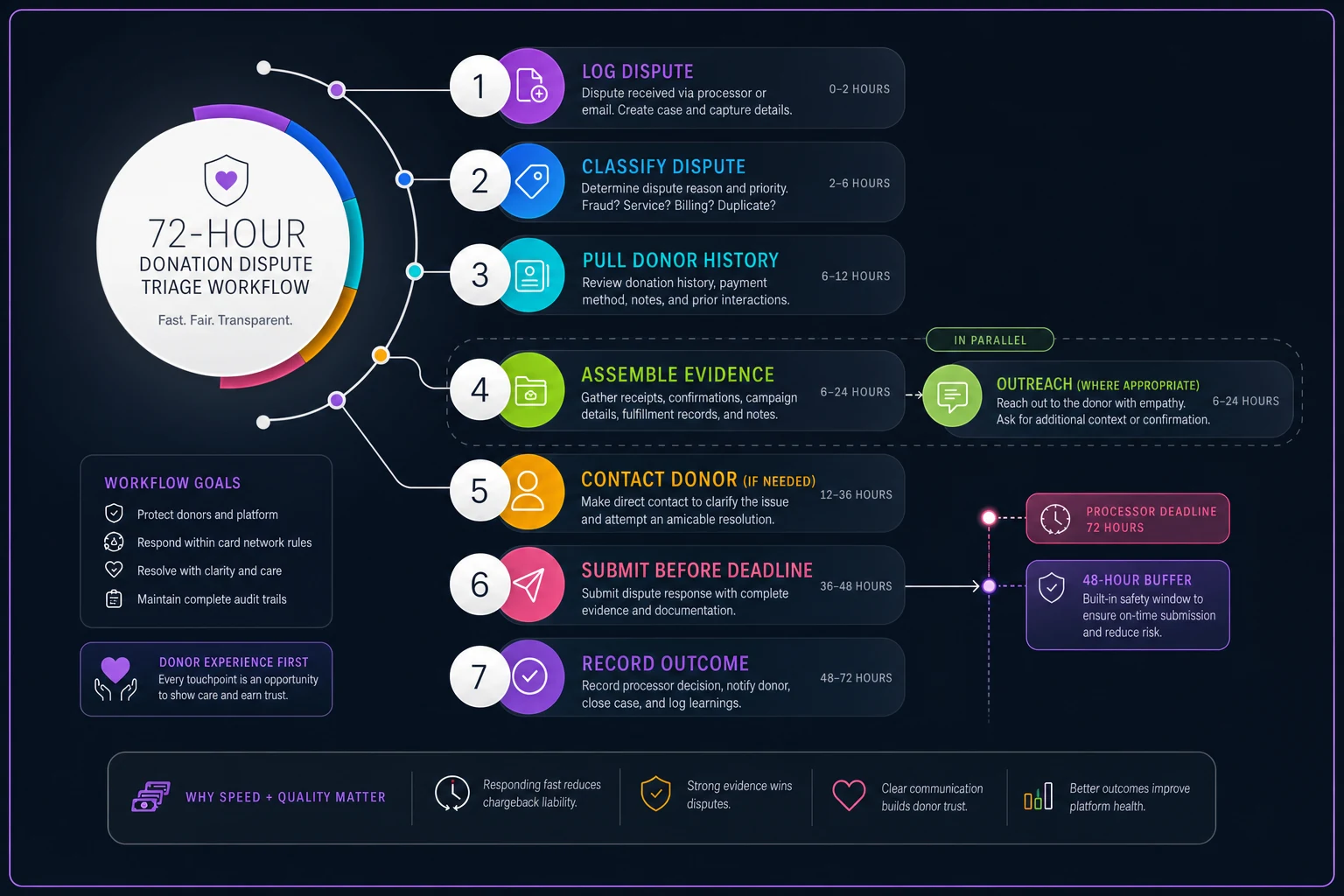
This diagram maps each step to the recommended timing so teams can follow the clock visually.
The evidence checklist for donation chargebacks
When you're building your representment (the formal response to the dispute), you're assembling a case for authorization. Here's what actually moves the needle, roughly in order of weight:
-
AVS and CVV match results from the original transaction. If both matched, that's strong evidence the physical card and cardholder info were present.
-
IP address and device data captured at donation time, ideally geolocating near the donor's known address.
-
The donation form's consent language and timestamp — the exact checkbox text they agreed to, and when.
-
Recurring authorization record, if applicable
the date they set up the recurring gift and the terms shown to them.
-
Prior successful charges to the same card, especially for recurring donors. Nothing says "authorized" like six prior gifts that were never disputed.
-
The receipt/acknowledgment you sent, with the timestamp and the email address it went to.
-
Any donor correspondence — thank-you replies, event RSVPs, anything showing an ongoing relationship.
-
Your refund policy, shown at point of gift, demonstrating the donor had an easier path than a chargeback.
Preserve your form's version history so you can show the exact consent language that applied at the time of the gift.
Two things teams routinely fail to capture: IP/device data (because their form doesn't log it) and the exact consent text as it appeared on the day of the gift. If you've updated your form since then, you need the version history. This is one more reason clean, well-governed records matter — the same discipline covered in our writeup on donor data hygiene and repeatable monthly audits is what makes evidence assembly fast instead of frantic.
Donor-facing templates (the part everyone gets wrong)
The instinct when someone disputes a gift is to either go silent or get defensive. Both are wrong. Most friendly-fraud disputes come from confusion, not malice, and a warm, specific message often gets the donor to withdraw the dispute themselves — which is cleaner and faster than winning a representment.
Tone matters more than the words. Never imply they did something wrong. Assume confusion, offer help, make it easy.
Template A — Suspected recurring confusion (send within 24 hours): > Hi [Name], we noticed a question came up about a recent gift to [Org] on [date] for [$amount]. This was part of the monthly support you set up on [setup date] — thank you for that, it genuinely matters. If this charge caught you by surprise or your circumstances have changed, just reply here and we'll sort it out right away, including pausing or adjusting your gift. No hassle either way.
Template B — Suspected buyer's remorse / amount regret: > Hi [Name], thank you again for your recent gift of [$amount] on [date]. We want to make sure every supporter feels good about their giving. If you'd like a refund or to adjust the amount, just let us know directly — we're happy to take care of it quickly, no explanation needed.
Template C — Genuine fraud confirmed (card compromised): > Hi [Name], it looks like your card may have been used without your permission for a charge to [Org]. We've flagged the transaction and are processing a full reversal. We're sorry this happened and we're reviewing our systems on our end. Please let us know if there's anything else we can do.
Notice Template C accepts the loss and reassures. Fighting a real fraud victim to save $50 is how you generate a one-star review and a complaint to your board. The proactive-refund offer in Template B feels counterintuitive — you're offering to give money back on a gift you might win. But a chargeback costs you a fee plus staff time plus a mark against your dispute ratio. A voluntary refund keeps your ratio clean and often keeps the donor. Sometimes losing the $75 is the better business decision.
Accounting treatment: don't just delete the gift
This is where small teams create audit problems for themselves. When a dispute or chargeback lands, the wrong move is going into the CRM and deleting or editing the original gift so the numbers "look right." Now your books and your processor records disagree, and your auditor has questions you can't answer.
-
Original gift
leave it exactly as recorded, including its receipt and date.
-
Chargeback/refund
record as a separate contra-transaction (a reversal) dated when it actually occurred, linked to the original gift ID.
-
Chargeback fee
record separately as an expense — it's not a reduction of contribution revenue, it's a bank/processing fee.
-
Receipt status
if a tax receipt was already issued and the gift is reversed, you need a process to void or correct it. Issuing a receipt for a gift that got charged back is a real compliance exposure.
For revenue recognition, a reversed gift reduces contribution revenue in the period the reversal happens, not retroactively in the original period — unless it crosses a fiscal year, in which case talk to your accountant. Restricted gifts add a wrinkle: if a chargeback reverses a gift you already released from restriction because you reported it as spent, you've got a cleanup on the net-asset side too.
If any of this feels shaky, it usually means the underlying reconciliation isn't tight. The structure we lay out in the audit-ready donation reconciliation workflow — matching processor payouts to recorded gifts — is what makes disputes a line item instead of a mystery. Disputes are much easier to handle when every gift already ties cleanly to a payout.
SLAs that keep the timer from beating you
The reason disputes get lost isn't laziness. It's that no single person owns the clock, and the deadline is invisible until it's blown. Assigning SLAs fixes both.
-
Acknowledge internally
dispute logged with a deadline within 4 business hours of the notification arriving.
-
Classify + pull history
same business day.
-
Donor outreach (for eligible categories)
within 24 hours.
-
Evidence assembled
within 48 hours.
-
Submit representment
no later than 48 hours before the processor's hard deadline.
-
Outcome recorded + donor flagged
within 24 hours of resolution.
The buffer before the processor deadline is the single most important line. Teams that submit "on the last day" lose winnable cases to portal timeouts and time-zone confusion. Treat the real deadline as 48 hours earlier than it is.
One operational note: dispute deadlines don't care about your weekends or holidays. A notification arriving Friday afternoon before a long weekend can burn three days of a seven-day window. Whoever monitors the dispute inbox needs coverage that accounts for that, or at least an alert that doesn't rely on someone happening to check email.
Where automation genuinely helps (and where it doesn't)
The manual version of this runbook works fine at low volume. The cracks show up when disputes arrive irregularly and the person who knows the process is out, or when you're stitching together the processor portal, your CRM, and a spreadsheet by hand under a deadline.
The parts worth automating are the boring, error-prone ones: pulling the deadline off the processor notification and turning it into a tracked task with escalating reminders, auto-attaching the donor's gift history and prior consent record to the dispute file, and flagging the donor record so no cheerful appeal goes out mid-dispute. Workflow platforms built for fundraising operations can watch the dispute feed, spin up the record, populate the evidence you already have on file, and hold the SLA clock so nobody has to remember it. That's the difference between a dispute being a 15-minute task and a half-day scramble.
What you should not automate is the donor conversation and the fight/refund/accept decision. Those need judgment. A template can draft the outreach; a human should read the donor's history and decide the tone. The classification in that first table is a human call, especially the line between friendly fraud you fight and remorse you refund.
When to fight, when to fold
Not every dispute is worth contesting. A quick decision frame:
Fight it when: you have AVS/CVV matches, prior successful charges from the same card, clear consent records, and the amount justifies the staff time. Recurring-gift disputes from long-term donors are usually the most winnable.
Refund proactively when: it's buyer's remorse, the donor is otherwise valuable, and your dispute ratio needs protecting. A voluntary refund is cheaper than a contested loss.
Just accept it when: it's genuine fraud. Don't fight fraud victims. Accept, reverse, and shore up your form.
Who should not build an elaborate runbook at all: if you're processing a handful of gifts a month and see one dispute a year, a single documented checklist is plenty. Don't over-engineer. The runbook earns its keep when disputes are frequent enough that inconsistency costs you money and relationships.
A real scenario
A regional arts nonprofit running a monthly-giving program of roughly 400 sustainers started seeing a cluster of disputes — around 6 to 8 a month, almost all on recurring gifts in the $20–$50 range. Their statement descriptor showed an abbreviated processing name nobody recognized. Disputes were landing in a shared inbox, getting handled whenever someone noticed, and they were winning maybe a third of the ones they bothered to fight.
Two changes moved the needle. First, they fixed the descriptor to clearly show the org name plus a short "monthly gift" tag — that alone cut the confusion disputes noticeably within a couple of billing cycles. Second, they put the 72-hour sequence in place with a real deadline tracker and a warm outreach email for recurring-confusion cases.
Over the next quarter, disputes dropped by more than half, and of the ones that still came in, a good number of donors withdrew the dispute after the outreach email — because they'd simply forgotten. Recovery on contested cases went from roughly a third to well over half. Nothing dramatic, no software miracle. Just a clear descriptor, a defined clock, and a message that assumed good faith.
Donation disputes feel like an accounting event, but they're really a relationship event with an accounting tail and a deadline. The teams that handle them badly treat every chargeback as a loss to be quietly written off. The teams that handle them well have a short, boring, repeatable sequence: log the clock, classify honestly, pull history, reach out warmly where it's appropriate, keep the books clean, and never let the timer beat them.
Build the runbook once, fix your statement descriptor this week, and most of your disputes stop being emergencies. The rest become fifteen-minute tasks with a paper trail your auditor will actually thank you for.
Ready to elevate your fundraising efforts?
Join 2,000+ nonprofits using Givioly to save time, increase donations, and build lasting donor relationships.