


This piece is about building a service-level agreement (SLA) matrix for acknowledgements — a same-day / 7-day / 30-day framework tied to gift type and payment method — plus the templated receipt language each type actually requires, and a few low-code automation triggers that keep the whole thing from slipping. Not a list of tips. A system.
Why "we sent it eventually" is quietly costing you renewals
Most small nonprofits don't have an acknowledgement problem in the way they think they do. They assume it's a speed issue — that thank-yous go out late. The real problem is that acknowledgement gets treated as one undifferentiated task instead of a set of different obligations, each with its own deadline, legal language, and level of donor sensitivity.
A $25 online gift, a $10,000 stock transfer, a $5,000 grant disbursement, and a check that showed up in the PO box with a sticky note attached are not the same event. But in a lot of orgs, they all funnel into the same vague intention: "we'll thank them this week." That's where things quietly break — and it gets worse the more you grow.
The core idea: acknowledgement is a promise, so treat it like one
An SLA is just a promise with a deadline attached. When you say "donors get thanked promptly," that's not a promise anyone can hold you to. When you say "online credit-card gifts get an emailed receipt within 5 minutes, and any gift over $1,000 gets a personal call within 48 hours," now you have something operational.
Simplify donor management and fundraising workflows.
Givioly helps you organize campaigns, engage donors, and maximize fundraising impact seamlessly.
- Unified donor profiles
- Real-time donation tracking
- Automated impact reporting
No credit card required
The reason this matters isn't customer service theater. Acknowledgement timing is one of the few donor-facing moments you fully control, and it correlates with second-gift behavior. A first-time donor who gets a warm, correct acknowledgement fast is measurably more likely to give again than one who waits two weeks and gets a generic form letter with their name misspelled.
The pattern worth internalizing: different gift types fail in different ways. Online gifts fail silently — the auto-receipt never fired. Stock and non-cash gifts fail legally — wrong or missing language on the receipt. Offline checks fail invisibly — nobody logged it for six days. A single SLA can't catch all three because the failure modes aren't the same.
Building the SLA matrix
The matrix has two axes: response tier (same-day, 7-day, 30-day) and gift/payment type. The response tier isn't only about speed — it's about what happens and who does it. Same-day usually means an automated receipt plus a flag for human follow-up. The 7-day and 30-day tiers are where personal, non-automated touches live.
Here's a working version you can adapt:
| Gift / Payment Type | Automated Receipt SLA | Personal Acknowledgement SLA | Owner | Notes |
|---|---|---|---|---|
| Online credit/debit (under $250) | Same-day (immediate email) | Optional 30-day batch | System | Watch for silent receipt failures |
| Online credit/debit ($250–$999) | Same-day | 7-day email or note | Dev/Gift Officer | Crosses IRS $250 substantiation line |
| Major gift ($1,000+) | Same-day | 48 hours (call) + 7-day letter | ED / Major Gifts | Personal touch drives retention |
| Recurring / monthly | Same-day first gift; annual summary | Onboarding at day 3 | System + Dev | Don't re-thank every month |
| Offline check | Within 3 days of logging | 7-day letter | Gift Entry | Failure point is logging, not sending |
| Stock / securities | Within 5 days of receipt | 7-day letter (no value stated) | Finance + Dev | Special language required |
| In-kind / non-cash | Within 7 days | 7-day letter (describe, don't value) | Gift Entry | Never state a dollar value |
| Grant / restricted | 7-day formal acknowledgement | 30-day if reporting terms apply | Grants Manager | Tie to restricted-fund tracking |
| Event / auction | Within 7 days | 30-day for high-value | Events team | Split gift vs. fair-market value |
Two things stand out when orgs first build this. The "owner" column is where most of the arguments happen — because until now, ownership was ambiguous, which is exactly why gifts slipped. And people are often surprised that automation only covers the same-day tier. The 7-day and 30-day tiers are deliberately human. Automation buys you the speed to make room for the personal work; it doesn't replace it.
The clock has to start on the right event
A subtle mistake: teams set SLAs against the gift date when they should set them against the date the org can actually act. For online gifts those are the same moment. For a mailed check, the gift date might be five days before anyone opens the envelope. If your SLA says "7 days from gift date" and the check sat in a mailbox, you're already behind before you start.
Better rule: online SLAs run from the transaction timestamp; offline SLAs run from the logging timestamp — with a separate SLA on how fast things get logged. That second SLA (say, "checks logged within 2 business days of receipt") is the one that actually protects you, and it's the one everybody forgets.
Most teams who build this matrix for the first time realize they've been measuring from the wrong starting point for years. It's a small distinction that compounds badly at volume.
Receipt language changes by payment type — and this is where legal risk lives
Speed problems annoy donors. Language problems create IRS and audit exposure. These are genuinely different categories of risk, and the templated language per gift type is different in ways that matter.
-
Cash and credit gifts of $250 or more need a written acknowledgement that states whether any goods or services were provided in return, and if so, a good-faith estimate of their value. "Thank you for your $500 gift" is not sufficient.
-
Stock and securities receipts should describe the gift (e.g., "50 shares of XYZ Corp") but not state a dollar value. Valuation is the donor's responsibility. Orgs that helpfully write in a dollar figure are creating a problem, not solving one.
-
In-kind / non-cash gifts follow the same rule
describe the item, do not assign a value. "A donation of 12 laptops" — not "$4,800 worth of laptops."
-
Quid pro quo gifts (galas, auctions, anything where the donor received something) must separate the deductible portion from the fair-market value of what they received. A $200 dinner ticket where the meal was worth $75 needs the receipt to state the deductible amount is $125.
-
Recurring gifts are usually best handled with an annual consolidated statement rather than 12 separate receipts — but the donor should get an immediate confirmation on the first charge.
The practical move is to maintain a small library of templated blocks — a same-day email template per payment type and a formal letter template per type — with required language pre-written and variable fields ({{amount}}, {{sharecount}}, {{itemdescription}}, {{fmv_received}}) clearly marked. When a volunteer or new hire drafts an acknowledgement, they're picking a correct template, not composing legal language from memory at 4:45 on a Friday.
If your intake forms are also collecting consent and contact preferences cleanly, the whole acknowledgement chain gets easier — this connects directly to how you build accessible, compliant donation forms with proper consent language and verification, because bad data captured at the front end shows up as wrong or undeliverable acknowledgements at the back end.
What actually breaks at scale
At 300 gifts a year, an SLA matrix feels like overkill — one person more or less remembers everything. The trouble is that informal systems don't degrade gracefully. They work fine until a specific set of conditions hit at once, and then they fail all at once.
-
The heavy-day problem. Year-end and spring campaigns create days with 40–60 gifts instead of 3–4. The manual "thank everyone this week" habit silently drops the middle-tier gifts, because someone triaged the big ones and rushed the tiny ones.
-
The handoff gap. Finance needs to confirm a stock gift landed before Development sends the receipt. When one person did both jobs, no handoff existed. Add a second person and a five-day gap appears between "received" and "acknowledged" that nobody owns.
-
The silent automation failure. The online receipt integration breaks — an API key expires, a webhook stops firing — and because it's automated, nobody's watching. Two weeks later a donor emails asking where their receipt is, and you realize 200 people got nothing.
-
Template drift. Someone updates the thank-you wording for a campaign and quietly strips out the required "no goods or services were provided" line. Now every receipt for that period is non-compliant.
These aren't effort problems. Nobody got lazy. The system that worked at small scale simply had no mechanism to catch these specific failures, and growth exposed all of them roughly at the same time.
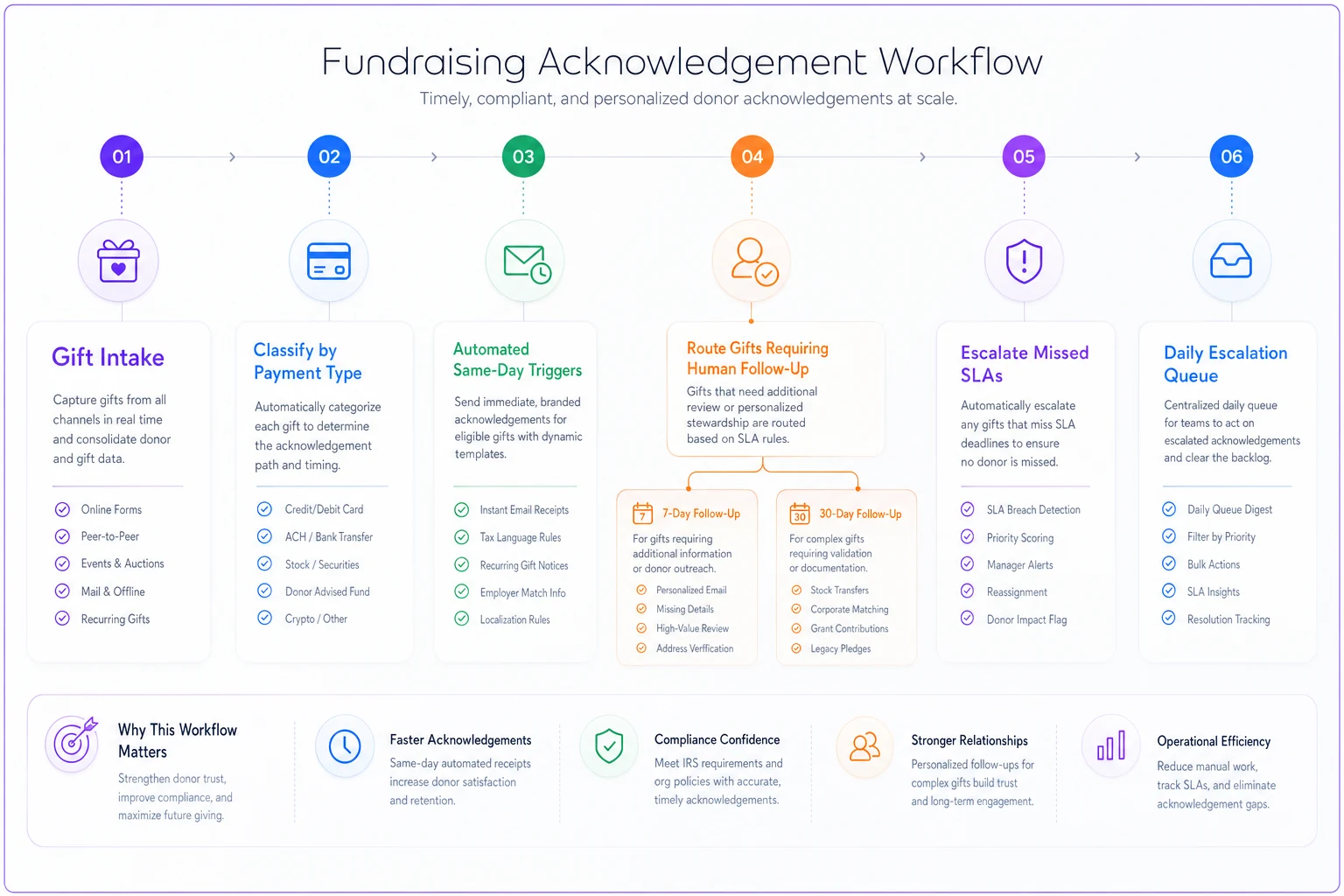
The automation layer: triggers, not magic
This is where low-code automation earns its place — not as a replacement for stewardship, but as the thing that guarantees the same-day tier fires and flags the human tiers before they slip. The goal is boring reliability, not impressive technology.
A few concrete trigger examples worth building, using whatever workflow tool your stack supports (native CRM automation, Zapier/Make, or a purpose-built operational platform):
-
Trigger
new online gift recorded → send templated receipt by payment type within minutes → tag record
Simple, but the tag is what lets you audit later.acknowledged_auto. -
Trigger
gift amount ≥ $1,000 → create a task assigned to the ED with a 48-hour due date → notify in Slack/Teams.
The automation doesn't make the call; it makes sure the call gets assigned. -
Trigger
gift type = stock/in-kind → route to Finance for confirmation → block auto-receipt → apply the correct no-value template on confirmation.
This prevents the wrong language from going out for these gift types. -
Trigger
no acknowledgement logged 24 hours after a gift → escalate to a "missed SLA" queue.
This is the single most valuable one because it catches silent failures. If the auto-receipt broke, this is what tells you. -
Trigger
daily digest of any gifts approaching their 7-day or 30-day SLA that still lack a personal touch.
Turns "did we forget anyone?" from a memory task into a report.
The pattern across all of these: automation handles detection and routing; humans handle the meaningful acknowledgement. The escalation trigger — flagging what didn't happen — is what separates a real system from a hopeful one. Most teams automate the sending and forget to automate the catching.
Where this ties into the rest of your operation: acknowledgements should reconcile against actual recorded gifts. A gift that was acknowledged but never fully reconciled — or reconciled but never acknowledged — is a gap. Wiring your acknowledgement status into the same records you use for an audit-ready donation reconciliation workflow means one source of truth answers both "did we thank them?" and "did the money land correctly?"
Tag auto-acknowledged gifts (for example,
acknowledged_auto) so audits and missed-SLA detection are straightforward.
The escalation trigger — flagging what didn't happen — is what separates a real system from a hopeful one. Most teams automate the sending and forget to automate the catching.
A short checklist to pressure-test your current setup
A short checklist to pressure-test your current setup
-
- [ ] Do you have a distinct SLA for each major gift/payment type, not one blanket rule?
-
- [ ] Do offline SLAs start from logging date, with a separate SLA on logging speed?
-
- [ ] Is there a named owner per gift type — not "development" but a person or role?
-
- [ ] Are receipt templates locked down so required IRS language can't be accidentally deleted?
-
- [ ] Do stock and in-kind templates describe the gift without stating a value?
-
- [ ] Is there an escalation trigger for gifts that didn't get acknowledged on time?
-
- [ ] Would you know within 24 hours if your automated receipt stopped firing?
-
- [ ] Do recurring donors get a first-gift confirmation and an annual statement, not 12 receipts?
If you can't check the last three, you don't have an acknowledgement system — you have an acknowledgement habit, and habits don't scale.
A real scenario
A regional literacy nonprofit — two development staff, roughly $600k in annual contributions, around 2,800 gifts a year — ran acknowledgements manually. Online gifts got an auto-receipt; everything else got batched into a weekly letter run. During their fall appeal, gift volume spiked and the weekly batch slipped to every 10–12 days. A board member's $2,500 check went unacknowledged for almost three weeks, and a stock gift went out with a dollar value written into the letter, which their auditor flagged at year-end.
They rebuilt around an SLA matrix. Online gifts stayed same-day. They added a 2-business-day logging SLA for offline gifts, a 48-hour major-gift task for anything over $1,000, and a routing rule that sent stock and in-kind gifts to their finance contact with the correct no-value template. The critical addition was an escalation queue: any gift with no acknowledgement logged after 24 hours surfaced on a daily list.
Within a couple of campaign cycles, the "missed" queue that started with 30–40 stragglers per heavy week dropped to a handful. The auditor's language flag didn't recur. Nobody would claim the second-gift rate jumped because of this alone, but their team stopped losing an afternoon a week chasing "did we thank so-and-so?" — and the board member gifts stopped slipping, which mattered more than any metric.
When this is worth building — and when it isn't
Building an SLA matrix makes sense when you're processing enough gifts that memory and goodwill are no longer reliable — especially if you handle more than one gift type, or you've already had a compliance scare. Somewhere above 1,000 gifts a year, or once more than one person touches the acknowledgement chain, the matrix starts paying for itself in avoided slips.
A brand-new org doing 50–100 gifts a year, all online, with one person who genuinely sees everything — that org doesn't need a nine-row matrix and five automation triggers. Build the templated receipt language now, because that's the compliance-protecting part, and add the SLA tiers and triggers when volume or a second gift type forces the issue.
One thing worth being clear about: don't over-engineer the personal tiers. The moment your $5,000 donor gets a robotic "thank you" that reads like your $25 auto-receipt, you've used automation to destroy the exact relationship it was supposed to protect. Automate detection, routing, and the small-gift same-day layer. Keep human hands on the gifts that carry a relationship.
The takeaway worth keeping
Acknowledgement isn't a courtesy you get to eventually — it's a set of time-bound promises that differ by gift type and carry real legal weight.
The orgs that handle it well aren't faster because they try harder; they're faster because they stopped treating a check, a stock transfer, and a $30 online gift as the same task. Map the gift types, attach a realistic SLA and the correct language to each, assign an owner, and let low-code triggers catch what humans inevitably miss on a 50-gift day. That's the difference between a system that scales and a habit that eventually lets a $2,500 check sit for three weeks.
Acknowledgement isn't a courtesy you get to eventually — it's a set of time-bound promises that differ by gift type and carry real legal weight. The orgs that handle it well aren't faster because they try harder; they're faster because they stopped treating a check, a stock transfer, and a $30 online gift as the same task.
Ready to elevate your fundraising efforts?
Join 2,000+ nonprofits using Givioly to save time, increase donations, and build lasting donor relationships.