

Most acknowledgement programs fail in a weird way. They're not bad—they're just flat. The $25 online gift and the $5,000 appreciated-stock transfer get the exact same auto-receipt with the same "Thank you for your generous support" line, and the only thing that changes is the dollar amount pulled from a merge field. Donors notice. They don't always say anything, but the next gift tells you.
The fix isn't "write warmer thank-yous." It's building a matrix that decides, for any given gift, three things at once: what the copy should say (and legally must say), how fast it needs to go out, and which channel actually matches the gift's weight. Get those three working together and personalization stops being a vague aspiration and becomes a set of rules anyone on the team can follow.
This piece is about building that matrix. Not the philosophy of gratitude—the actual grid, the template language, and the flags you'd set so the routine runs without someone eyeballing every gift.
Why the flat approach keeps happening
The honest answer is that acknowledgement lives in the gap between two systems. The receipt side is driven by compliance and accounting—it has to go out, it has to carry the right tax language, and someone's already automated it. The stewardship side is driven by relationships and lives in the gift officer's head. Nobody owns the middle.
So what you get is this: the compliance receipt fires automatically and feels like a bank statement, and the "real" thank-you only happens for gifts big enough to land on someone's desk. Everything in between—the $250 donor, the second-year sustainer who bumped their monthly gift, the memorial gift from six people—falls through. There's no rule telling the system those gifts deserve something different, so they get the default.
If you've already set up acknowledgement SLAs and receipt automation, you've solved the speed and compliance half. The matrix below is the personalization half that sits on top of it.
What the matrix actually controls
Think of every gift as having a handful of characteristics that should change how you respond. Not just the amount—the amount is the laziest variable. The ones that actually matter:
Simplify donor management and fundraising workflows.
Givioly helps you organize campaigns, engage donors, and maximize fundraising impact seamlessly.
- Unified donor profiles
- Real-time donation tracking
- Automated impact reporting
No credit card required
-
- Gift size tier (entry, mid, major, principal)
-
- Donor status (first-time, repeat, lapsed-reactivated, sustainer)
-
- Gift type (one-time cash, recurring, stock/non-cash, tribute/memorial, matched)
-
- Designation (unrestricted vs. restricted/program-specific)
-
- Solicitation source (appeal, event, peer-to-peer, unsolicited)
A single gift carries several of these at once. A first-time $300 gift made in memory of someone, designated to a specific program, is a very different acknowledgement than a repeat $300 unrestricted gift from a 10-year sustainer—even though the amount is identical. The matrix's job is to read those characteristics and route the gift to the right copy, timing, and channel combination.
The core matrix
Here's a working version. Treat the tiers as examples—your thresholds depend on your gift distribution—but the logic holds across organizations.
| Tier / Characteristic | Timing SLA | Primary channel | Secondary touch | Copy character |
|---|---|---|---|---|
| Entry ($1–$99), repeat | Receipt within 24 hrs (auto) | — | Warm, short, impact-forward. No ask. | |
| Entry ($1–$99), first-time | Receipt 24 hrs + welcome 72 hrs | Postcard within 2 weeks | Welcome framing, "what happens next" | |
| Mid ($100–$999), repeat | Receipt 24 hrs + personal note 5 days | Email receipt + mailed note | — | Specific impact tied to designation |
| Mid ($100–$999), first-time | Receipt 24 hrs + note 5 days | Mailed note | Email welcome series | Introduce the org, not just thank |
| Major ($1,000–$9,999) | Receipt 24 hrs + call 2 biz days | Phone (gift officer) | Handwritten note within 7 days | Personal, named officer, specific use |
| Principal ($10,000+) | Receipt 24 hrs + call 1 biz day | Phone (leadership) | Letter + optional visit | Leadership voice, long-term relationship |
| Tribute / memorial (any size) | Receipt 24 hrs + notification per family instructions | Mail (notification card) | Email receipt to donor | Sensitive, honoree-centered |
| Stock / non-cash (any size) | Acknowledgement within 48 hrs of transfer | Mail (no value stated) | Call for gifts $5k+ | Describes asset, not dollar value |
| Matched / matching-eligible | Standard tier receipt + match nudge 3 days | — | Thank + "double your impact" prompt | |
| Lapsed donor reactivated | Receipt 24 hrs + "welcome back" 5 days | Email + mailed note | Call for mid+ | Acknowledge the return explicitly |
A couple of things worth flagging in this grid.
The tribute and memorial row is the one most teams get wrong, because the acknowledgement splits in two directions—one receipt to the donor for tax purposes, one notification to the family that must never mention the amount. The timing is driven by the family's instructions, not your SLA clock. If you haven't nailed that workflow down, the tribute and memorial giving workflow walks through the family-and-tax errors that show up when this gets rushed.
The stock/non-cash row has a compliance landmine baked in: your acknowledgement describes the asset ("200 shares of XYZ") but never states a dollar value. Valuation is the donor's responsibility. A warm, personalized note that accidentally quotes a value creates a problem for both of you.
Compliant copy that doesn't read like a form
Personalization and compliance aren't in tension—people assume they are. The IRS substantiation language for gifts of $250 or more is short. You need the organization name, the gift amount (for cash), a statement of whether goods or services were provided, and if so their value. That's it. Everything around those required elements is yours to make human.
The common mistake: teams bury the required language as the message. The whole thing reads like boilerplate because the compliance sentence is doing all the work. Flip it. Lead with the person and the impact, then let the required statement sit quietly at the bottom like a footer.
Mid-tier, repeat donor, program-designated — mailed note template:
> Dear [First name], > > Your gift of [amount] to [program] came through this week, and I wanted to write personally. Because you've given to [program] before, you probably already know [one specific, concrete outcome]. This gift keeps that going—[specific near-term use]. > > Thank you for sticking with this. > > [Signer name, real title] > > --- > [Org legal name] is a 501(c)(3) organization. No goods or services were provided in exchange for this contribution. This letter serves as your receipt for a gift of [amount] received on [date].
The compliance block is intact. The donor reads two warm sentences before they hit it. That ordering is the entire trick.
Major gift, phone-first — call framing (not a script to read):
The call isn't a recited thank-you. It's three beats: name the specific gift and what it funds, ask one genuine question about why they give to this, and tell them the written piece is coming. The handwritten note that follows references something they said on the call. That reference is what makes it feel personal instead of processed.
The timing SLAs, and why they're tiered
Speed matters most at the extremes. A $25 donor expects an instant receipt and nothing else—a slow receipt reads as disorganized. A major donor expects a fast human call, and a slow call reads as "we didn't notice."
-
1. Automated receipt fires within 24 hours for every gift, no exceptions. This is the compliance backbone and it never waits on a human.
-
2. Mid-tier personal note mails within 5 business days. Batched, not instant—that's fine.
-
3. Major gift call happens within 2 business days; principal within 1. These are the only SLAs where a missed deadline actually damages the relationship.
-
4. Tribute notifications follow the family's timeline, with a hard rule that the family hears before any public recognition.
-
5. Reactivation touches go out within 5 days with explicit "welcome back" language—reactivated donors are the most likely to lapse again, and the window is short.
The pattern across these: automate the floor, protect the ceiling. The automated receipt catches everything so nothing goes unacknowledged. The human touches are reserved for the tiers where a human actually changes the outcome.
Implementation flags for automation
This is the part that makes the matrix executable instead of aspirational. Each gift needs flags set at entry so the routing happens on its own. You're not asking a person to decide "does this one get a call?"—the flags decide.
-
-
tier— derived from amount against your thresholds -
-
donor_status— first-time / repeat / lapsed-reactivated / sustainer -
-
gift_type— cash / recurring / stock / tribute / matched -
-
designation— unrestricted / [program code] -
-
source— appeal / event / p2p / unsolicited -
-
family_contact— (tribute only) name + preferred channel + "notify before public" -
-
value_suppress— (non-cash) true, blocks any dollar value in output -
-
humantouchrequired— true for major+, tribute, non-cash over threshold -
-
touch_owner— assigned gift officer or leadership name
Visual of the intake-to-routing workflow:
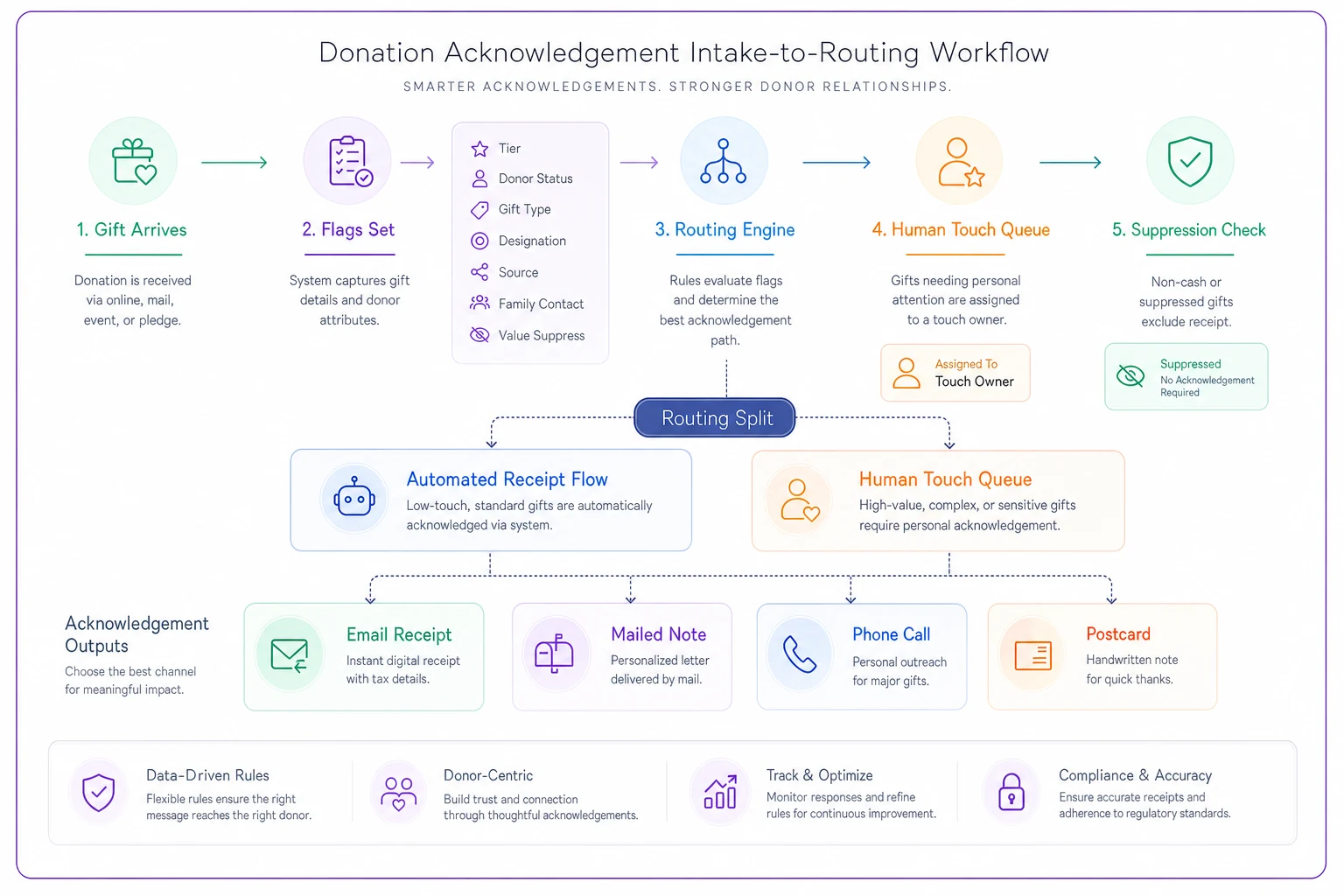
Use the
humantouchrequiredflag to auto-populate owners' task lists so nothing slips.
The flag that saves you most often is humantouchrequired. It pulls the handful of gifts that need a person out of the automated stream and drops them on a named owner's list with a deadline. Everything without that flag gets the right templated touch and never hits a human desk. That separation is what lets a two-person team run a tiered program without drowning.
The value_suppress flag is the compliance guardrail. One true/false field prevents the most common non-cash acknowledgement error—quoting a value you shouldn't.
A real scenario
A regional environmental nonprofit—around 4,200 active donors, development team of three—ran one acknowledgement template for everything under $1,000. Gifts above that got a call when someone remembered. Their biggest problem wasn't the entry tier; it was the mid-level band, roughly $150–$800, where second-year retention was sitting around 48%.
They built a version of the matrix above. The only real change for the mid tier was a mailed note within five business days, personalized to the program the donor had designated, with the compliance language moved to the footer. The major-gift calls got an actual SLA—two business days—and an assigned owner, so they stopped slipping.
Over the following year, mid-tier second-year retention moved into the high 50s. Not a transformation, but on that band it worked out to something like an extra $9k–$12k in retained giving, against maybe two hours a week of added note-writing. The major-gift side was harder to measure cleanly, but the calls went out on time instead of three weeks late, which the officers said changed the tone of the next conversation.
When this level of structure makes sense
If you're acknowledging more than a few hundred gifts a year across a real mix of sizes and types, the matrix pays for itself—mostly by making sure the mid-tier and the tricky gift types (tribute, non-cash, reactivated) stop getting the default treatment.
When it's overkill: a very small all-volunteer group doing a few dozen gifts a year. At that scale a thoughtful person writing each note by hand beats any matrix. The grid solves a coordination problem, and coordination only becomes a problem when volume outgrows memory.
Who should not try to automate the human-touch rows: anyone tempted to auto-generate the major-gift and tribute touches. Those are exactly the gifts where templating shows, and showing is worse than being slightly slow. Automate the floor. Keep humans on the ceiling.
The whole point of the matrix is that it collapses dozens of case-by-case judgment calls into a small set of rules—read the gift's characteristics, apply the matching copy, timing, and channel, flag the few that need a person. The flat acknowledgement problem isn't caused by teams not caring. It's caused by no one owning the middle and no system deciding what "different" means for each gift.
Build the grid once, set the flags at intake, and the program runs with the entry tier handled automatically and the relationships that actually move your revenue getting the human attention they warrant—on time, in the right channel, with language that stays compliant without sounding like it.
Ready to elevate your fundraising efforts?
Join 2,000+ nonprofits using Givioly to save time, increase donations, and build lasting donor relationships.