

Corporate sponsorships are weird operational animals. They're not quite donations, not quite grants, and definitely not simple transactions. Most nonprofits treat them like regular major gifts—track the check, send a thank you, maybe throw in some logo placement. Then six months later, the sponsor calls asking why their employee volunteer day never happened, where their quarterly impact reports went, and why their benefits package looks nothing like what was promised.
The problem isn't that development teams don't care about sponsor fulfillment. It's that corporate sponsorship operations nonprofit teams typically lack the right operational infrastructure to handle these complex, multi-stakeholder agreements that span months or years. Unlike individual donations that flow through standard acknowledgment processes, sponsorships involve deliverables across marketing, programs, events, and finance—each with different timelines, approval chains, and success metrics.
Why sponsorship fulfillment breaks down
Corporate partnerships fail operationally for three core reasons that compound each other.
First, deal terms live in scattered places. The signed agreement sits in someone's email. The benefits breakdown lives in a spreadsheet on the development director's desktop. The activation timeline got discussed in a meeting but never documented. Finance has their own tracking for recognition thresholds. Marketing has a completely different understanding of logo usage rights. When fulfillment time comes, nobody has the complete picture.
Second, benefits delivery requires cross-departmental coordination that most nonprofits aren't structured for. A typical mid-tier sponsorship might include quarterly program updates, social media mentions, event tickets, employee engagement opportunities, and financial reporting—each touching a different team operating on a different calendar with competing priorities. Without centralized tracking, things slip.
Third, the renewal conversation happens too late. Teams scramble to prove value in month eleven of a twelve-month agreement, desperately pulling together metrics and impact stories. By then, the sponsor has already mentally allocated next year's budget elsewhere. The rushed renewal pitch feels transactional rather than relationship-based.
These aren't failures of intention. They're predictable outcomes when complex, multi-deliverable agreements get managed through general donation workflows.
Building a deal intake form that actually prevents problems
A proper sponsorship intake form does more than capture deal terms—it creates accountability across your organization before anyone signs anything.
Simplify donor management and fundraising workflows.
Givioly helps you organize campaigns, engage donors, and maximize fundraising impact seamlessly.
- Unified donor profiles
- Real-time donation tracking
- Automated impact reporting
No credit card required
Deliverable ownership mapping. For each promised benefit, explicitly assign a primary owner and backup owner by name, not department. "Marketing team" means nobody. "Sarah Chen with David Park as backup" means accountability.
Activation triggers and deadlines. Benefits need specific triggers, not vague timelines. Instead of "quarterly reports," specify: "Report due 15 days after quarter close, triggered by finance closing books, Sarah sends reminder on day 10."
Recognition thresholds and escalation tiers. Cash versus in-kind contribution tracking affects benefit levels differently. A $10k cash sponsorship might warrant different recognition than $10k in pro-bono services. Your form needs clear formulas for calculating combined value and determining benefit tiers.
Interdependency flags. Some benefits depend on others. Event sponsorship benefits require the event to actually happen. Volunteer opportunities need program capacity. Flag these dependencies upfront so you can proactively communicate if anything changes.
Sponsor engagement preferences. How does this sponsor want to be communicated with? Monthly check-ins or quarterly reports? Email updates or phone calls? Single point of contact or direct access to program staff? Capture this during intake, not after problems arise.
Include primary and backup owner email addresses in the intake form to speed handoffs.
The intake process should trigger automatic notifications to every team involved. When marketing sees they're responsible for twelve social posts over six months, they can plan accordingly. When programs knows a site visit is expected in Q3, they can prepare properly.
The benefits checklist that keeps everyone aligned
Most sponsorship benefits checklists are just lists of what was promised. That's only half the equation. An operational checklist tracks not just what, but how, when, who, and whether it actually happened.
Here's the structure that works:
| Benefit Category | Specific Deliverable | Owner | Due Date | Completion Trigger | Verification Method | Status |
|---|---|---|---|---|---|---|
| Brand Visibility | Logo on event materials | Marketing/Jane | March 15 | Printer proof approved | Screenshot saved to folder | Pending |
| Employee Engagement | Volunteer day for 20 staff | Programs/Carlos | Q2 (flexible) | Date confirmed with sponsor | Attendance sheet signed | Not started |
| Impact Reporting | Quarterly metrics dashboard | Development/Marie | April 10, July 10, Oct 10, Jan 10 | Finance closes quarter | Email confirmation from sponsor | Q1 complete |
| Recognition | Board meeting presentation | CEO/Director | June board meeting | Invitation sent to sponsor | Meeting minutes note attendance | Scheduled |
The checklist should live somewhere every stakeholder can access. Not about surveillance—it's about preventing the awkward moment when a sponsor asks about something nobody remembered was promised.
For benefits spanning multiple months, break them into discrete checkpoints. "Social media recognition" becomes twelve specific posts with individual due dates and draft deadlines. "Program partnership" becomes quarterly touchpoints with defined agendas.
Creating a fulfillment calendar that handles complexity
The fulfillment calendar is where good intentions meet operational reality. Unlike a simple deadline tracker, it needs to accommodate the messiness of real sponsorship delivery.
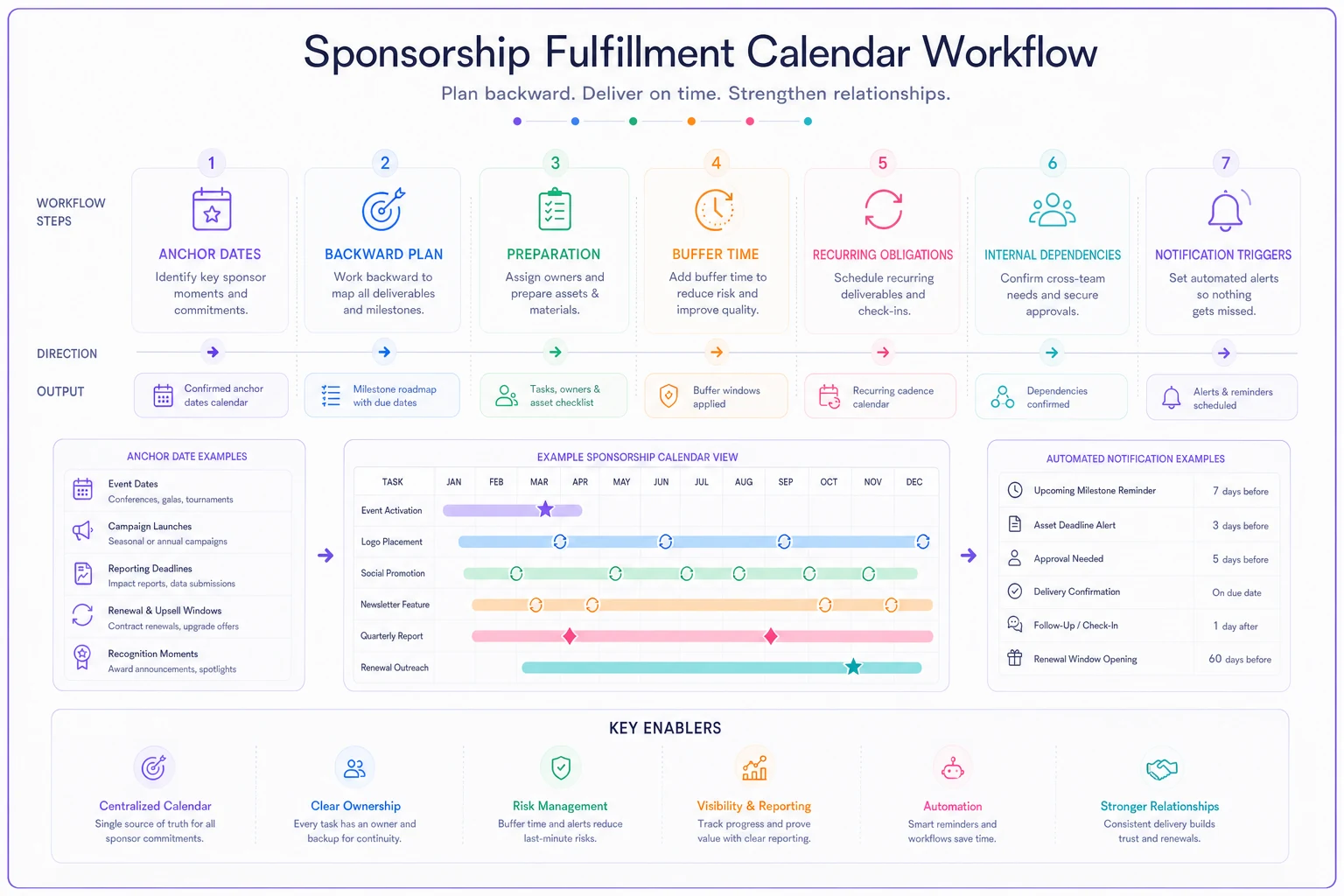
Start with anchor dates—non-negotiable deadlines like event dates, report due dates, and renewal conversations. Work backward from these to establish preparation timelines. If the annual gala is September 15, sponsor benefits tied to that event need staggered triggers: logo deadlines by July 1, ticket names by August 15, speaking opportunities confirmed by August 1.
Layer in recurring obligations next. Monthly social posts, quarterly reports, and semi-annual check-ins create the rhythm of engagement. Spread them strategically so sponsors see consistent touchpoints rather than long silences followed by a burst of activity.
The calendar also has to account for internal dependencies. If sponsor recognition at the gala requires board approval, the board meeting date drives the entire timeline backward. If quarterly reports pull from program data, they can't be scheduled until programs closes their reporting period.
Build buffer time. Sponsors change their logo right before printing. Key contacts leave the company mid-year. Events get postponed. Your calendar needs breathing room to handle these without cascading failures.
Most importantly, the calendar should trigger proactive communication. Two weeks before a volunteer day, someone confirms details with the sponsor. One month before renewal, someone schedules the partnership review. These triggers prevent the frantic scrambling that quietly erodes sponsor confidence.
This diagram shows the flow of anchor dates, dependencies, preparation timelines, recurring obligations, buffer time, and notification triggers in a fulfillment calendar.
The calendar should trigger proactive communication. Two weeks before a volunteer day, someone confirms details with the sponsor. One month before renewal, someone schedules the partnership review.
The reconciliation routine that catches discrepancies
Sponsorship reconciliation goes beyond matching payments to pledges. You're reconciling delivered benefits against promised benefits, tracked engagement against reported engagement, and recognized value against actual value.
Payment versus recognition timing. A sponsor might pay $25k upfront for a year-long partnership, but recognition milestones are quarterly. Track both payment received and recognition earned to make sure you're not over-delivering early or under-delivering late.
Cash versus in-kind value. When a sponsor provides both cash and in-kind support, their total partnership value determines benefit levels. But reconciling in-kind donations requires consistent valuation methods. If you promised benefits based on $50k total support, you need documentation showing how you reached that number.
Delivered versus promised benefits. Every month, audit what was actually delivered against the checklist. Did the social posts go out? Was the logo included in the newsletter? Did the volunteer opportunity get scheduled? Flag gaps immediately, not at renewal time.
Internal tracking versus sponsor perception. Your records might show perfect fulfillment, but if the sponsor doesn't perceive value, you still have a problem. Include soft reconciliation—checking in on sponsor satisfaction, not just checking boxes internally.
Document everything in a standardized format. When renewal conversations start, you need a clear record of what was promised, what was delivered, what worked, and what needs to change.
Building renewal cadence into operations
Renewal starts the day after signing, not eleven months later. The best sponsorship operations treat the entire partnership period as cultivation for the next agreement.
Quarter 1 sets the operational tone. Deliver early benefits without fumbling. Send a 90-day check-in reviewing delivered benefits, confirming upcoming activities, and asking for feedback. Not a renewal conversation—just relationship building.
Quarter 2 focuses on engagement depth. Facilitate the meaningful interactions—site visits, volunteer opportunities, program connections—that create investment beyond transactional benefits.
Quarter 3 is when you introduce impact storytelling. Share specific outcomes their support enabled. Lead with stories, follow with metrics. This is when sponsors start mentally planning next year's budgets, even if they won't admit it.
Quarter 4 opens renewal discussions explicitly. But instead of a desperate pitch, you're building on a year of consistent delivery. The conversation becomes collaborative: what worked, what didn't, what they'd want to see adjusted.
The renewal package should include:
-
Complete fulfillment record showing all delivered benefits
-
Impact metrics tied specifically to their support
-
Testimonials or stories from beneficiaries
-
Proposed partnership structure for next year
-
Clear timeline for decision-making
Track renewal rate by sponsorship tier, industry, and benefit package type. If tech companies consistently don't renew, examine whether your benefits actually align with their priorities. If sponsors above $25k renew but those below $10k don't, your fulfillment resources might be misallocated.
Where AI-powered operational platforms reduce friction
The complexities of corporate sponsorship operations multiply with each additional partnership. A five-person development team managing twenty corporate sponsors is juggling hundreds of individual deliverables across departments and timelines—and that's before anything goes sideways.
AI-assisted operational software addresses this directly. Instead of manually tracking every benefit across scattered spreadsheets, the platform monitors fulfillment status, flags upcoming deadlines, and notifies responsible parties automatically. When a quarterly report deadline approaches, the system can pull preliminary metrics, draft the update template, and route it for review—turning a two-day scramble into a two-hour task.
The deeper value comes from pattern recognition over time. Which benefit packages correlate with renewals? Which deliverables consistently run late? Which sponsors need extra attention based on engagement patterns? That kind of visibility transforms sponsorship management from reactive firefighting into something more strategic.
For resource-constrained nonprofits, the coordination overhead that typically burns staff time is the first thing to shrink. Automated reminders ensure nothing slips. Centralized benefit tracking gives everyone visibility into what's owed. Integrated reconciliation catches discrepancies before sponsors notice them.
Making sponsorship operations sustainable
Corporate sponsorships should be your most predictable revenue stream. Unlike individual giving that fluctuates with economic conditions or grants that depend on foundation priorities, corporate partnerships can provide multi-year commitments when managed properly.
The operational infrastructure—intake forms, benefits checklists, fulfillment calendars, and reconciliation routines—isn't overhead. It's what turns one-time sponsors into long-term partners. Every missed benefit erodes trust. Every exceeded expectation builds it.
Start with your next new sponsorship. Implement the intake form completely. Track every benefit. Schedule every touchpoint. Document every delivery. Use that partnership as the operational template, then scale it across your portfolio.
The difference between nonprofits that retain corporate sponsors and those constantly chasing new ones isn't program impact or mission alignment—it's how well they execute on what they promised. When sponsors experience consistent delivery and real communication throughout the year, renewal becomes a natural conversation rather than a difficult one.
Your corporate sponsors aren't just funding sources. Build the operational infrastructure that reflects that, and the relationships tend to go somewhere much more valuable than a logo placement and an annual check.
Ready to elevate your fundraising efforts?
Join 2,000+ nonprofits using Givioly to save time, increase donations, and build lasting donor relationships.