


Most recurring giving programs don't fail dramatically. They just quietly stall. A nonprofit launches a monthly giving ask, gets a decent first wave of sign-ups, and then eighteen months later they're sitting at roughly the same active donor count they hit in month four. New sign-ups roughly equal cancellations. Revenue looks flat on the dashboard. Nobody can quite explain why the number won't move.
The instinct is almost always to blame acquisition — "we need more sign-ups." But the honest answer is usually structural. The program was built as a campaign, not as an operating system. A recurring giving strategy only compounds when the whole organization treats it like a book of predictable revenue that needs maintenance, not a one-time push that gets checked on quarterly.
This piece is about the system underneath the number. Where recurring revenue actually leaks, why the leaks stay invisible until they're expensive, and how the economics change once you model retention properly and assign ownership across teams instead of leaving it orphaned in one person's inbox.
The core misunderstanding: monthly giving isn't a campaign, it's a book of business
A one-time campaign has a start and an end. You run it, count the money, move on. A recurring giving program is a portfolio that gains and loses value every single month based on how well you maintain it.
If you have 400 monthly donors giving an average of $22, that's roughly $8,800 in monthly revenue — but only if nobody leaves. The real value depends entirely on how long donors stay. And most organizations have no idea how long their monthly donors actually stay, because they've never built the reporting to see it.
What tends to happen in small development shops is that the program gets set up once, the thank-you email gets written once, and then the whole thing runs on autopilot with nobody actually watching the two numbers that determine its long-term value: net monthly retention and the rate at which failed payments quietly kill active donors.
That second one is worth sitting with. A meaningful chunk of monthly cancellations aren't cancellations at all. They're expired cards, insufficient funds, and processor declines that nobody follows up on. The donor didn't decide to leave. Their card just expired and the gift silently stopped. If you're not treating involuntary churn as a distinct problem from voluntary churn, you're losing donors who fully intended to keep giving.
Where the money actually leaks
Recurring programs leak in a handful of predictable places, and the leaks tend to stack. Here's a breakdown of the common failure points and where they typically live inside the organization.
Simplify donor management and fundraising workflows.
Givioly helps you organize campaigns, engage donors, and maximize fundraising impact seamlessly.
- Unified donor profiles
- Real-time donation tracking
- Automated impact reporting
No credit card required
| Leak point | What it looks like | Who usually owns it (or doesn't) |
|---|---|---|
| Failed payments (involuntary churn) | Cards expire, gifts silently stop, no recovery attempt | Finance thinks Development owns it; Development thinks the platform handles it |
| Onboarding gap | Donor signs up, gets a receipt, then hears nothing for months | Nobody — it's assumed the CRM "does it" |
| No upgrade path | Same $15/month donor for four years, never asked to increase | Major gifts ignores them; annual fund forgot them |
| Stewardship silence | Impact only communicated at year-end appeal time | Comms treats them like one-time donors |
| Reporting blindness | Leadership sees gross revenue, never net retention by cohort | Ops has no dashboard for it |
The pattern in that right-hand column is the real story. Almost every leak lives in the seam between two teams. Finance sees the failed transactions but doesn't consider donor recovery their job. Development owns the relationship but doesn't watch the payment data. Comms sends the newsletter but doesn't know which recipients are monthly donors versus one-time givers.
Recurring revenue dies in the handoffs. Not because anyone is negligent, but because nobody was ever explicitly assigned the space between the teams.
Lifecycle economics: the number that should drive every decision
To make good decisions about a recurring program, you need to know what a monthly donor is actually worth over their full lifespan — not what they gave this month.
The math isn't complicated. Take the average monthly gift, multiply by the average number of months a donor stays. If your average monthly donor gives $20 and stays about 30 months, each new monthly donor is worth roughly $600 in lifetime value. That single number reframes every spending decision.
Think of acquisition spend as an investment evaluated against lifetime value, and prioritize recovery work that preserves that LTV.
Suddenly, spending $40 to acquire a monthly donor isn't an expense — it's an investment that returns 15x over the relationship. And spending real effort to recover a failed payment isn't a nice-to-have; every recovered donor is worth the full remaining lifetime value, not just next month's $20.
Improving retention is almost always cheaper and higher-return than improving acquisition, but it's harder to get credit for, so it gets ignored. Acquisition produces a visible number — "we got 50 new monthly donors this quarter." Retention prevents an invisible loss. It's genuinely hard to celebrate the donors who didn't leave. So the retention work quietly falls to the bottom of everyone's list, and the leak keeps running.
A useful reframe: push average tenure from 24 months to 30 months and you've increased the lifetime value of your entire program by 25% without acquiring a single new donor. That's the highest-leverage work available to most recurring programs, and it costs a fraction of what acquisition does.
Retention cohort forecasting (without needing a data team)
You don't need a data scientist for this. You need to group donors by the month they started and track how many are still giving over time. That's a cohort, and watching cohorts is how you catch decay before it becomes a crisis.
-
How many donors started that month (the cohort size)
-
What percentage of that cohort is still active at month 3, month 6, month 12, month 24
-
The average gift of that cohort over time (does it climb or stay flat?)
What you're looking for is the shape of the curve. Healthy programs lose a chunk of donors in the first 90 days and then flatten out — the people who stick past three months tend to stay a long time. Unhealthy programs bleed steadily and never flatten, which usually points to a stewardship or payment-recovery problem rather than an acquisition problem.
One pattern worth watching: if one cohort retains dramatically worse than the others, look at how those donors were acquired. Donors recruited through a high-pressure emotional moment — a viral appeal, a disaster response — tend to churn faster than donors who opted into recurring giving deliberately. Two cohorts can have identical month-one numbers and completely different lifetime value. If you don't split them out, you'll misread your whole program.
Once you can see cohort retention, forecasting becomes real instead of aspirational. You can look at your existing cohorts, apply their observed decay curves, layer in expected new sign-ups, and produce a monthly revenue projection leadership can actually plan around. That's the difference between "we hope monthly giving grows" and "based on current retention and sign-up rates, monthly revenue should land around $11k–$12k by Q3."
Here's a simple workflow for tracking cohorts and responding to drops.
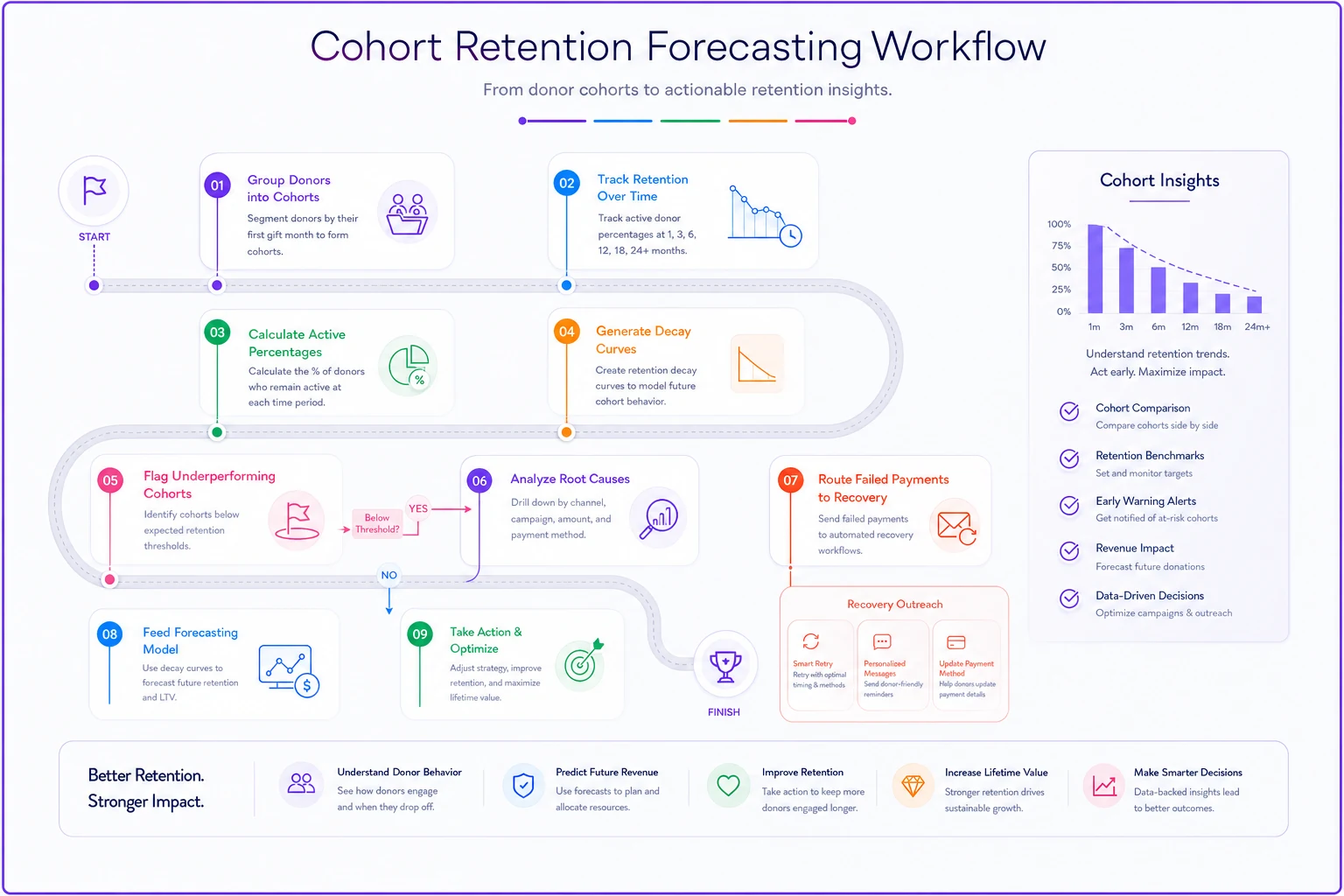
This flow shows grouping → monitoring → flagging → routing so you can act before a cohort becomes a serious loss.
Cross-team ownership: the part everyone skips
You can have perfect cohort analysis and a solid lifetime value model, and the program will still stall if no one owns the operational responses those numbers demand.
-
When a payment fails, who reaches out, and within how many days?
-
When a donor hits 12 months, who triggers the upgrade conversation?
-
When a cohort's retention drops below a threshold, who investigates and reports back?
-
When a monthly donor's card is about to expire, who sends the update-your-card message?
In most small nonprofits, the honest answer to all of these is "nobody, specifically." The work either doesn't happen or happens whenever someone remembers. That's not a discipline problem — it's a design problem. The roles were never defined and the escalation paths were never drawn.
A workable ownership structure for a small team looks roughly like this:
-
Finance flags the data. Payment failures, upcoming card expirations, and reconciliation gaps get pulled on a set cadence — not "when someone notices," but every week or every billing cycle.
-
Development owns the relationship response. They get the flagged list and run the recovery outreach, the upgrade asks, and the stewardship touches. This is their book of business.
-
Comms owns the ongoing narrative. Monthly donors get segmented communications that treat them differently from one-time donors — more impact, fewer asks.
-
Ops owns the numbers. Someone produces the cohort retention view and the revenue forecast on a regular schedule so leadership sees net retention, not just gross deposits.
-
Leadership owns the escalation trigger. When retention drops or a cohort underperforms, there's a defined threshold that kicks off a review, so problems surface in weeks instead of quarters.
The specific division matters less than the fact that it exists in writing. If you can't point to a document that says who does what when a payment fails, that work is not happening reliably.
The onboarding and first-year problem
Everything upstream matters less if the first 90 days are broken. The single biggest predictor of long tenure is whether a new monthly donor feels like something happened after they signed up. Not a receipt — an actual welcome, a sense of belonging, some early signal that their $15 is doing something real.
This is closely tied to the same dynamics that drive one-time donor attrition, and a lot of the operational playbook overlaps with the work of reducing first-year donor churn. The core idea is the same: the relationship is won or lost early, and the early touches need to be systematic rather than improvised.
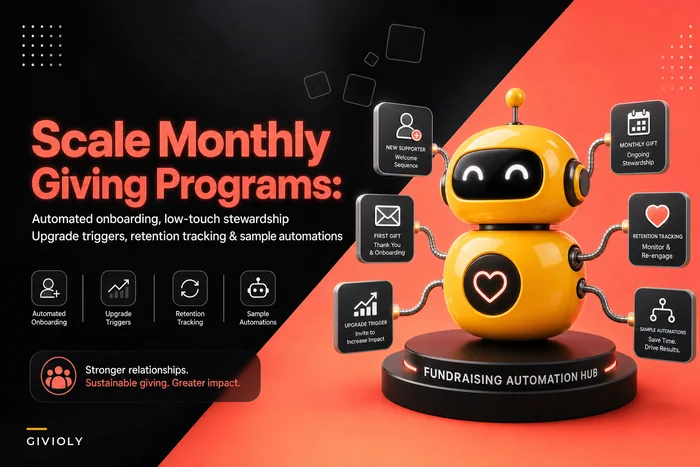
For monthly donors specifically, the onboarding sequence needs to do three things — confirm the gift, set expectations for what they'll hear from you, and make them feel like part of something ongoing. Programs that build a structured onboarding flow and clear upgrade triggers, along the lines of what's covered in this breakdown on scaling monthly giving programs, tend to hold their cohorts far better than programs that fire off a single automated receipt and go quiet.
The mistake here is subtle. Teams assume that because a recurring gift is "set and forget" from the donor's side, it can be set-and-forget from the org's side too. The opposite is true. Because the donor isn't taking a fresh action each month, they actually need more reinforcement that they made a good decision — not less. Silence reads as "my gift doesn't matter here," and that's usually the thought that precedes a cancellation.
A real scenario
Consider a mid-sized arts nonprofit with about 520 monthly donors averaging just under $19 a month — around $9,800 in monthly recurring revenue. On paper, healthy. But their active donor count had been flat for nearly two years despite steady new sign-ups.
When they finally pulled the payment data apart, the picture got clearer fast. Roughly 6–7% of their active donors each quarter were dropping off from failed payments alone — expired cards and declines that nobody was recovering. Nearly all of those were donors who'd never actually chosen to leave. On top of that, their retention curve never flattened, which pointed to weak stewardship: monthly donors were getting the exact same appeals as everyone else, mostly asking for more money.
They did two unglamorous things. First, they set up a weekly failed-payment list that a development coordinator worked through with a simple, warm "your card didn't go through, here's how to update it" outreach. Second, they built a monthly-donor-specific communication track focused on impact rather than asks.
Within about two quarters, recovered payments alone were adding back somewhere in the range of $600–$900 of monthly revenue that had previously been silently disappearing. The retention curve started to flatten. Nothing about their acquisition changed — they just stopped leaking.
The growth was hiding inside the donors they already had.
When building a system makes sense — and when it doesn't
Not every organization needs cohort dashboards and formal escalation paths. If you have 40 monthly donors, you can practically manage them by hand, and the overhead of building a system would cost more than it returns. Spend your energy on acquisition and basic stewardship until the program is big enough to justify the machinery.
The system approach starts paying off somewhere around the point where you can no longer hold the whole program in your head — usually a few hundred active monthly donors. At that scale, the manual approach breaks down. Failed payments slip through, upgrade opportunities get missed, and no single person can track who's due for what. That's when formalized ownership, cohort tracking, and defined escalation triggers stop being bureaucracy and start being the thing that actually protects your revenue.
Who should not rush into this: brand-new programs still figuring out their offer and their audience. Trying to optimize retention before you have enough donors to see a retention curve is premature. Get to a real base first, then build the system to hold it.
Where tooling fits, honestly
Most of what's described here is process, not software. You can run cohort tracking in a spreadsheet and payment recovery from a shared task list for a long time. But once the volume grows, the manual approach becomes the bottleneck — someone spends hours each week pulling failed-payment lists, cross-referencing donor records, and remembering who's due for an upgrade ask.
That's the point where AI-assisted operational tools earn their place: not by replacing the relationship work, but by handling the surfacing and routing underneath it. Automatically flagging failed payments and expiring cards, generating cohort retention views instead of hand-building them, routing the right donor to the right team member at the right moment. The judgment and the outreach stay human. The tedious detection and coordination — the stuff that quietly falls through the cracks between teams — is exactly what automation handles well. The goal is simply that no donor slips away because a spreadsheet didn't get updated.
The real takeaway
Programs that build genuinely predictable monthly revenue aren't the ones with the cleverest acquisition campaigns. They're the ones that treat recurring giving as an ongoing operation with real ownership — where someone watches the retention curve, someone recovers the failed payments, someone runs the upgrade conversations, and leadership sees net retention instead of just gross deposits.
Most stalled programs don't have an acquisition problem. They have a maintenance problem hiding as an acquisition problem. Fix the leaks, assign the seams between teams, and forecast off real cohort behavior — and the number that wouldn't move for two years finally starts to compound.
Ready to elevate your fundraising efforts?
Join 2,000+ nonprofits using Givioly to save time, increase donations, and build lasting donor relationships.