



There's a number worth sitting with: roughly $4.3 trillion in U.S. non-financial corporate bonds coming due between 2027 and 2031. Reuters recently reported on this maturity wall, and the short version is that a lot of companies are going to refinance big debt loads at borrowing costs far higher than what they locked in years ago.
Here's why that lands on your desk. When a company's finance team is staring down a refinancing event at elevated rates, they start trimming before the maturity actually hits. Discretionary spending goes first. And in most corporate budgets, "community partnerships," "event sponsorships," and "corporate giving" sit squarely in the discretionary column. You usually don't get a dramatic cancellation email. You get quieter signals: the multi-year renewal becomes a one-year handshake, the payment that used to land in January drifts to April, the $50k title sponsor comes back at $30k "for this cycle."
This post isn't about the macro story. It's about what your operation should be doing in the next two or three quarters so a corporate pullback doesn't blindside your forecast — or your cash position.
Start by sorting your corporate revenue by its real fragility
Most sponsorship pipelines are tracked by stage and dollar amount. Almost none are tracked by fragility — meaning how likely a given commitment is to shrink, slip, or disappear if the sponsor's finance team gets squeezed. That gap is worth closing first, because it changes how you forecast and where you put your stewardship energy.
Not all corporate money carries the same corporate sponsorship risk, even at identical dollar values. A $40k multi-year pledge from a highly leveraged regional company refinancing debt in 2027 is a very different asset than a $40k commitment from a privately held firm with no debt wall and ten years of consistent giving. The dollar amount looks the same. The probability it shows up on time is not.
A simple fragility breakdown across a corporate portfolio:
| Signal | Lower fragility | Higher fragility |
|---|---|---|
| Commitment term | Multi-year, signed | Single-year or verbal "we'll do it again" |
| Payment history | Pays early or on schedule | Already slipped once in last 18 months |
| Funding source | Foundation arm / endowed | Marketing or community-relations budget line |
| Company balance sheet | Low debt, stable sector | Near-term refinancing, rate-sensitive sector |
| Relationship depth | Multiple champions, board tie | Single contact who could leave |
You don't need perfect financial intel on every sponsor. You need enough to tag each corporate account as low, medium, or high fragility and weight your forecast accordingly. A medium-fragility $40k commitment might reasonably forecast at 70–75% of face value for planning purposes. High fragility, maybe 50%. That's not pessimism — it's just refusing to treat a hope as a receivable.
The deeper problem: sponsorship revenue is forecast like it's contracted when it mostly isn't
Nonprofits tend to book sponsorship commitments into forecasts at full value the moment there's a yes, then build program budgets and staffing on top of those numbers. It feels responsible. It's actually a hidden exposure, because a large share of corporate "commitments" are discretionary line items that can be revised unilaterally without breaking any contract.
Simplify donor management and fundraising workflows.
Givioly helps you organize campaigns, engage donors, and maximize fundraising impact seamlessly.
- Unified donor profiles
- Real-time donation tracking
- Automated impact reporting
No credit card required
When money flows freely, nobody notices. The pledge becomes the payment, the forecast holds, and the gap between "committed" and "contractually enforceable" stays invisible. A Reuters piece on higher rates and harder corporate choices captures the dynamic well — when borrowing costs climb, finance teams reopen budgets they'd normally leave alone. That's exactly when the soft commitments in your pipeline get tested.
The operational fix isn't complicated, but it requires discipline most teams skip: separate what's contracted from what's merely committed, and forecast them differently. If you can't point to a signed agreement with a payment schedule and a clear scope, it's not contracted revenue. It's a probability.
This is also where sponsor deal operations quietly protect you. A tight intake and reconciliation routine — the kind laid out in our corporate sponsorship deal ops playbook — means every agreement already has documented payment timing, benefit obligations, and terms on file. When you need to reforecast fast, you're reading your own records instead of emailing sponsors to ask what they actually agreed to.
Read your existing contracts before you need to
One pattern that comes up constantly: teams renegotiate or chase payments under pressure without having read the clauses that actually govern the relationship. A sponsor delays, and nobody on the nonprofit side knows whether there's a payment deadline, a cure period, or a termination-for-convenience clause buried in the agreement.
Spend an afternoon pulling every active corporate agreement and logging five things per contract:
-
Payment schedule — exact dates and amounts, not "Q1."
-
Termination clause — can they walk with 30 days' notice? Is there a penalty?
-
Benefit obligations tied to payment — do you owe deliverables before you've been paid?
-
Renewal mechanics — auto-renew, opt-out date, or fully manual?
-
Who signed and who approves payment — the name you'll actually chase.
This matters now because in a tightening cycle, the sponsors most likely to delay are often the ones with the loosest terms. If your three largest sponsors all operate on verbal annual renewals with no written payment schedule, that's not really a contract problem — it's a forecasting problem you need to fix before budget season, not during it.
A concrete example of how this plays out: a mid-sized arts organization had around $180k in annual corporate sponsorship across eleven sponsors. Two of them — close to $70k combined — were on handshake renewals with no signed terms. When one sponsor's parent company started refinancing and froze discretionary spend, the nonprofit had no payment schedule to point to, no deliverable leverage, and no fallback. They recovered maybe half that commitment after six weeks of uncomfortable back-and-forth. The sponsors with signed agreements and documented payment dates? Paid on time, no drama. The difference wasn't goodwill. It was whether the terms existed on paper.
Tighten reconciliation cadence before the slippage starts
In normal conditions, monthly sponsor reconciliation is fine. In a tightening cycle, monthly is too slow to catch payment timing risk — by the time a missed January payment shows up in a February reconciliation, you've already lost a month of runway to react.
Shift high-fragility and large accounts to a shorter reconciliation loop — every two weeks, or even weekly for your top five. The point isn't to nag sponsors. It's to catch a slipped payment on day three instead of day thirty, so you can open a stewardship conversation while it's still a timing question and not a default.
A practical reconciliation checklist for the tighter cadence:
-
Expected payments due in the next 14 days, by sponsor and amount
-
Payments that were due but haven't landed (flag anything 5+ days late)
-
Benefits/deliverables owed before next payment milestone
-
Any sponsor who's gone quiet on routine comms for 3+ weeks
-
Reforecast adjustment if a payment slips a full cycle
-
Note any sponsor whose company is in a known refinancing window
This is exactly the kind of repetitive, deadline-driven tracking that gets dropped when a two-person development team is stretched. Keeping a shared pledge-and-payment ledger that flags due dates automatically — rather than relying on someone remembering to check a spreadsheet — is where a solid operational system earns its keep. Not because it's clever. Because it removes the "we forgot to look" failure that turns a two-week delay into a quarter-end surprise.
For your top-five sponsors, move to weekly reconciliation to catch slips early.
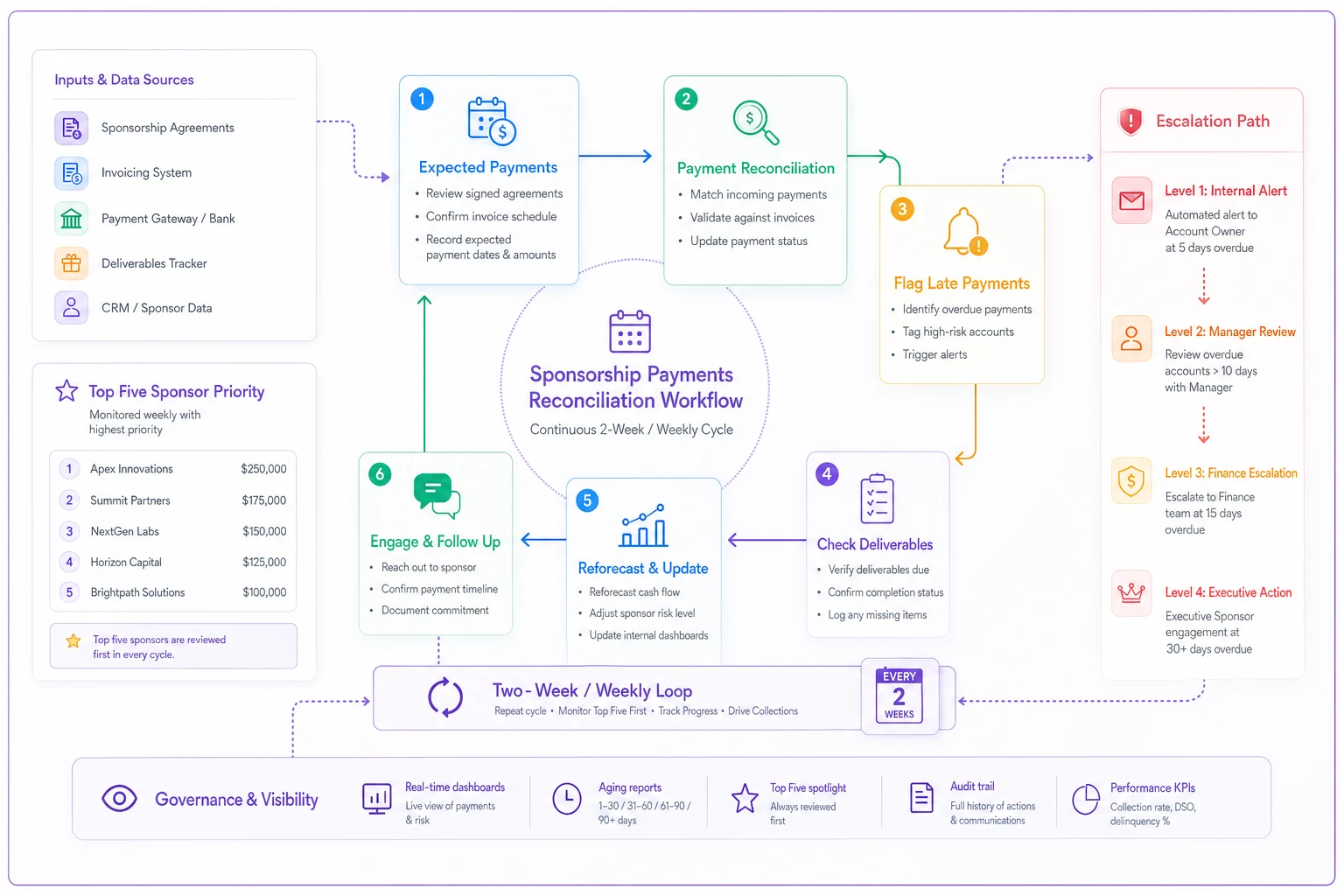
A simple visual of the reconciliation loop makes it easier to assign owners and deadlines.
Shift your pipeline weight while there's still time
The instinct when corporate money tightens is to double down on corporate — chase harder, pitch more, add sponsors. Sometimes that's right. Often it's not, because you're pouring effort into the exact revenue category under the most pressure.
The smarter move in a tightening environment is to rebalance toward pipelines that hold up better when corporate budgets wobble: recurring individual giving, mid-level donor upgrades, existing multi-year grants. These don't swing with a single CFO's refinancing timeline. They're slower to build, which is exactly why you start now instead of in Q3 when the gap is already visible.
When leaning harder into corporate still makes sense: your sponsors are mostly low-fragility — stable, low-debt, foundation-funded — and you have genuine capacity for new relationships. A tightening cycle can actually create openings here, because some companies want visible community commitments precisely when budgets are under scrutiny and competitors are pulling back.
When it's a bad idea: your corporate base is concentrated in a few highly leveraged accounts in rate-sensitive sectors, and those three or four sponsors represent more than half your corporate revenue. Concentration plus fragility is the dangerous combination. Adding another similar sponsor doesn't diversify risk — it compounds it.
Who should probably hold steady: organizations with a balanced mix and healthy liquidity. If corporate is 20% of revenue and well-diversified, you don't need to overhaul anything. Tag fragility, tighten reconciliation on the big accounts, keep stewardship warm.
Build a liquidity buffer assumption into the forecast now
The quietest risk in all of this isn't losing a sponsor outright — it's payment timing shifting enough to create a cash crunch even when total annual revenue holds. A sponsor who pays $45k but moves it from January to May hasn't reduced your annual revenue at all. They've punched a four-month hole in your cashflow, and if your program spending is front-loaded, that hole is real.
Build a simple timing-stress view: take your expected corporate payments, push the high-fragility ones back one full quarter in a second scenario, and see what your cash position looks like month by month. Here's a rough process for running that stress test:
-
List every expected corporate payment with its original due date and amount.
-
Flag each as low, medium, or high fragility using the criteria from the table above.
-
In your second scenario, shift every high-fragility payment back by one full quarter.
-
Map both scenarios month by month against your projected operating expenses.
-
Identify any month where the stressed scenario dips below your comfortable reserve threshold.
-
For any gap you find, decide now
line of credit, accelerated individual giving, or adjusted program timing.
If the stressed scenario dips below your comfortable operating reserve at any point, that's your signal — either secure a line of credit early (before terms tighten further), accelerate individual-giving revenue, or adjust when program spending hits.
The organizations that get hurt in a tightening cycle usually aren't the ones that lost the most money. They're the ones that ran their forecast on a single optimistic timeline and had no second scenario to react against.
A corporate debt wall isn't your problem to solve — but its downstream effects on discretionary budgets absolutely are. The teams that come through a tightening cycle in decent shape aren't the ones with the best luck on renewals. They're the ones who knew which commitments were fragile, read their contracts before they needed the leverage, caught slipped payments in days instead of weeks, and stress-tested their cash position against a timeline where the money arrived late.
None of that requires a bigger team. It requires treating sponsorship revenue with the same operational rigor you'd give any other asset that can shrink without warning — and starting the work now, while a soft commitment is still just a timing question and not a hole in next year's budget.
Ready to elevate your fundraising efforts?
Join 2,000+ nonprofits using Givioly to save time, increase donations, and build lasting donor relationships.