

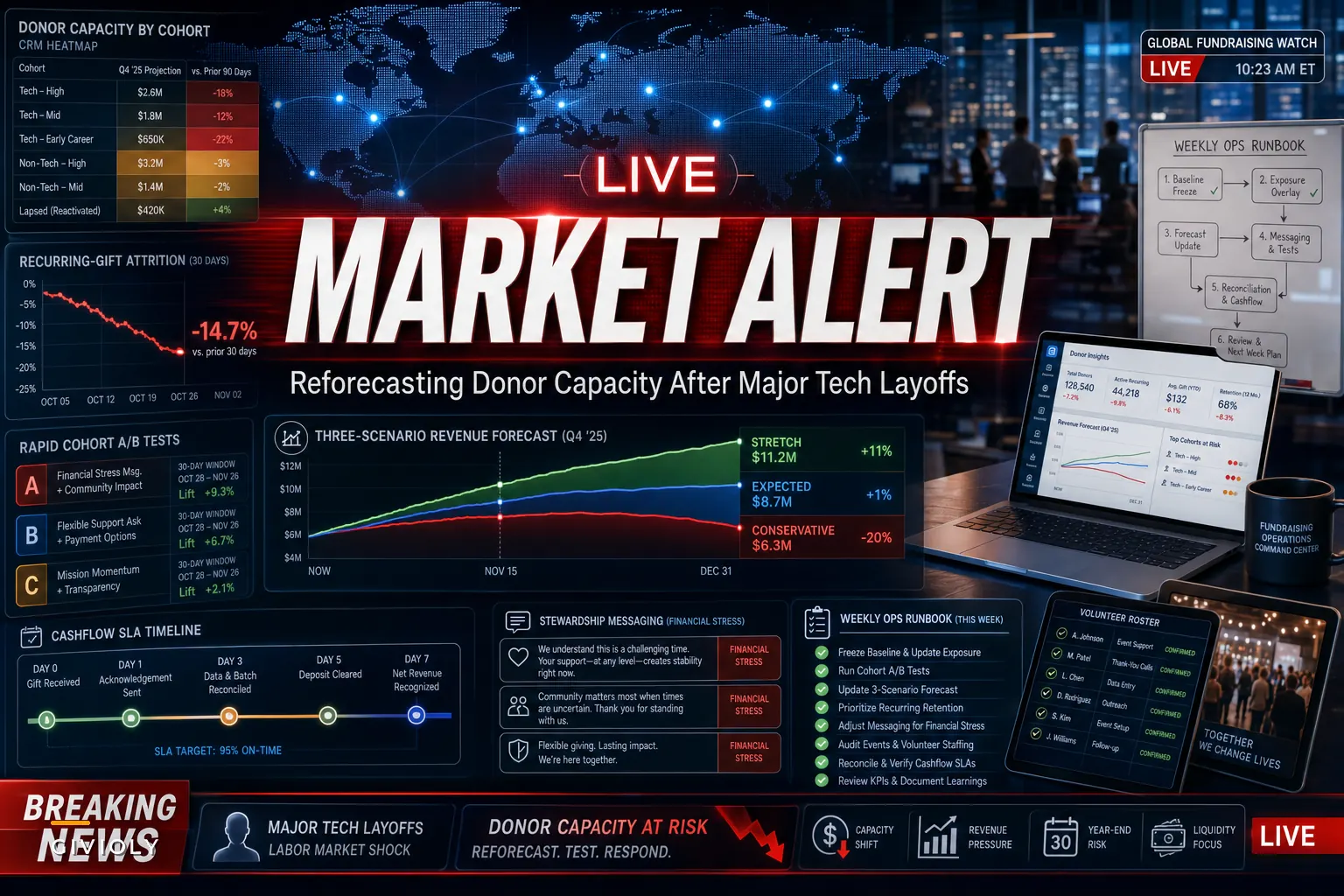

The timing could hardly be worse. Amazon just cut another ~250 jobs in its Devices & Services unit at the end of October, adding to a year that's already been brutal for tech headcount. Business Insider's running layoff tracker reads like a who's-who of companies that employ a lot of your mid-level and major donors — Meta, Dropbox, and plenty of others. For fundraising teams, this isn't an abstract macro story. It lands right in the middle of the window where you'll pull 30–40% of annual revenue.
Most teams get this wrong. They treat a layoff wave as a reason to panic about December numbers when the real problem is slower and more structural. A donor who loses a $180k job in October doesn't cancel their gift the next morning. They quietly let a recurring charge fail in January, skip the year-end ask entirely, or downgrade from a $2,500 gift to $500 without ever telling you why. By the time that shows up in your reports, the window to do anything useful has already closed.
So this piece isn't really about the layoffs themselves. It's about how to run a fast, operational donor capacity reforecast before year-end — one that catches early signal instead of reacting to the damage six months late.
Why income shocks hit fundraising forecasts sideways
Most reforecast conversations happen at the wrong altitude. Leadership asks "are we going to hit our number?" and someone adjusts a top-line projection by gut feel. That's not a reforecast. That's a guess with a spreadsheet attached.
Layoffs are tricky because the impact is concentrated, not evenly spread. If your donor file skews toward tech employment — common for orgs in the Bay Area, Seattle, Austin, or any org that's benefited from corporate matching programs — a handful of layoff announcements can hit a specific slice of your file hard while leaving the rest almost untouched. A blanket 5% haircut across your whole projection ends up simultaneously too pessimistic for your retiree donors and wildly optimistic for your newly-unemployed software engineer donors.
In practice, this usually shows up as a widening gap between pledged and realized revenue in Q1. The pledges looked fine in November. Then recurring gifts start failing, upgrade asks go unanswered, and the mid-level tier — people most likely to be dual-income tech households — underperforms by a margin nobody forecasted.
The underlying problem this keeps exposing: most small nonprofits can't segment their file by employment exposure, and they can't detect capacity changes until the money is already gone. That's a data and workflow gap, not a fundraising-talent gap.
Start with exposure, not with panic
Before touching your forecast, figure out who in your file is actually exposed. You're not trying to be perfect — you're trying to go from "no idea" to "rough map" in a few days.
Simplify donor management and fundraising workflows.
Givioly helps you organize campaigns, engage donors, and maximize fundraising impact seamlessly.
- Unified donor profiles
- Real-time donation tracking
- Automated impact reporting
No credit card required
Pull what you have on employer data. Orgs that have been diligent about matching-gift capture have a real advantage here, because employer fields are already populated. If you've been sloppy about it, you'll be working with partial data, and that's fine for a first pass.
-
High exposure — donors with employer records at companies in active layoff cycles, or in roles and industries clearly affected. Think large-cap tech, plus the contractor and services firms that orbit them.
-
Possible exposure — donors in tech-adjacent geographies or industries, or households you suspect are dual-income tech without confirmation.
-
Low exposure — retirees, public-sector employees, grant-funded program partners, donors whose giving has never correlated with employment income (bequest-oriented, foundation-tied, etc.).
Here's a quick way to think about how each bucket should change your forecast behavior:
| Exposure bucket | Forecast treatment | Primary risk | First action |
|---|---|---|---|
| High | Haircut realized-gift expectation 15–30%, flag all recurring gifts for monitoring | Silent recurring-gift failure, skipped year-end ask | Proactive stewardship + payment-method check |
| Possible | Haircut 5–10%, watch for early churn signals | Downgrade rather than cancellation | Light-touch engagement, no ask pressure |
| Low | No adjustment | Minimal | Business as usual, protect these relationships |
The point of the table isn't precision. It's to stop you from applying one number to a file that behaves in three completely different ways.
The reforecast itself: a 7-step operational process
Once you've got rough exposure buckets, run the actual reforecast. This should take a focused day or two — not a quarter-long committee exercise.
-
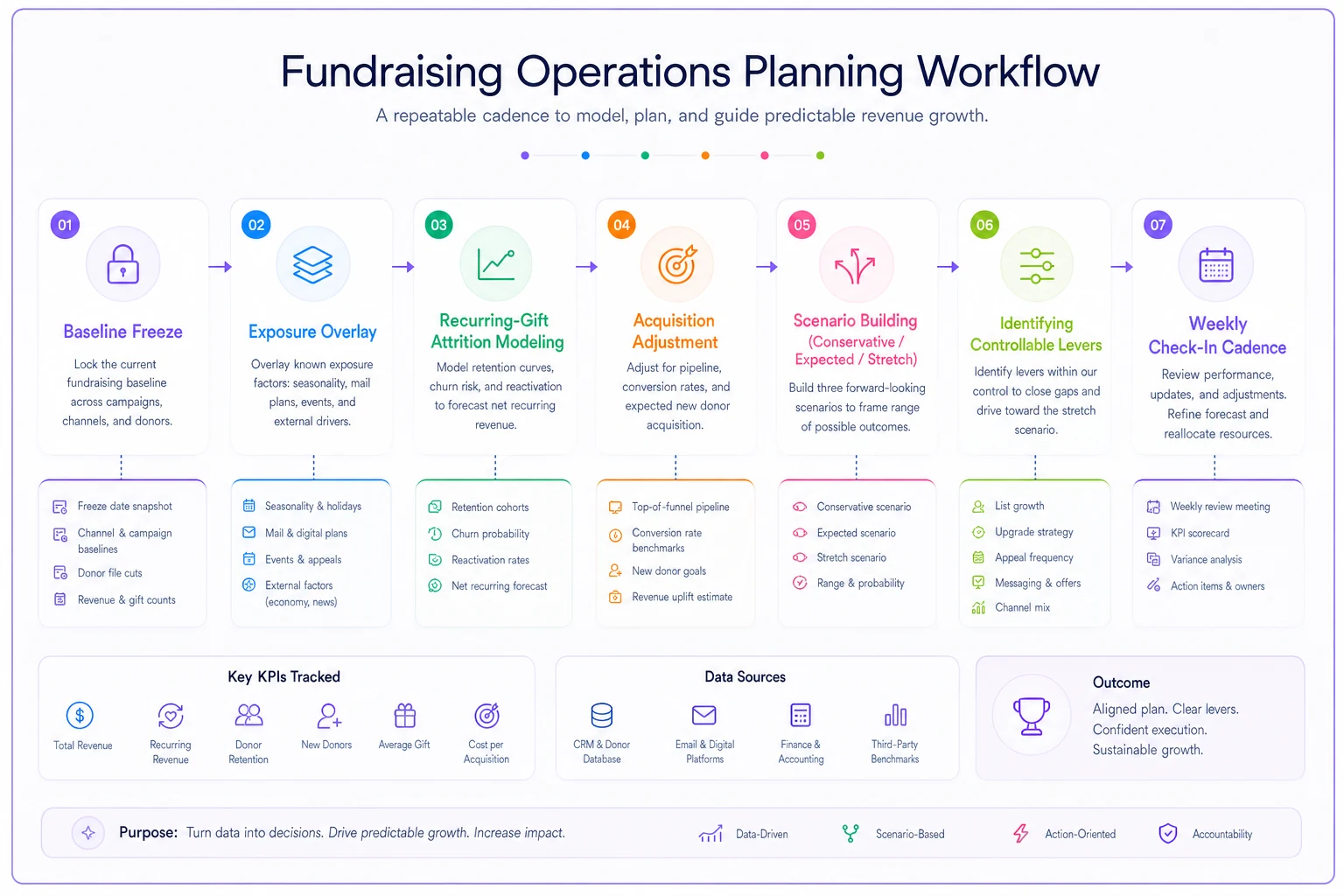
Freeze your baseline. Export your current year-end projection as-is, before any adjustments. You need something to measure the reforecast against, and you need to be able to show leadership exactly what changed and why.
-
Overlay the exposure buckets onto expected revenue. Map how much of your year-end target sits inside the high- and possible-exposure groups. Orgs are frequently surprised here — sometimes 40%+ of the year-end ask is sitting on donors in the top two buckets.
-
Model recurring-gift attrition separately. Recurring donors fail differently than one-time donors. A layoff doesn't change a one-time gift that already cleared, but it will break recurring charges in the months ahead. Build a separate attrition assumption for monthly donors in high-exposure segments.
-
Adjust acquisition expectations down slightly. New-donor acquisition tends to soften during visible economic stress, especially cold acquisition. If your year-end plan assumed aggressive new-donor numbers, trim them.
-
Build three scenarios, not one. Conservative, expected, and stretch. The gap between conservative and expected is essentially your early-warning budget — the amount you'd need to protect through retention work.
-
Identify the controllable levers. Retaining existing recurring donors is almost always cheaper than net-new acquisition. Your reforecast should make that cost difference obvious so leadership funds the right thing.
-
Set a weekly check cadence through December. A reforecast built in late October is stale by Thanksgiving if nobody updates it. Pick a weekly 30-minute slot to compare actuals against your scenarios.
> → How these steps connect: > Baseline freeze → Exposure overlay → Attrition modeling → Acquisition trim → Scenario build → Lever identification → Weekly cadence
Here's a simple visual of how the steps connect.
The mistake teams make is treating the reforecast as a one-time document. The layoff situation is still developing — more announcements are likely — so your forecast needs to stay live.
Detecting early churn before it shows up in revenue
This is the part that actually separates teams that weather an income shock from teams that get blindsided in February. Revenue is a lagging indicator. By the time giving drops, the donor has usually already disengaged.
The leading indicators are behavioral, and most of them are already sitting in your CRM if you know where to look:
-
Recurring gifts that start failing or get paused (watch the dunning and retry logs closely)
-
Open and click rates dropping in a specific segment while the rest of the file holds steady
-
Donors who historically respond to the year-end ask by early December going quiet
-
Downgrade requests clustering — especially voluntary ones ("can I lower my monthly gift?")
-
Address or employer field changes, which sometimes signal a job change before anything else does
Treat failed recurring charges in high-exposure cohorts as stewardship events rather than pure billing problems — reach out with gratitude and an offered pause first.
The best way to make these signals visible is cohort analysis. Instead of asking "how's giving overall," you compare groups — say, high-exposure recurring donors acquired in 2024 — against matched cohorts that aren't exposed. When the exposed cohort starts diverging, you see it weeks before it materializes as a revenue miss. If you haven't set this up before, our cohort analysis playbook for fundraising walks through the common setup mistakes and the actual queries, which will save you from the usual pitfalls of mismatched cohort windows.
Worth internalizing: a failed recurring charge in a high-exposure cohort is a stewardship event, not a billing event. Treating it like a payment problem when it's actually an income problem will make things worse.
A real scenario
A mid-sized education nonprofit — roughly $2.1M annual revenue, heavy donor concentration in two tech hubs — went into last year-end with about 1,400 active recurring donors and a December target around $540k.
When the layoff news hit, they didn't have clean employer data on most of their file, so they ran a rough geographic exposure pass: donors in two metro areas, cross-referenced with anyone who'd ever used a corporate matching portal. That flagged around 310 donors as high or possible exposure — a bigger share of recurring revenue than anyone expected, close to a third of the monthly-giving base.
Instead of a generic year-end blast, they split outreach. Low-exposure donors got the normal campaign. High-exposure donors got a quieter message that led with impact and gratitude, softened the ask, and explicitly offered a pause-instead-of-cancel option for recurring gifts.
The result wasn't dramatic in a headline way. Recurring attrition in the exposed segment came in around 9% over the following quarter instead of the 15–18% they'd been bracing for based on the dunning trend. A chunk of donors who would've silently canceled chose to pause and came back in spring. The net protected revenue landed somewhere in the low tens of thousands — real money for an org that size, earned mostly by not sending a tone-deaf ask to people who'd just lost their jobs.
Adapting stewardship for financially stressed donors
The messaging shift deserves its own attention because it's where good intentions go sideways. The instinct during a revenue scare is to ask harder. For exposed donors, that's exactly backwards.
What tends to work:
-
Lead with impact and thanks, not urgency
-
Offer a graceful downgrade or pause path before they ask for it — a voluntary pause retains the relationship; a hard cancellation often ends it permanently
-
Avoid guilt-based language entirely with this segment
-
Keep the door open for these donors to come back up when their situation stabilizes, which many will
The donors you handle well during a hard stretch tend to become your most loyal donors later. The ones you pressure at the wrong moment often don't come back at all.
Don't forget the demand side
Layoffs don't just depress giving — they can increase demand for your services if you run programs that touch employment, housing, food security, mental health, or family support. The same event that pressures your revenue can spike your program load.
Surface this to program teams early. If intake or referral volume starts climbing, leadership needs to know the revenue reforecast and the demand forecast are moving in opposite directions simultaneously. That's a harder conversation than either one alone, and it's a lot better to have it in November than in crisis mode in Q1.
When this level of effort makes sense — and when it doesn't
This makes sense when a meaningful share of your file is concentrated in affected industries or geographies, you lean on recurring and mid-level giving, and year-end is a major revenue event for you. If you can map even rough employment exposure across a third or more of your donors, the reforecast will pay for itself.
This is overkill when your revenue comes mostly from foundations, government grants, or a bequest-heavy base with no real correlation to tech employment. If your donors are overwhelmingly retirees or your funding is contractually locked in, a full exposure reforecast is wasted motion — spend that time elsewhere.
Who should skip the cohort-level detection entirely: very small shops with a few hundred donors and no CRM worth querying. At that scale, you're better off making a dozen personal calls to your top donors than building analytics infrastructure you won't maintain.
The real lesson underneath all of this
The layoff wave is a stress test, and it keeps revealing the same gap at most small nonprofits: they can't see donor capacity changing until it's already reflected in the bank account. The orgs handling this well aren't the ones with bigger budgets. They're the ones who built the habit of segmenting their file, watching behavioral signals, and reforecasting continuously instead of once a year.
You won't fix the employment data gap in the next 30 days. But you can run a rough exposure pass, split your year-end outreach so you're not asking laid-off donors to dig deeper, and set up a weekly check that catches recurring-gift failures as the stewardship signals they actually are. Do that, and a hard fourth quarter becomes a managed one instead of a surprise you're reading about in your January reports.
You won't fix the employment data gap in the next 30 days. But you can run a rough exposure pass, split your year-end outreach so you're not asking laid-off donors to dig deeper, and set up a weekly check that catches recurring-gift failures as the stewardship signals they actually are. Do that, and a hard fourth quarter becomes a managed one instead of a surprise you're reading about in your January reports.
Ready to elevate your fundraising efforts?
Join 2,000+ nonprofits using Givioly to save time, increase donations, and build lasting donor relationships.