

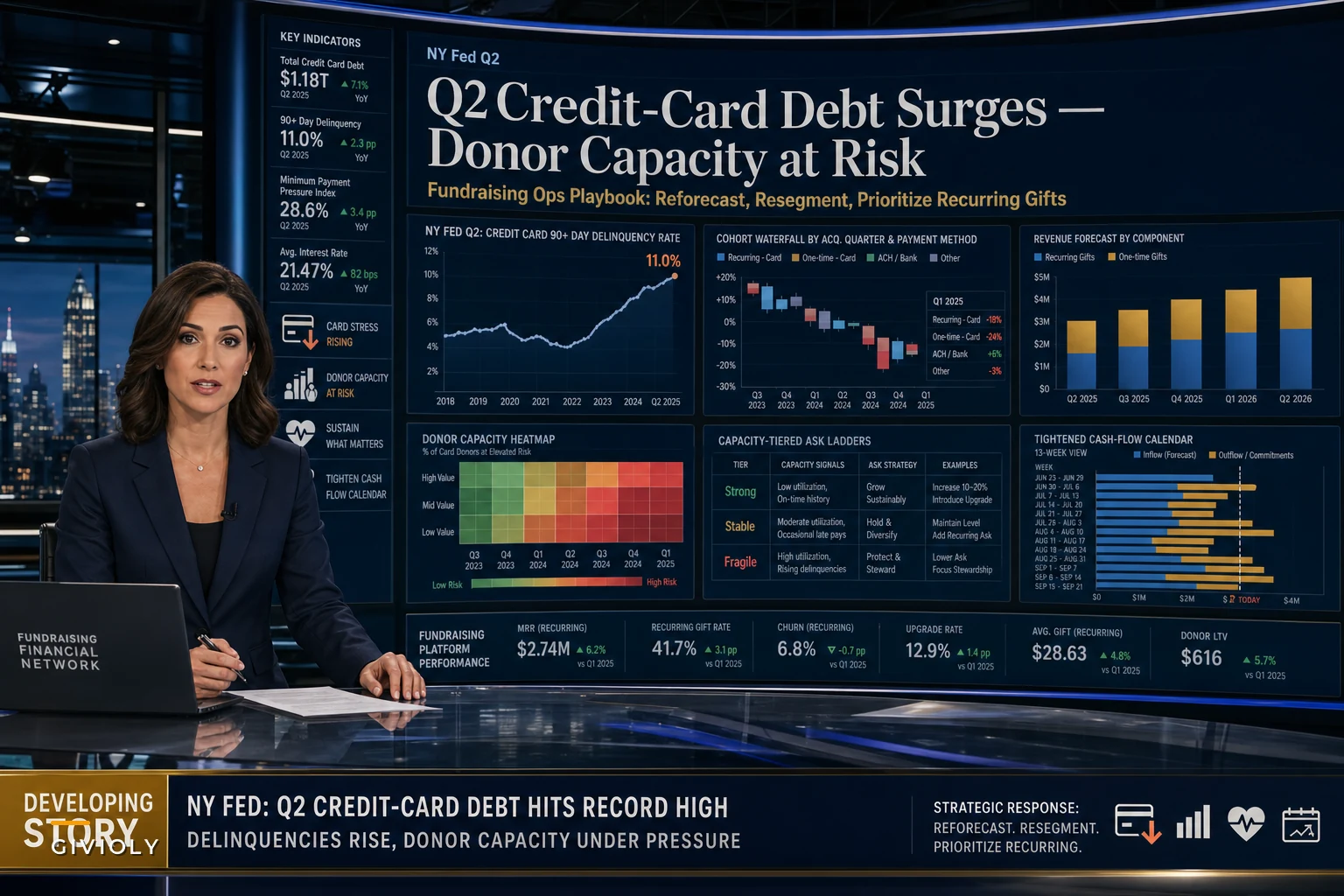

The New York Fed's Q2 2026 numbers landed in early August, and they weren't great. Credit card balances climbed another $21 billion to $1.26 trillion, and 90-plus-day delinquencies pushed toward 12.8%. CNBC's coverage leaned into the "K-shaped" story — some households are fine while others are quietly drowning — and that split is the part fundraising teams should actually care about.
A rising national debt number by itself doesn't tell you much about your file. But the divergence does. It means your donor base isn't moving in one direction. Some of your recurring donors will be tightening up through the fall while others barely notice. If you run your year-end appeal like it's 2023 and blast the same ask ladder to everyone, you'll do two things at once: leave money on the table with the stable segment and quietly trigger cancellations and chargebacks in the strained one.
This isn't a doom post. Giving doesn't collapse in a soft consumer environment — it gets lumpier and less predictable. The teams that come out ahead treat this as a reforecasting and resegmentation problem, not a messaging problem.
Start by admitting your forecast is probably wrong
Most small-shop revenue forecasts are built on a straight-line assumption: last year's retention rate, times last year's average gift, plus a growth nudge from leadership. That model breaks the moment donor behavior stops being uniform.
The mistake teams make constantly is reforecasting total revenue without reforecasting the components. They shave 5% off the top-line number and call it prudent. But the risk isn't spread evenly. Recurring gift failure rates, average one-time gift size, and lapsed-donor reactivation all move differently under financial pressure — and they move differently across your donor segments.
A more honest reforecast separates at least these lines:
-
Recurring revenue, split by card-based vs. ACH/bank-draft donors
-
New one-time gifts (acquisition-dependent, most fragile)
-
Reactivated lapsed donors
-
Mid-level and major gifts (usually the most insulated)
-
Sponsorship / grant income (different risk profile entirely)
Card-based recurring donors matter more than people realize right now. When someone's credit line is maxed or a card gets declined mid-cycle, your recurring gift is one of the first casualties — not because the donor decided to stop supporting you, but because the payment just failed and nobody chased it. Involuntary churn spikes in exactly this environment, and it's completely invisible if you're only watching top-line revenue.
Resegment around payment behavior, not just giving history
Traditional segmentation leans on recency, frequency, and monetary value. Useful, but backward-looking. In a squeezed environment you want a second axis: payment fragility.
Simplify donor management and fundraising workflows.
Givioly helps you organize campaigns, engage donors, and maximize fundraising impact seamlessly.
- Unified donor profiles
- Real-time donation tracking
- Automated impact reporting
No credit card required
Two donors can look identical on an RFM chart — both gave $50/month for three years — but behave completely differently when things get tight. One pays via bank draft and never fails. The other is on a credit card that's getting declined every other month and needs a dunning email to recover. Same lifetime value on paper. Very different risk today.
A simple way to layer capacity signals on top of your existing segments:
| Signal | What it tells you | Ops action |
|---|---|---|
| Payment method (card vs. ACH) | Card recurring is higher involuntary-churn risk | Prioritize card-updater flows, offer ACH switch |
| Recent decline / retry history | Early sign of household strain | Softer touch, no upgrade asks yet |
| Gift downgrade in last 6 mo. | Voluntary belt-tightening | Protect, don't push — stewardship only |
| Consistent same-day-of-month gift | High stability, low fragility | Safe to test modest upgrade ask |
| Multiple small increases over time | Engaged, capacity likely intact | Strongest upgrade candidates |
The point isn't to build a data science project. It's to stop treating "a donor" as a single thing. Donor capacity is not a fixed attribute — it's a moving estimate, and right now it's moving in different directions for different people. Segmenting on payment behavior gives you a leading indicator instead of finding out in January that a quarter of your recurring file quietly fell off in Q4.
Cohorts are the tool that actually shows you the movement
Aggregate retention numbers hide the story. A 2024 acquisition cohort and a 2021 cohort will respond to financial pressure very differently — newer donors have thinner loyalty and lapse faster when their budget tightens, while older cohorts are stickier but carry larger average gifts that are more sensitive to downgrade.
If you're not already running cohorts by acquisition period and payment method, now is the time. Watching how each cohort's revenue per donor and involuntary churn rate trend month over month shows you where strain is showing up first — usually in your youngest, card-heavy cohorts. Our cohort analysis playbook for fundraising walks through the setup mistakes that make these numbers lie to you, but the short version: keep cohort definitions stable, separate voluntary from involuntary churn, and never blend one-time and recurring behavior in the same view.
A pattern worth watching: when the economy tightens, cohorts don't fail all at once. The retry recovery rate drops first — cards that used to recover on the second attempt stop recovering. That's roughly your two-month early warning before the churn actually shows up in revenue.
A practical reforecast-and-resegment sequence
If you have a few weeks before your fall campaign locks, run this in order:
-
Pull 24 months of recurring gift data, tagged by payment method and decline/retry history. You need the raw behavior, not summary stats.
-
Rebuild cohorts by acquisition quarter. Calculate revenue-per-donor and involuntary vs. voluntary churn for each.
-
Flag the fragile segment
card-based recurring donors with any decline in the last 6 months, plus anyone who downgraded. Pull them out of your upgrade lists entirely.
-
Reforecast by component, not top-line. Apply a higher involuntary-churn assumption to card cohorts, a modest downgrade assumption to mid-level, and hold major/sponsorship steady unless you have a specific reason.
-
Build a capacity-tiered ask ladder. The healthy segment gets a normal-to-slightly-higher ask. The fragile segment gets a hold-the-line ask — renew at current level, no increase.
-
Tighten your cash-flow calendar. Map expected recurring recovery timing so a slow December doesn't catch finance off guard in the middle of payroll.
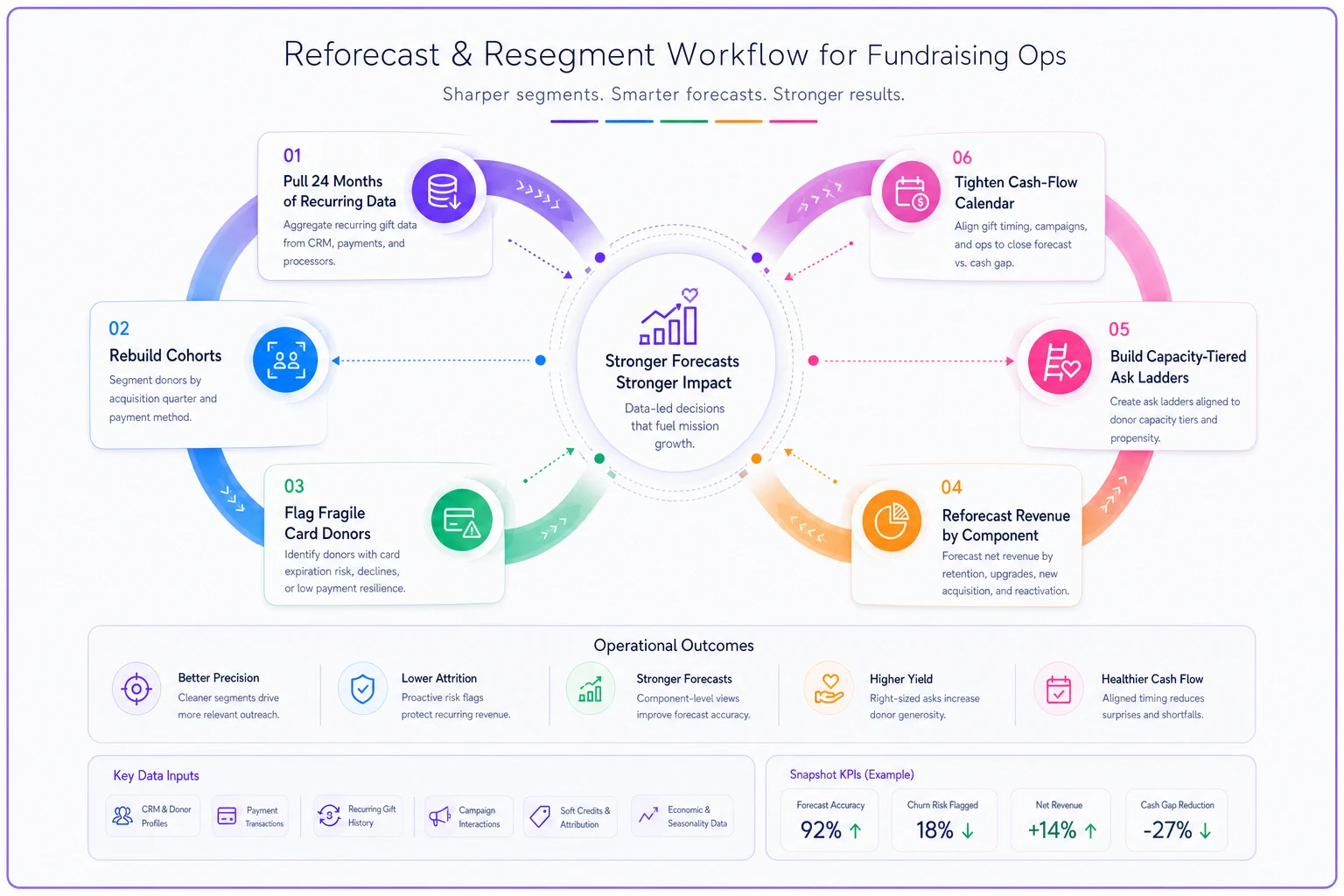
A visual like this helps teams align on the sequence and handoffs.
Step 5 is the one teams skip, and it's the one that protects both revenue and relationships. Asking a strained donor to upgrade doesn't just fail — it often prompts them to cancel entirely, converting a recoverable involuntary lapse into a permanent voluntary one.
Protecting recurring revenue is mostly unglamorous plumbing
Nobody gets excited about card-updater tools and dunning sequences, but in an environment like this they're worth more than a new campaign. A meaningful share of "lost" recurring donors in a soft economy never decided to leave. Their card expired, got reissued after a fraud flag, or got declined once and never retried.
A tight recurring-recovery workflow looks like this:
-
Automatic card updater enabled through your processor so reissued cards keep working without donor action
-
A staged retry schedule — not one attempt, space retries across several days
-
A short dunning sequence that leads with the mission, not "your payment failed"
-
An easy ACH switch offer for donors whose cards keep bouncing
-
A monthly involuntary-churn report so this stays visible to leadership
Enable your processor's automatic card updater before the fall campaign locks to reduce involuntary churn.
This is exactly the kind of repetitive, rules-based work where operational software with light automation earns its keep — flagging failed payments, triggering the right recovery sequence, keeping a clean audit trail of what recovered and what didn't. Not because automation is exciting, but because a two-person shop physically cannot chase every declined card by hand, and the ones that slip through are pure lost revenue.
A real scenario: the community food-security nonprofit
A mid-size regional food-security org — roughly 4,200 active recurring donors, around $95k/month in recurring revenue — noticed their December recovery numbers looking soft heading into fall. Their monthly recurring failure rate had crept from about 6% up toward 9%, and most of the increase was concentrated in donors acquired in the previous 18 months on credit cards.
Instead of pushing their usual year-end upgrade ask across the whole file, they split it. Stable-payment donors on bank draft with no declines got the normal ask ladder. The fragile card-heavy cohort got a "renew and thank you" message with no increase, plus a quiet nudge to switch to bank draft. They also turned on their processor's card-updater and rebuilt their retry timing.
By late January the involuntary churn on that fragile cohort had settled back down to around 6–7%, and — this is the part that surprised them — the ACH switch offer converted a decent slice of chronic decliners into stable donors. Total recurring revenue came in only slightly under the prior year instead of the double-digit drop their original straight-line forecast had quietly baked in. Not a miracle. Just resegmenting before the season instead of reconciling the damage after it.
When aggressive asks still make sense — and when they don't
You don't have to play defense across the board. The healthy segment is real, and under-asking it is its own mistake. Donors on stable payment methods with rising gift histories are not the ones the delinquency numbers are about. Ask them confidently.
Where a cautious posture makes sense:
-
Newer card-based cohorts with any decline history — protect, don't push.
-
Recently downgraded donors — they've already told you something. Listen.
-
Broad acquisition campaigns — new-donor conversion is the most economically sensitive line there is, so don't over-invest your fall budget there right now.
Where holding back is a mistake:
-
Your major and mid-level donors, most of whom sit on the insulated side of the divide.
-
Corporate and sponsorship income, which runs on a different clock than household budgets.
-
Long-tenured, stable-payment recurring donors — treating them as fragile just leaves money on the table.
The whole point of resegmentation is to stop making one decision for everyone. The debt report describes a divided donor base; your ask strategy should be divided to match.
The underlying problem this exposes
The credit-card data is really just a stress test for something that was already true: most small fundraising operations forecast and segment as if their donor base is homogeneous. It never was. A soft consumer environment just makes the cost of that assumption visible faster.
The organizations that stay steady through the fall aren't the ones with the cleverest appeal. They're the ones who can see their file clearly — cohort by cohort, payment method by payment method — and act on what they see before the churn shows up in the bank account. If you want to go deeper on the mechanics, the New York Fed publishes its full household debt and credit report quarterly, and it's worth watching the delinquency and retry-adjacent trends as leading indicators for your own recurring file.
Reforecast by component. Resegment on payment behavior. Watch your cohorts. Protect capacity where it's fragile and ask confidently where it isn't. Do those four things and a lumpy giving season stops being a threat and becomes something you've already planned for.
Ready to elevate your fundraising efforts?
Join 2,000+ nonprofits using Givioly to save time, increase donations, and build lasting donor relationships.