

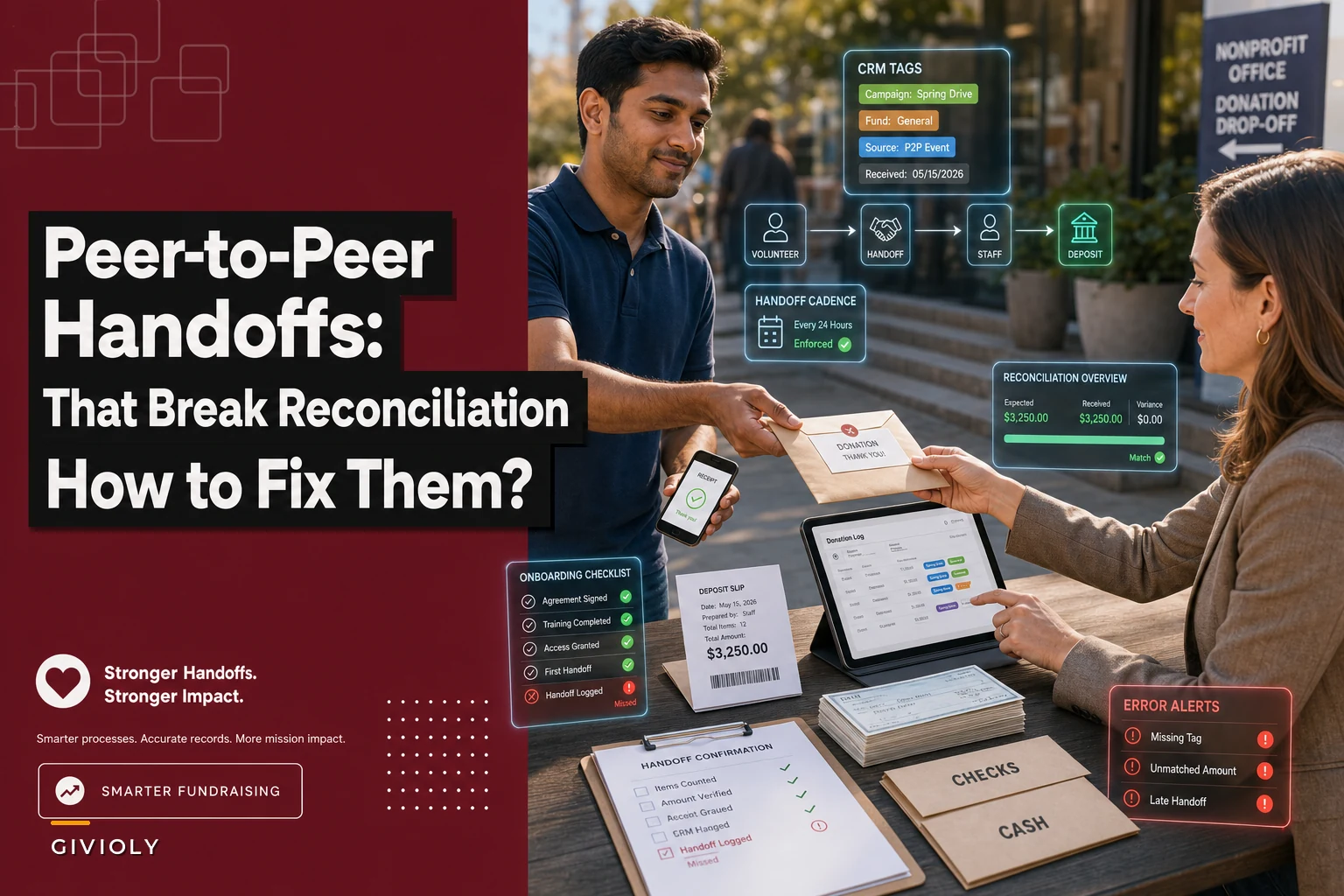

The gifts almost always look fine on the surface. Your P2P platform shows a clean total, the campaign page hit its goal, and everyone's celebrating in the team Slack. Then finance opens the export three weeks later and asks the question that ruins the afternoon: who is this $250 from, why is it credited to a volunteer who isn't in our CRM, and where's the receipt?
That gap — between what the fundraiser thinks happened and what your books can actually prove — is where most peer-to-peer fundraising operations quietly fall apart. Not at the ask. Not at the donation. At the handoff, when a volunteer's activity has to become clean, attributed, receipt-ready data inside your systems.
This post is narrowly about that handoff. How it breaks, what it costs, and the specific onboarding, routing, compliance, and CRM-tagging rules that keep P2P money reconcilable instead of guesswork.
The specific failure: attribution dies at the volunteer boundary
There's a pattern that shows up constantly in P2P programs, regardless of platform.
-
The volunteer collects two checks at a family barbecue and mails them to your office.
-
A coworker Venmos the volunteer $100 "for your run" and the volunteer forwards it to your Zelle.
-
Someone donates directly on your main website after the volunteer texts them a link — but the link had no attribution code.
All four gifts belong to that volunteer's effort. Only one arrives with clean attribution. The other three enter your world as orphaned money — real dollars with no reliable connection to the person who raised them.
Multiply that by 40 volunteers in a campaign and you've got a reconciliation problem that isn't about accounting skill. It's about the fact that P2P generates gifts through channels your platform never sees, and nobody built a rule for what happens when money crosses from a volunteer's hands into yours.
Why this happens (it's structural, not sloppy)
The instinct is to blame volunteers for being disorganized. That's the wrong diagnosis.
Simplify donor management and fundraising workflows.
Givioly helps you organize campaigns, engage donors, and maximize fundraising impact seamlessly.
- Unified donor profiles
- Real-time donation tracking
- Automated impact reporting
No credit card required
Volunteers aren't staff. They don't know your gift-entry conventions, they don't have CRM logins, and they shouldn't. So every piece of information they hold — donor names, designations, the fact that a check is a match-eligible gift — has to be transferred to you, and transfers are where data dies.
Off-platform giving is the norm, not the exception. In most P2P campaigns, a meaningful chunk of dollars — often somewhere in the 15–30% range — comes in as cash, checks, and peer payment apps that route around the fundraising platform entirely. Your platform total and your bank deposit will never naturally match, because they're measuring different things.
Attribution links are fragile. A volunteer copies their page URL, pastes it into a text, the recipient clicks, gets distracted, and later Googles your org and donates through the main form. The gift is real. The attribution is gone. This is most of the "why is our website revenue up during the campaign but nobody's credited" mystery.
The result is that the volunteer knows things your CRM doesn't, and nobody built a repeatable moment to move that knowledge across.
What it actually costs
The dollars usually reconcile eventually — you don't lose the money, you lose the ability to explain it. And that has a price.
Volunteer credit gets wrong, and volunteers notice. When a top fundraiser raised roughly $4,200 but your leaderboard shows $2,900 because a third of it came in off-platform and never got attributed, that person feels it. They're your best recruiter for next year, and you just told them their effort didn't count.
Receipts go out late or wrong. Off-platform donors who gave through a volunteer are the most likely to get a delayed acknowledgement or none at all, because their gift entered as an orphan. If you've already built donation acknowledgement SLAs, P2P off-platform gifts are exactly the population that slips past them.
Finance burns hours in the wrong month. A campaign that raised $60k might generate 6–10 hours of untangling for a bookkeeper weeks later, matching Venmo transfers to volunteer names from memory. It always lands during close.
Compliance exposure hides in the pile. Buried in P2P gifts you'll sometimes find a donation from a board member's business, a gift that triggers a matching program, or money routed through a volunteer's personal payment app in a way that muddies whose gift it legally is. Without a check at intake, these surface during an audit instead of at the moment you could've handled them cleanly.
The fix, part one: onboard volunteers like they're a data source
Volunteer onboarding usually focuses on motivation — here's the cause, here's your page, go raise money. That's fine, but it skips the operational half. Your onboarding has to teach volunteers the handful of behaviors that keep their money reconcilable.
You don't need a training program. You need a one-page checklist every volunteer gets before they start, covering the moments where attribution dies.
Volunteer onboarding checklist (the operational half):
-
Always share your personal page link — never the org's main donation URL — so gifts attribute automatically.
-
If someone hands you cash or a check, write the donor's full name, mailing address, and email on the gift log — a check alone isn't enough for a receipt.
-
Don't route donations through your personal Venmo/Zelle/PayPal. If someone insists, log their real name and contact info so we can credit and receipt them, not you.
-
Mark any gift where the donor mentioned an employer match.
-
Flag if a gift comes from a business you own or a family member's company — we handle those slightly differently.
-
Turn in your gift log within 48 hours of collecting anything offline, even if the campaign is still running.
Make the one-page checklist a required step before a volunteer's page goes live.
That last rule matters more than it looks. The single biggest attribution killer is delay — a volunteer collects $600 across three weeks, then reconstructs it from memory at the end. Fresh logs are accurate logs.
The fix, part two: gift routing and reconciliation rules
Once money leaves the volunteer's hands, it needs a predetermined path to your books. The failure mode is having no default — so cash goes wherever, checks pile on someone's desk, and payment-app money gets forwarded inconsistently.
Here's a routing table that removes the guesswork:
| Gift type | How it should arrive | Attribution captured by | Receipt owner |
|---|---|---|---|
| Online through personal page | Platform (automatic) | Platform code | Automated |
| Check via volunteer | Mailed/dropped to office + gift log | Volunteer's log entry | Gift entry staff |
| Cash via volunteer | Deposited to org, logged same-day | Volunteer's log entry | Gift entry staff |
| Peer app (Venmo/Zelle) to volunteer | Discouraged; if unavoidable, logged with donor's real identity | Volunteer's log entry | Gift entry staff |
| Direct website gift (no code) | Main donation form | Manual match at reconciliation | Automated, then re-attributed |
The bottom row is the one people forget. You will get uncoded website gifts during a campaign. Build a rule: any main-form gift during an active P2P campaign gets a quick check against the volunteer roster — donor last name, employer, or a note in the gift comment field often reveals the connection. It's not perfect, but it recovers a chunk of the orphaned attribution instead of writing it off.
For reconciliation itself, the principle mirrors any audit-ready reconciliation workflow: reconcile three totals against each other, not two. Platform total, bank deposits, and your offline gift logs. When platform + logs equals your deposits, you're clean. When they don't, the gap is almost always an unlogged offline gift or a peer-app transfer nobody recorded — and now you know exactly where to look.
This diagram shows the routing and reconciliation workflow in one view.
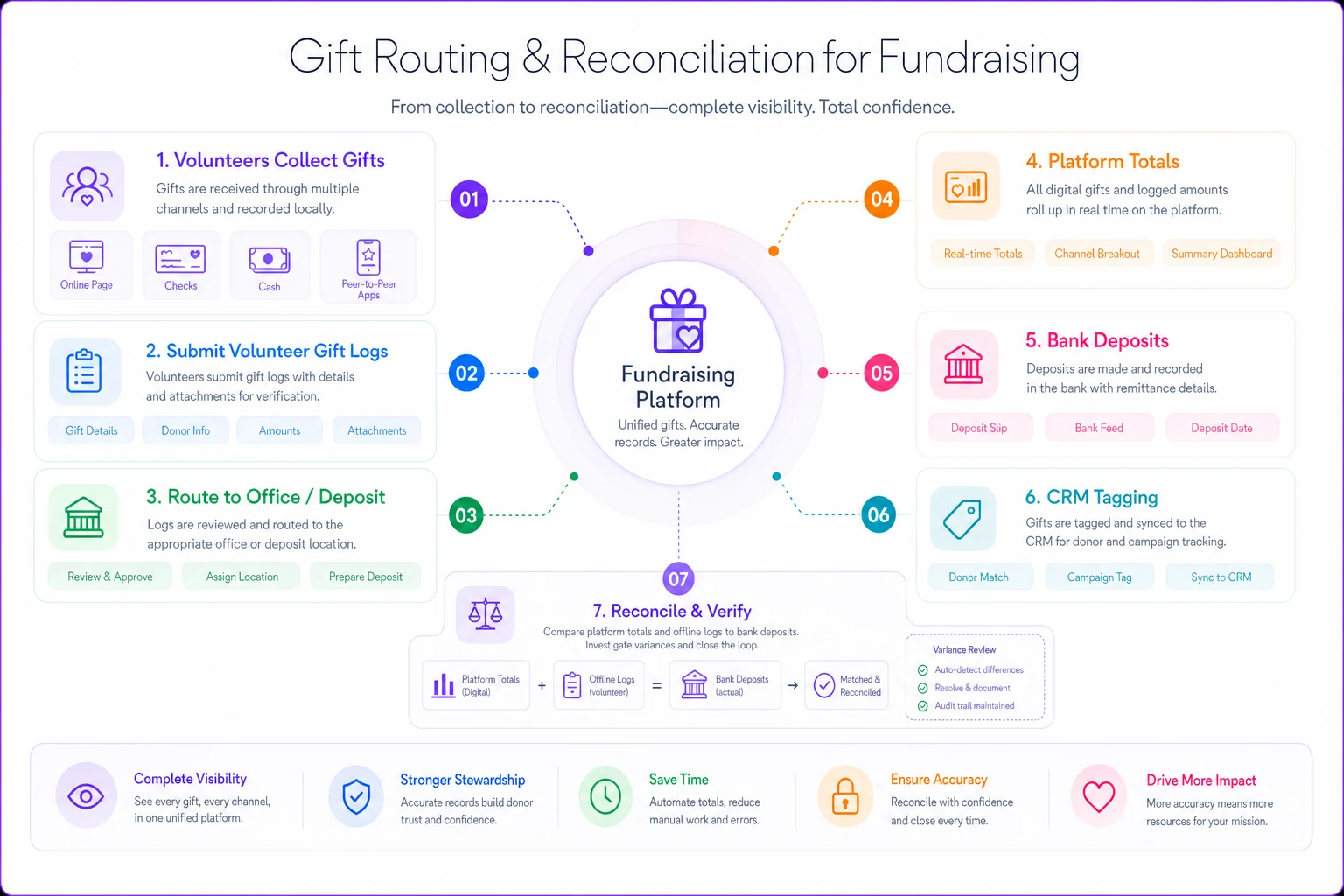
Use this as a checklist when you design your intake forms and staff responsibilities so each handoff point is covered.
The fix, part three: light compliance and conflict-of-interest checks
You don't need a legal review on every P2P gift. You need a thin filter at intake that catches the few gifts that carry risk. Most programs have no filter at all, which is how a conflicted gift ends up discovered by an auditor.
-
Self-dealing / insider gifts. A gift from a board member's company, a staff member's spouse, or the volunteer's own business through their page. These aren't necessarily problems — they just need to be flagged and documented, not routed silently into general revenue.
-
Pass-through money. When a volunteer collects funds through a personal account and forwards a lump sum, the donor of record is the original giver, not the volunteer. Getting this wrong misstates who gave what and can distort receipting and giving history.
-
Restricted or conditional gifts. A donor tells the volunteer "this is for the scholarship fund." That designation lives in the volunteer's head unless the log captures it — and unrestricted-vs-restricted errors are painful to unwind later.
-
Match-eligibility. Not compliance exactly, but the same failure shape: information the volunteer has that your system needs.
The mechanism is one field on the gift log: "Anything unusual about this gift? (business gift, restricted purpose, employer match, forwarded from someone else)" — and a staff member who reviews flagged entries before they're posted. That's the whole system. It costs a few minutes and saves you the audit-day surprise.
The fix, part four: the staff–volunteer handoff cadence
The reason handoffs break is that they happen whenever, which means they effectively happen never until the end. Fix that with a rhythm.
For a multi-week campaign, a workable cadence:
-
Kickoff every volunteer submits contact info and acknowledges the onboarding checklist. No page goes live without it.
-
Weekly each volunteer with offline activity submits (or updates) their gift log. A staff owner reviews new logs, enters gifts, and clears any compliance flags within a couple of days.
-
Mid-campaign check staff reconciles platform + logs against deposits so far. Gaps get chased while memories are fresh, not three weeks later.
-
Wrap (within one week of close) final logs in, final reconciliation, leaderboard corrected to include attributed offline gifts, receipts confirmed sent.
The weekly touch is what prevents the end-of-campaign avalanche. A volunteer reporting $200 this week is accurate; the same volunteer reconstructing $1,400 across six weeks is guessing.
CRM tagging conventions that make attribution survivable
None of the above sticks unless your CRM can tell you, later, that a gift was P2P, which campaign, which volunteer, and how it arrived. Free-text notes won't do it — they're unsearchable and inconsistent across whoever did the entry.
-
Source tag
P2Pon every gift, no exceptions. -
Campaign tag
P2P-SpringRide-2025— consistent naming so you can pull the whole campaign in one query. -
Fundraiser link the volunteer's constituent record connected to each gift (soft credit or your platform's equivalent), so leaderboards and thank-yous can be built from data, not spreadsheets.
-
Channel tag
online/check/cash/peer-app— this is what makes your three-way reconciliation possible. -
Flag tag
review-insider,restricted,match-eligiblewhere relevant.
Consistency beats sophistication here. A simple schema everyone actually follows will out-perform an elaborate one applied unevenly — and the same discipline that keeps P2P clean is what good donor data hygiene looks like across the board. If two staff members tag the same campaign three different ways, your reporting is broken no matter how good the platform is.
A real scenario
A mid-sized animal welfare nonprofit ran an annual peer-to-peer walk with about 50 volunteer fundraisers. The platform reported roughly $58k raised. Their bank deposits, weeks later, came to something closer to $71k — the difference being cash, checks, and a pile of peer-app transfers that had entered as general website and lockbox gifts with no P2P connection.
The bookkeeper spent most of two afternoons trying to reconstruct which volunteer raised the offline money, mostly from memory and email threads. Attribution on roughly a fifth of the total was never recovered. Two top fundraisers were under-credited on the leaderboard by several hundred dollars each, and about a dozen offline donors got their receipts more than a month late.
The next year they changed almost nothing except process: a one-page onboarding checklist, 48-hour gift logs, weekly log submission, a single "anything unusual?" field, and consistent P2P + channel tagging in the CRM. Same platform, same volunteer count. Post-campaign reconciliation dropped from two painful afternoons to under two hours, attributed offline gifts nearly all made it to the right volunteer, and receipting stayed inside their normal SLA. Nothing exotic — they just stopped treating the handoff as an afterthought.
Where tooling helps — and where it doesn't
Software won't fix a missing process. If volunteers aren't logging offline gifts, no platform recovers information that was never captured. The human behaviors — collect the donor's name, log it fast, flag the weird ones — have to exist first.
Where operational tooling earns its keep is in the repetitive coordination around those behaviors: sending volunteers the onboarding checklist and chasing acknowledgements, nudging weekly log submissions, routing flagged gifts to a staff reviewer, keeping tagging conventions consistent so reconciliation is a query instead of an archaeology project. Workflow platforms with light automation can carry the reminder-and-routing load that otherwise falls on one overloaded coordinator — which matters most in the exact weeks when your team has no spare attention. The point isn't to automate judgment; it's to make sure the handoff actually happens on schedule instead of collapsing to the end.
When to invest in this — and when not to
If your P2P program is one or two volunteers and a few thousand dollars, this level of structure is overkill. Log the gifts, tag them P2P, and move on.
Build the full system when any of these are true: you run multi-week campaigns with 20+ volunteers, a meaningful share of your P2P dollars arrives offline, you're seeing leaderboard disputes, or finance regularly complains that campaign months are hard to close. That's where the handoff stops being an annoyance and starts being a recurring, quantifiable drain.
Peer-to-peer fundraising doesn't break at the fundraising. It breaks in the quiet moment when a volunteer's effort has to become your data. Build the checklist, the routing table, the light compliance filter, the handoff cadence, and the tagging convention — and that moment stops eating your reconciliation alive.
Ready to elevate your fundraising efforts?
Join 2,000+ nonprofits using Givioly to save time, increase donations, and build lasting donor relationships.