

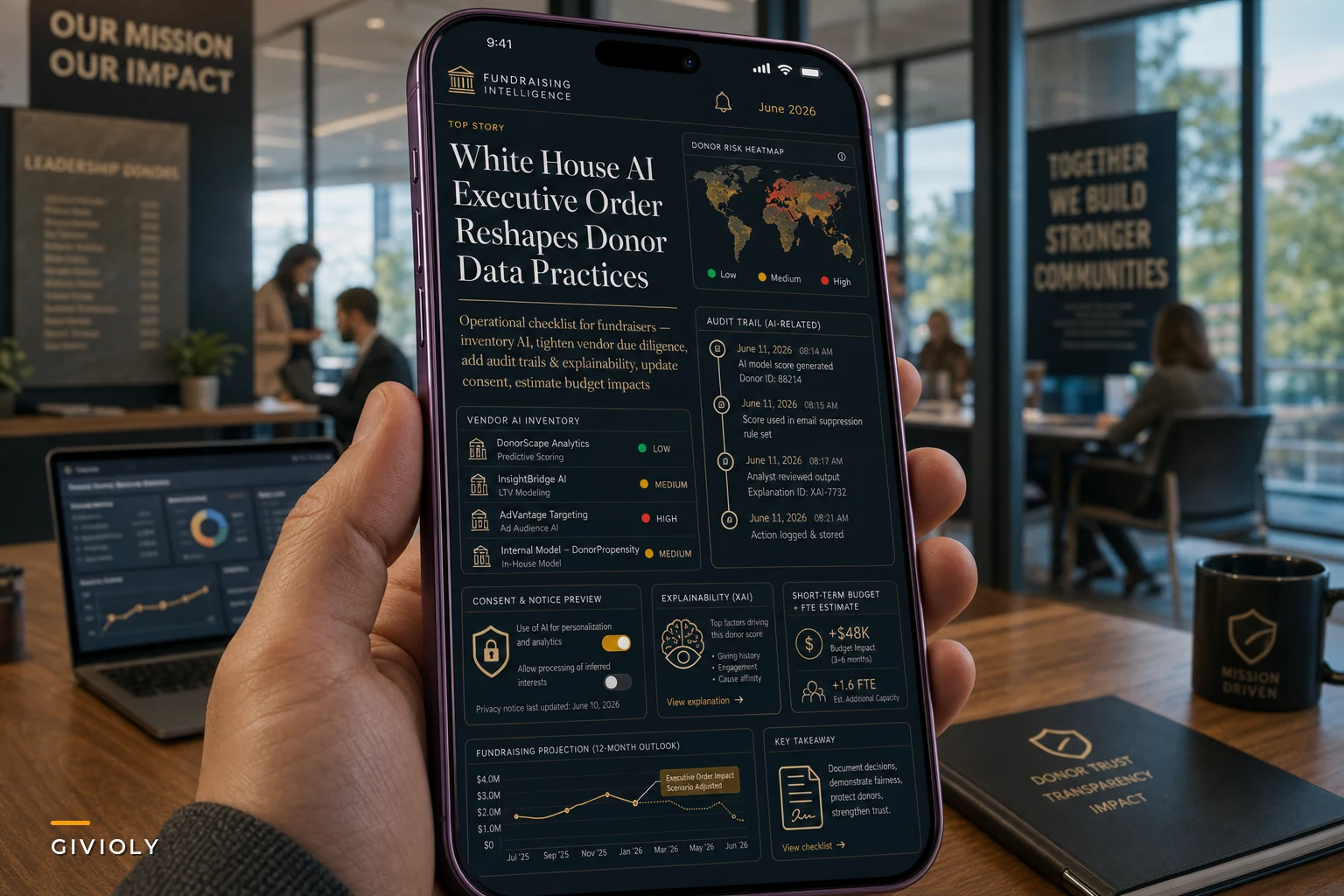

Monday morning, and your development director forwards you the White House's new AI executive order with a single question: "Does this affect our donor scoring model?"
Short answer: Yes. Along with your email personalization, your major gift predictions, and that chatbot handling donor inquiries on your website.
The executive order demands federal agencies establish AI safety guidelines, cybersecurity protocols, and voluntary model testing frameworks. For nonprofits, this means your fundraising tech stack just became a compliance concern. Not next year. Right now.
When federal standards emerge, foundation grant applications start asking about them. Corporate sponsors add them to due diligence questionnaires. Board members start questioning vendor contracts. And suddenly that donor analytics platform you bought last year needs documentation you never thought to request.
Your donor data sits at the intersection of three compliance pressures
Most fundraising teams think about donor data through a simple lens: GDPR for European supporters, state privacy laws for U.S. donors, maybe PCI compliance for payment processing. The AI executive order creates a fourth layer that cuts across everything.
Take your typical mid-size nonprofit's data flow. Donation comes through your payment processor. Gets logged in your CRM. Flows to your email platform for acknowledgment. Feeds into your analytics tool for segmentation. Each vendor in that chain might be using AI for fraud detection, duplicate matching, or engagement scoring.
Under emerging AI donor data compliance standards, you need visibility into what models each vendor uses, how they train them, and what happens when they make mistakes. A donor gets incorrectly flagged as fraudulent? You need an audit trail. A major gift prospect gets deprioritized by bad scoring? You need explainability.
The challenge compounds when you realize most nonprofits have between eight and twelve different tools touching donor data. Your wealth screening service, your peer-to-peer platform, your event registration system, your matching gift vendor—each one potentially using AI models you've never examined.
The vendor contract gap that's about to become expensive
Pull up any fundraising software contract signed before this week. Search for "artificial intelligence" or "machine learning." You'll probably find nothing. Maybe a vague reference to "data processing" or "analytics capabilities."
Simplify donor management and fundraising workflows.
Givioly helps you organize campaigns, engage donors, and maximize fundraising impact seamlessly.
- Unified donor profiles
- Real-time donation tracking
- Automated impact reporting
No credit card required
That silence just became a liability.
I worked with an education nonprofit last month—we discovered their donor engagement platform was using generative AI to write email subject lines. Not disclosed in the contract. Not mentioned during implementation. They found out when a donor complained about receiving an email with factually incorrect program information the AI had hallucinated.
The vendor's response? "It's still in beta." But the nonprofit had been sending those emails to 40,000 donors for six months.
This scenario plays out differently under AI donor data compliance expectations. Vendors need to disclose AI use upfront. Document model capabilities and limitations. Provide opt-out mechanisms. Establish error correction processes. And accept liability for AI-generated mistakes.
Your existing contracts don't include these protections. Which means renegotiation. Legal fees. Procurement delays right when you're trying to plan your year-end campaign.
Building an AI inventory when you don't know what you're looking for
The first step sounds simple: catalog every AI touchpoint in your fundraising operations. Reality gets messy fast.
Your grant writer uses ChatGPT to draft proposals. Does that count? Your database administrator built a Python script that predicts monthly giving cancellations. Is that AI? Your email platform's "smart send time" feature uses machine learning. Should that be documented?
The answer to all three: Yes, and you need different compliance approaches for each.
Start with vendor-provided AI. These are easiest to identify but hardest to control. Your CRM's duplicate detection, your payment processor's fraud screening, your peer-to-peer platform's suggested donation amounts. For each one, document:
-
What decisions the AI makes
-
What data it uses
-
Whether you can disable it
-
How errors get reported
-
Who's liable for mistakes
Next, tackle internally developed models. That Excel spreadsheet with regression analysis predicting major gifts? That counts. The custom scoring algorithm your data analyst built? Definitely counts. These need:
-
Documentation of logic and assumptions
-
Testing records
-
Bias audits
-
Version control
-
Approval processes
Finally, address shadow AI usage. The development associate using Jasper to write thank you letters. The events coordinator using Midjourney for gala invitations. The major gifts officer using Perplexity to research prospects. Each creates compliance risk without central oversight.
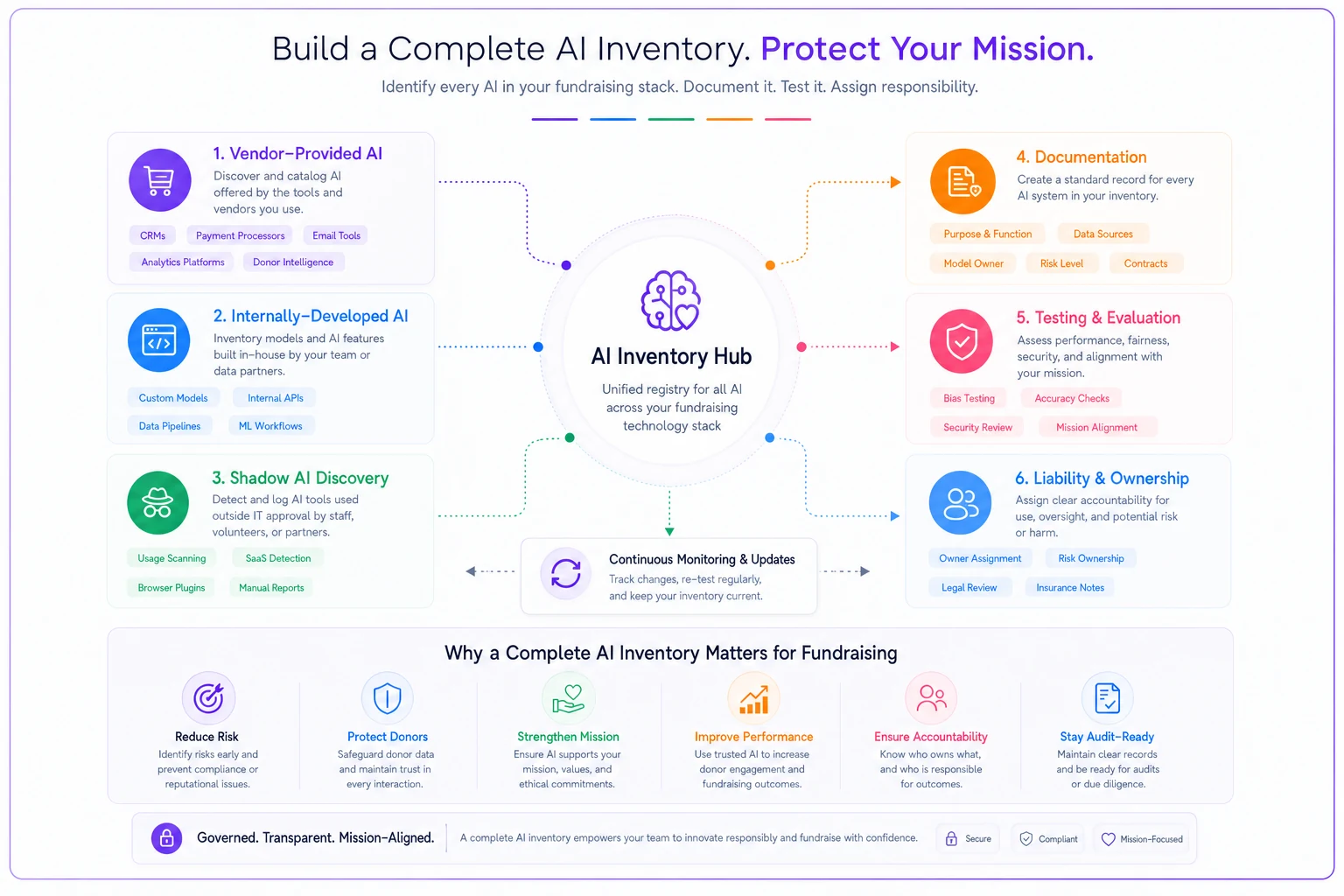
This diagram shows the practical steps for cataloging vendor, internal, and shadow AI and assigning compliance actions.
The answer to all three: Yes, and you need different compliance approaches for each.
The three operational changes you need by September
Federal guidelines typically give organizations 90-180 days to establish compliance frameworks. Based on similar regulatory rollouts, your realistic timeline:
| Deadline | Action |
|---|---|
| By July 31: | Complete your AI inventory and vendor assessment. You need to know what you're using, who provides it, and what risks it creates. This isn't a technology project—it's an operational audit that requires every fundraising team member's input. |
| By August 31: | Update your donor data policies and consent mechanisms. Your privacy policy probably mentions "analytics" or "improvement of services." Under AI donor data compliance standards, you need specific disclosures about automated decision-making, especially for major gift cultivation and grant applications. |
| By September 30: | Implement audit trails and explainability protocols. When a donor asks why they received a certain appeal, or didn't receive a tax receipt, or got assigned to a particular giving level, you need a clear answer that traces through any AI involvement. |
The timeline sounds aggressive because it is. But waiting means scrambling when your first foundation asks for your AI governance policy, or when a donor requests information about automated processing of their data.
Why small nonprofits face bigger compliance challenges than universities
Large nonprofits have dedicated data teams, procurement departments, and general counsels. Small and mid-size organizations have a development director wearing six hats and a part-time database manager.
This resource gap becomes critical for AI donor data compliance. You can't assign a team to vendor assessments when you don't have a team. You can't conduct thorough model audits when you barely understand what a model is.
The operational reality: nonprofits with budgets under $10 million typically have 2-3 people touching donor data systems. They bought their tools based on features and price, not architecture documentation. They integrated systems through Zapier or basic APIs without considering data lineage. They trust vendors because they don't have the expertise to verify claims.
Reuters reported that the executive order includes provisions for helping smaller organizations meet standards. But help doesn't mean exemption. You still need compliant operations, just with fewer resources to achieve them.
The hidden cost of AI compliance in fundraising operations
Budget season just got more complicated. Beyond the obvious costs—legal review, vendor audits, policy updates—AI donor data compliance creates operational overhead that compounds over time.
Every new tool needs deeper evaluation. That donor prospecting service with amazing match rates? Now requires a two-week security review. The email personalization platform that could boost open rates? Add a month for contract negotiation.
Training becomes an ongoing expense, not a one-time cost. Your team needs to understand not just how to use AI tools, but how to document their usage, identify problems, and respond to donor inquiries about automated processing.
Then there's the efficiency paradox. AI tools promise to save time, but compliance requirements add time back. That automated thank you letter system? Now needs human review for accuracy. That donor scoring model? Requires quarterly bias audits.
A health-focused nonprofit I evaluated last month calculated the full cost: $47,000 in the first year. Not for the AI tools themselves, but for the infrastructure to use them compliantly. Legal fees, staff training, system documentation, vendor assessments, and ongoing monitoring.
For context, that's roughly equivalent to a full-time development coordinator in most markets. The ROI question becomes stark: Does AI-enhanced fundraising generate enough additional revenue to offset both tool costs and compliance overhead?
Creating a pragmatic compliance framework without paralysis
The path forward doesn't require perfection. It requires pragmatic decision-making about where AI helps versus where it creates risk.
Start by establishing clear boundaries. AI for donor research and wealth screening? Probably worth the compliance burden. AI for writing grant proposals or donor communications? The risk might outweigh the efficiency gains.
Next, consolidate where possible. Every additional vendor multiplies complexity. If your CRM offers native email marketing, use it instead of a separate platform. If your payment processor includes fraud detection, don't add another layer.
Build compliance into selection criteria. When evaluating new tools, ask about AI governance upfront. Request example audit reports. Check if they've completed SOC 2 Type II certification. Verify they have clear data processing agreements.
Start by auditing the top three donor-facing AI tools that touch the most people—those will yield the biggest risk reduction for the least effort.
Most importantly, document everything contemporaneously. Not for regulators, but for your own operations. When something goes wrong—and something always does—you need to quickly identify whether AI was involved, what decisions it made, and how to prevent recurrence.
The competitive advantage hiding in compliance requirements
Most nonprofits miss this: Donors increasingly care about data ethics. They research organizations before giving. They ask about overhead ratios and program effectiveness. Soon, they'll ask about responsible AI use.
The nonprofits that establish strong AI governance now position themselves as trustworthy stewards of both donations and data. That matters when competing for major gifts, foundation grants, and corporate partnerships.
Consider how you'd respond to these donor questions today:
"How do you use AI in your fundraising?" "Can I opt out of automated decision-making?" "Do you sell or share my data for AI training?" "How do you ensure AI doesn't discriminate in program delivery?"
Most organizations would struggle to answer clearly. Those who build AI donor data compliance frameworks can answer confidently, turning a regulatory requirement into a trust-building opportunity.
Connecting compliance to your existing metrics framework
Your nonprofit already tracks fundraising metrics. Donor retention rates, average gift size, cost per dollar raised. AI compliance adds a new dimension to these measurements.
That pragmatic framework for nonprofit fundraising metrics you've built? It needs updating to account for AI-influenced touchpoints. When a model recommends cultivation strategies, you need to track both the recommendation accuracy and the human override rate.
This creates an interesting operational dynamic. AI promises better prediction and personalization. But compliance requires measuring whether those promises materialize. A donor scoring model that's 60% accurate isn't just ineffective—under emerging standards, it might be non-compliant if it can't explain its failures.
The measurement burden extends to vendor management. You can't just track whether your email platform delivers messages. You need to monitor whether its AI-powered send-time optimization actually improves open rates, and document when it doesn't.
The operational reality of AI governance in fundraising
Working with dozens of nonprofits on operational improvements, the pattern is clear: compliance frameworks fail when they're separate from daily operations. They succeed when they're embedded in existing workflows.
Don't create a separate AI committee. Add AI assessment to your existing vendor review process. Don't build a new documentation system. Extend your current data governance practices. Don't schedule special training sessions. Incorporate AI literacy into regular team meetings.
The goal isn't perfect compliance—it's sustainable operations that happen to be compliant. That means choosing battles carefully. Focus first on high-risk, donor-facing AI applications. Address internal productivity tools later. Fix current problems before preventing theoretical future ones.
Remember that compliance exists to protect both your donors and your organization. Every requirement traces back to a real risk: biased decisions, privacy violations, security breaches, or reputational damage. Frame compliance as risk management, not box-checking.
Moving forward with purpose, not panic
The White House AI executive order signals the beginning of serious AI governance, not the end. More requirements will come. Standards will evolve. Enforcement will clarify expectations.
But nonprofits that act now—inventorying systems, updating contracts, establishing governance—position themselves to adapt rather than scramble. They turn compliance into competitive advantage. They build donor trust through transparency.
Most importantly, they ensure AI enhances their mission rather than complicating it. Because ultimately, AI donor data compliance isn't about technology. It's about maintaining the trust that makes fundraising possible.
The clock is ticking. But you've got time to do this right. Start with the inventory. Build from there. And remember: every nonprofit faces these same challenges. The ones who address them thoughtfully will emerge stronger.
Your donors trust you with their money. Now they're trusting you with their data in an AI-powered world. That's a responsibility worth taking seriously, executive order or not.
Ready to elevate your fundraising efforts?
Join 2,000+ nonprofits using Givioly to save time, increase donations, and build lasting donor relationships.