



When Fed Chair Kevin Warsh stood up at Jackson Hole on August 28 and signaled that more tightening is on the table if inflation stays sticky, markets repriced within hours. Nonprofit budgets don't work that way. They sit in a spreadsheet from last spring, built on assumptions that are now quietly wrong.
That's the actual problem. Not the rate signal itself — nonprofits have survived plenty of rate cycles — but the fact that most small-to-mid orgs run their annual forecast once, lock it, and don't touch it until something breaks. Warsh's comments, covered by CNBC, are a reasonable prompt to break that habit. This piece isn't about predicting what the Fed does next. It's about building a process for reforecasting when the ground shifts — so you're not scrambling in November trying to explain why Q4 appeals underperformed.
Why higher-rate risk hits fundraising differently than most people assume
The instinct is to worry about the endowment. Fair — if you hold long-duration bonds, mark-to-market losses are real. But for most small-to-mid orgs, endowment exposure isn't what will surprise you. Donor capacity is.
Higher rates squeeze households unevenly, and that unevenness is exactly what breaks a forecast built on averages. Major donors with equity exposure and cash reserves might barely feel it. Mid-level donors carrying variable-rate debt — HELOCs, credit cards, small business lines — feel it fast. Your monthly recurring donors, often loyal but budget-conscious, are the ones who quietly cancel a $25/month gift when minimum payments tick up.
A Reuters analysis raised the right question — whether Warsh's shift is a genuine course correction or a temporary detour. You don't need to answer it. You need to be ready either way, which means modeling scenarios rather than betting on one outcome.
The deeper problem: your forecast is a single number, not a range
The pattern in most underprepared orgs looks the same. The annual budget shows one revenue line for individual giving — say, $840k. A point estimate. Nobody wrote down the assumptions underneath it: what monthly retention rate it implies, what average mid-level gift, what major-gift close rate.
Simplify donor management and fundraising workflows.
Givioly helps you organize campaigns, engage donors, and maximize fundraising impact seamlessly.
- Unified donor profiles
- Real-time donation tracking
- Automated impact reporting
No credit card required
So when giving softens, the finance team knows revenue is down but can't isolate why. Fewer new donors? Lower average gift? Higher recurring churn? Without decomposition, you can't respond surgically — you just panic-cut program spend across the board, which is almost always the wrong move.
Reforecasting properly means turning that one number into a range with named drivers behind it.
A three-scenario reforecasting model you can build this week
Don't overthink it. Three scenarios, driven by the handful of variables that actually move your revenue.
| Driver | Baseline | Moderate stress | Severe stress |
|---|---|---|---|
| Monthly recurring churn (annual) | 8% | 12% | 18% |
| Mid-level avg gift change | 0% | −7% | −15% |
| Major gift close rate | 35% | 30% | 24% |
| New donor acquisition | flat | −10% | −20% |
| Restricted grant timing | on schedule | 30–60 day slips | 60–90 day slips |
Plug your real numbers in. The output isn't a prediction — it's a spread. If baseline says $840k and severe stress says $690k, you now know your real exposure is roughly $150k, and you know which levers drove it. That changes how you plan reserves and how aggressively you protect recurring revenue.
The mistake people make here is building twelve scenarios with false precision. Three scenarios sharing the same underlying logic, updated monthly, beat one elaborate model that never gets touched again.
The reforecasting process, step by step
Most teams skip at least two of these steps. That's usually where the process breaks down.
-
Pull your actuals through the most recent closed month. Not estimates — reconciled numbers. If your reconciliation cadence is lagging, fix that first. You can't reforecast on dirty data.
-
Decompose last year's giving into the five drivers above. Recurring, mid-level, major, new acquisition, restricted timing. This is the step most teams skip.
-
Set baseline assumptions from trailing 12-month behavior, not from the optimistic number leadership wants to see.
-
Apply the stress adjustments for moderate and severe cases.
-
Identify the trigger metrics — the early signals that tell you which scenario you're actually living in.
-
Define pre-decided actions per scenario so you're not improvising under pressure.
-
Re-run monthly and compare projected vs. actual on each driver, not just total revenue.
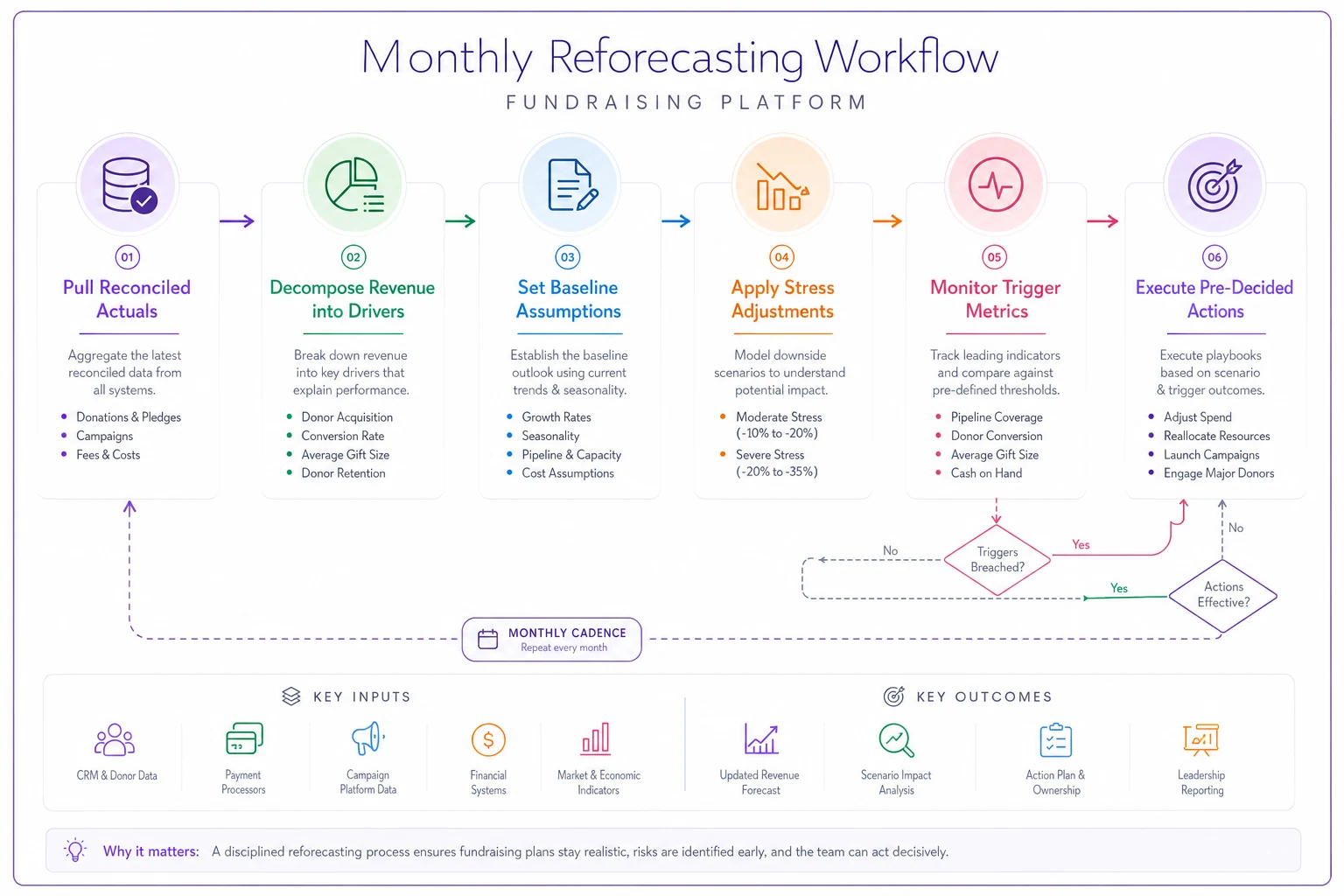
This diagram shows the monthly reforecast workflow.
That last point matters more than the model itself. A forecast you revisit monthly is a management tool. A forecast you build once is a wish.
Trigger metrics: how to know which scenario you're in
Scenarios are worthless if you can't tell which one is unfolding. These signals tend to move weeks before total revenue does, which is the whole point of watching them:
-
Recurring card decline rate creeping up (failed charges are the first sign of household stress — watch this weekly, not monthly)
-
Recurring cancellation reasons shifting toward "financial" language
-
Mid-level gift downgrades — same donor giving less than last cycle
-
Appeal response rate dropping while list size holds steady
-
Average gift softening even as donor count stays flat
-
Restricted grant disbursement dates slipping in your grant tracker
When two or three of these move together, you've left baseline. That's the cue to activate pre-decided actions rather than schedule a meeting to debate them.
Where recurring giving becomes your stability layer
In a tightening environment, the most valuable thing to protect is predictable monthly revenue — because it's least dependent on any single big decision. But "protect recurring giving" means something specific operationally: catch failed payments before they become cancellations, and make downgrading easier than canceling.
Worth stealing: when a recurring card declines, most orgs send one generic "update your payment" email and move on. The ones who actually retain that revenue run a short recovery sequence — retry on a smart schedule, send a warm reminder that leads with impact rather than logistics, and offer a lower tier as an alternative to full cancellation. Under rate stress, giving a stretched donor a $10 option instead of a binary keep-or-quit choice can save a relationship that comes back stronger the following year.
Prioritize automating recovery sequences for cards that decline during peak giving months.
This is where a solid operational platform genuinely earns its keep. Manually tracking which recurring donors declined, when to retry, and who got which message is exactly the kind of coordination that falls apart the moment Q4 gets busy — and it always gets busy. Platforms with built-in automation can run those recovery sequences, flag downgrade candidates, and surface trigger metrics on a dashboard without someone rebuilding a spreadsheet every Monday. The goal isn't to remove judgment from the process. It's to make sure the routine stuff happens reliably so your team can focus on donors who need an actual conversation.
Tightening the operational controls that reveal problems early
Reforecasting only works if the underlying data cadence is clean. A few controls worth firming up before year-end volume hits:
-
Move reconciliation to at least weekly during appeal-heavy months. Monthly reconciliation means you're seeing a revenue dip 4–6 weeks after it started.
-
Reconcile restricted funds and grant cashflow separately from unrestricted, so a grant timing slip doesn't get buried in your total.
-
Review liquidity policy against your severe-stress scenario. If severe stress plus a grant slip creates a cash gap, you want to know that in September, not December.
-
Audit your recurring payment failure workflow end to end. Where does a decline go? Who sees it? What actually happens next?
-
Update stewardship messaging to be sensitive to donor financial strain — impact-forward, not pressure-forward.
None of this is glamorous. But early detection is the entire advantage. The org that spots a 3-point recurring churn increase in October has options. The one that finds it in the January close has excuses.
A real scenario: mid-sized advocacy nonprofit, roughly $1.1M budget
A regional advocacy org running about $1.1M annually had built its forecast in April assuming flat recurring churn and a modest bump in mid-level giving. By late summer, with rate expectations shifting, the finance lead ran the three-scenario model and found a spread of roughly $180k between baseline and severe stress.
The trigger metrics told the story fast. Recurring card decline rate climbed from around 4% to nearly 7% over two months, and mid-level downgrades started appearing in the data. They were trending toward moderate stress, not baseline.
Because actions had already been pre-decided, they moved without a committee meeting: activated a payment-recovery sequence for declined recurring gifts, added a lower monthly tier, and shifted appeal copy toward impact rather than urgency. Over the next quarter, recovered recurring revenue offset most of the mid-level softness. They still came in under the original April forecast — but by roughly $40k instead of the $120k+ they were tracking toward before they caught it.
The difference wasn't a better prediction. It was seeing the shift early and having decisions already made.
When aggressive reforecasting is the wrong move
Not every org should overhaul its forecast the week after a Fed speech. If you're a small all-volunteer org with a handful of major funders and almost no recurring base, elaborate scenario modeling is overkill. Your exposure is really just a few relationships, and direct conversations with those funders will tell you more than any model.
Reforecasting also backfires when the underlying data isn't clean enough to trust. Running scenarios on unreconciled numbers produces confident nonsense, which is worse than no model at all.
And don't let reforecasting become cover for slashing program spending preemptively. The point of scenarios is to avoid blunt cuts by knowing exactly which lever is moving. Cutting mission delivery in September because a Fed chair sounded hawkish is precisely the panic move good forecasting is supposed to prevent.
Connecting this to how your donor system is actually built
All of this — trigger metrics, downgrade paths, recovery sequences, clean handoffs between fundraising and finance — depends on having a donor operation designed as a system rather than a pile of disconnected tasks. If your stages, KPIs, and role handoffs aren't explicit, you'll struggle to catch capacity shifts because nobody owns watching for them.
That's a structural problem, not a data problem. The reforecasting model is only as useful as the lifecycle data feeding it, which means the underlying donor operation needs to be built with that kind of visibility in mind.
That's why it's worth pairing this playbook with a real look at how to design an operational donor lifecycle system with stage KPIs and explicit handoffs. The scenario model and the lifecycle design aren't separate projects — one depends on the other.
The takeaway for finance and fundraising teams
Warsh's signal is a prompt, not a prediction. Whether the Fed hikes again or holds, the orgs that come through year-end in good shape will be the ones who turned a single-number forecast into a monitored range, attached early-warning triggers to each scenario, and pre-decided their moves before the pressure arrived. The full text of his Jackson Hole remarks is on the Fed's site if you want the source language — but the operational homework doesn't change with the details.
Build the three scenarios this week. Wire up your trigger metrics. Protect recurring revenue like the load-bearing wall it is. Then get back to the actual work, knowing you'll see the next shift coming instead of finding it in the rearview.
Build the three scenarios this week. Wire up your trigger metrics. Protect recurring revenue like the load-bearing wall it is. Then get back to the actual work, knowing you'll see the next shift coming instead of finding it in the rearview.
Ready to elevate your fundraising efforts?
Join 2,000+ nonprofits using Givioly to save time, increase donations, and build lasting donor relationships.