

Most nonprofits don't have a donor privacy problem because they're careless. They have one because privacy lives in fragments. The consent checkbox was written by whoever built the donation page. The retention policy exists in a Google Doc from 2019. Lawful basis? Nobody's mapped it, because nobody's sure it even applies to a US-based 501(c)(3). And when a donor emails asking to see everything you have on them, three staff members spend a Tuesday afternoon reconstructing an answer from four different systems.
That's the actual shape of the problem. It's not that consent is missing — it's that consent, storage, and deletion are governed by different people using different assumptions, and none of those assumptions are connected to the CRM where the data actually lives.
This is a systems piece, not a compliance lecture. The goal is to give small teams a connected framework: a consent-language library that stays consistent, a lawful-basis matrix that maps directly to CRM fields, retention rules that trigger real deletions, a one-page policy your board can approve without a law degree, and a handful of lightweight audit checks a team of two can run in an afternoon. If you've already read our Fundraising Data Governance for Small Nonprofits guide, think of this as the privacy-and-consent layer that sits on top of that foundation.
Why donor privacy governance breaks in the same predictable places
The pattern across small development shops is pretty consistent. Privacy doesn't fail at the policy level — it fails at the seam between systems.
A typical example: a gift officer imports a spreadsheet of event attendees into the CRM. Those people never consented to receive fundraising appeals — they RSVP'd to a free lecture. But once they're in the CRM, they look identical to opted-in donors. Six months later they're in an appeal blast, someone complains, and now the team is manually scrubbing a list it should never have merged in the first place.
-
Consent language drifts. The donation page, event form, paper pledge card, and text-to-give flow all ask for permission differently. Some say "we'll keep you updated," some say nothing, some have a pre-checked box. There's no single source of truth for what you actually promised.
-
Retention is theoretical. Almost every organization has a policy that says "we keep financial records seven years." Almost nobody has anything that actually deletes non-financial data that's aged out. The data just accumulates forever.
-
Lawful basis is undefined. Even US nonprofits increasingly touch donors covered by state privacy laws or GDPR — that Canadian recurring donor, the alum who moved to California. Without knowing why you're allowed to hold each piece of data, you can't answer a deletion request cleanly.
The root cause isn't malice or laziness. It's that consent context gets stripped the moment data changes systems. The donation form knew why someone gave their email. The CRM doesn't. The email tool definitely doesn't. Every hop loses information, and privacy governance is entirely about preserving that information across those hops.
The core idea: govern the fields, not the documents
Most privacy frameworks live in prose — long policy documents describing intentions. But your donor data lives in fields: emailoptin, phoneconsent, source, createddate, lastgiftdate. Privacy governance only becomes real when your policy statements are mapped onto those specific fields.
Simplify donor management and fundraising workflows.
Givioly helps you organize campaigns, engage donors, and maximize fundraising impact seamlessly.
- Unified donor profiles
- Real-time donation tracking
- Automated impact reporting
No credit card required
The framework has four connected components, and the connection is the whole point:
-
A consent-language library — the exact approved wording, versioned.
-
A lawful-basis matrix — mapping each category of data to a reason you're allowed to hold it, tied to specific CRM fields.
-
Record-retention rules — expressed as field conditions, not vague timeframes.
-
Audit checks — lightweight queries that confirm the first three are actually being followed.
Skip any one and the others become decorative. A well-written policy document with no field mapping is a PDF nobody enforces.
Component 1: The consent-language library
Stop letting each intake point invent its own wording. Build a small library of approved consent statements, each with a version number and a defined purpose, and require every form to pull from it.
A workable structure looks like this:
| Consent type | Approved language (short form) | CRM field it sets | Version |
|---|---|---|---|
| Email marketing | "Send me updates and appeals by email" | emailoptin = true | v2.1 |
| SMS/text | "I agree to receive text messages, incl. fundraising" | sms_consent = true | v1.3 |
| Phone contact | "You may contact me by phone" | phone_consent = true | v1.0 |
| Event-only | "Register me — no marketing consent implied" | source = event, emailoptin = false | v1.2 |
| Data sharing | "You may share my info with partner orgs" | datashareok = true | v1.0 |
Fix pre-checked boxes on event forms before anything else — they're the most common source of consent disputes.
The version number matters more than it looks. When a donor disputes whether they opted in, you want to know which wording they agreed to and when. If you revised your consent language in March, donors who signed up in January agreed to something different — and you should be able to prove it. This also ties directly to how you classify contacts in your donor engagement taxonomy — consent status is a first-class attribute, not an afterthought.
Component 2: The lawful-basis matrix mapped to CRM fields
This is the piece most small teams skip, and it's the one that makes deletion requests actually answerable. For each category of data you hold, write down the reason you're allowed to hold it — and point that reason at the actual fields.
A simplified matrix:
| Data category | CRM fields | Lawful basis / reason held | Can donor request deletion? |
|---|---|---|---|
| Gift transaction records | giftamount, giftdate, payment_ref | Legal obligation (tax/audit) | No — retained per financial rules |
| Contact info for active donor | email, phone, address | Legitimate interest / relationship | Partial — can opt out of contact |
| Marketing consent | emailoptin, sms_consent | Consent | Yes — fully revocable |
| Wealth/prospect research | capacityrating, researchnotes | Legitimate interest | Yes — usually deletable |
| Event attendance | source, event_id | Consent (event-specific) | Yes |
When a deletion request arrives, you're not guessing. You look at the matrix, and you know instantly that gift records stay (legal obligation), marketing consent gets revoked, and research notes get purged. What used to be a panicked committee discussion becomes a five-minute lookup.
A pattern that comes up a lot: teams treat all donor data as one undifferentiated blob, so a deletion request either terrifies them — delete everything, including records they're legally required to keep — or gets ignored entirely. The matrix separates "must keep" from "can delete" so you can act with confidence on both.
Component 3: Retention rules written as field conditions
"We keep records for seven years" is a sentence, not a system. Translate it into conditions a person — or a scheduled job — can actually act on.
-
Financial records retain 7 years from
gift_date, then archive. Never auto-delete without finance sign-off. -
Inactive non-donor contacts if
emailoptin = falseANDlastgiftdate is nullANDcreated_date > 24 months ago→ flag for review, then delete. -
Revoked consent when
emailoptinchanges to false, suppress within 72 hours and log the change with a timestamp. -
Prospect research on non-donors if
research_notesexists AND no gift within 36 months → purge notes, keep basic contact record.
Retention rules that aren't expressed as conditions never get executed. They sit in a policy doc while the database fills up with 2011-era event contacts nobody can legally justify holding. Writing rules as field logic is also what eventually lets you automate the flagging — a scheduled query surfaces everything that's aged out, and a human approves the batch before deletion runs.
Here's roughly how that flow works in practice:
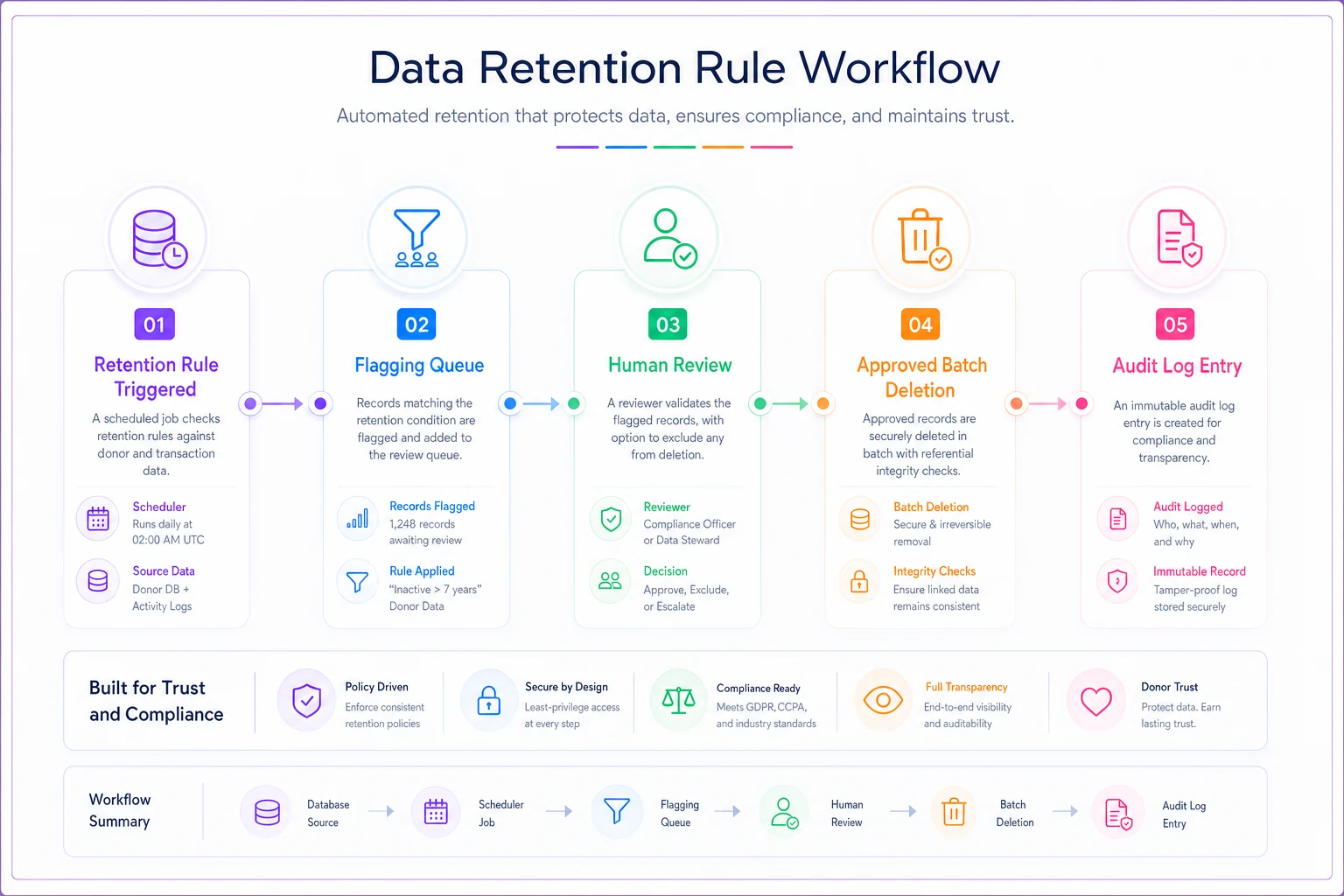
That sequence — condition, flag, review, delete — is the difference between a retention policy that exists and one that actually runs.
Component 4: Lightweight audit checks a two-person team can run
You don't need an audit department. You need three or four queries you run monthly and a habit of actually looking at the results. A realistic monthly routine:
-
Consent-integrity check. Pull everyone with
emailoptin = trueand confirm each has a matching consent source — form submission, or import with documented consent. Anyone opted-in with no recorded source is a red flag. -
Orphaned-import check. Find records created in the last 30 days via bulk import. Confirm the import carried consent metadata. This is where the event-list problem gets caught early.
-
Retention-overdue check. Run the retention conditions above and list everything past its window. Review, approve, purge.
-
Revocation-lag check. For anyone who unsubscribed in the last 30 days, confirm they were actually suppressed across every sending tool — not just the CRM.
-
Consent-version drift. Spot-check live forms against the language library. Confirm nothing's been quietly edited off-version.
The revocation-lag check catches the most embarrassing failures. Someone unsubscribes in your CRM, but your email platform still has them on a synced list, and they get the next appeal anyway. That's the kind of gap that erodes donor trust fast, and it's invisible until you go looking for it.
The one-page board policy
Boards approve policies they can read in one sitting. A four-page privacy document gets tabled "for review" and quietly dies. Give them one page with these sections:
-
- What we collect and why (three bullets, plain language)
-
- How donors control their data (opt-out, deletion, access requests)
-
- What we retain and for how long (the summarized retention table)
-
- Who's accountable (named role, not "the team")
-
- How we verify compliance (the monthly audit routine, in one sentence)
Attach the detailed matrix and library as appendices for anyone who wants to dig in. The board approves the one-pager; staff operate from the appendices. That separation keeps the policy both governable and actually usable.
A real scenario
A regional arts nonprofit — roughly 6,000 records in their CRM, two development staff — kept getting spam complaints after event blasts. When they finally audited, they found close to 1,900 contacts imported from past event lists with no marketing consent recorded, plus around 400 people who'd unsubscribed but stayed on a synced email list because the two systems never reconciled.
They spent about three weeks building the field-mapped version of this framework: rewrote their five intake forms to pull from a consent library, tagged every existing record with a lawful basis, and set up four monthly queries. The cleanup removed roughly 1,900 non-consented contacts from marketing eligibility. Spam complaints dropped to nearly zero within two send cycles, and when a donor sent a formal data-access request a few months later, they answered it in under an hour instead of the day-and-a-half it would've taken before.
None of that required expensive software. It required treating consent as a field, not a footnote.
When this framework makes sense — and when it's overkill
This makes sense when: you're importing lists from multiple sources, you have any donors in California, Canada, or the EU, you send marketing across more than one tool, or you've ever scrambled to answer a "what do you have on me" request. If two or more of those are true, you need the field-level mapping.
This is probably overkill when: you're a brand-new org with under a few hundred contacts, one intake form, and one email tool. At that scale, a clear consent checkbox and a simple retention note are enough. Don't build a matrix for 150 records — but do write your consent language carefully from day one, because retrofitting it later is the expensive part.
Who should not DIY the lawful-basis piece: if you handle health-related donor data, work with minors, or have meaningful EU exposure, get an actual privacy attorney to review your matrix. The framework organizes the thinking; it doesn't replace legal advice on genuinely regulated data.
Where automation fits — quietly
Most of this runs fine on manual queries and a monthly calendar reminder. As you grow past several thousand records and multiple synced tools, the audit checks and retention flagging are the natural candidates for automation — a scheduled job surfaces overdue and mismatched records, a person reviews the batch, and deletions happen with a documented approval trail. The consent-version and revocation-lag checks especially benefit from running automatically, since they're exactly the gaps humans forget to check manually.
Workflow platforms that centralize consent state across your CRM and sending tools also remove the reconciliation problem that caused the arts org's stale-list issue. But the automation only works because the fields and rules were defined first. Automate the framework — never skip straight to automating a mess.
The takeaway
Donor privacy governance isn't a document you write once. It's the connective tissue between your intake forms, your CRM fields, your retention logic, and the tools that actually send email. When those four things are mapped to each other, a deletion request is a lookup, a list import can't silently strip consent, and your board can approve a policy they actually understand.
When they're not mapped, privacy is just hope — and hope tends to fail on the Tuesday afternoon a donor finally asks what you know about them.
Start with the field mapping. Everything else — the library, the matrix, the audits, the board page — hangs off that single decision to govern the data, not the paperwork.
Start with the field mapping. Everything else — the library, the matrix, the audits, the board page — hangs off that single decision to govern the data, not the paperwork.
Ready to elevate your fundraising efforts?
Join 2,000+ nonprofits using Givioly to save time, increase donations, and build lasting donor relationships.