

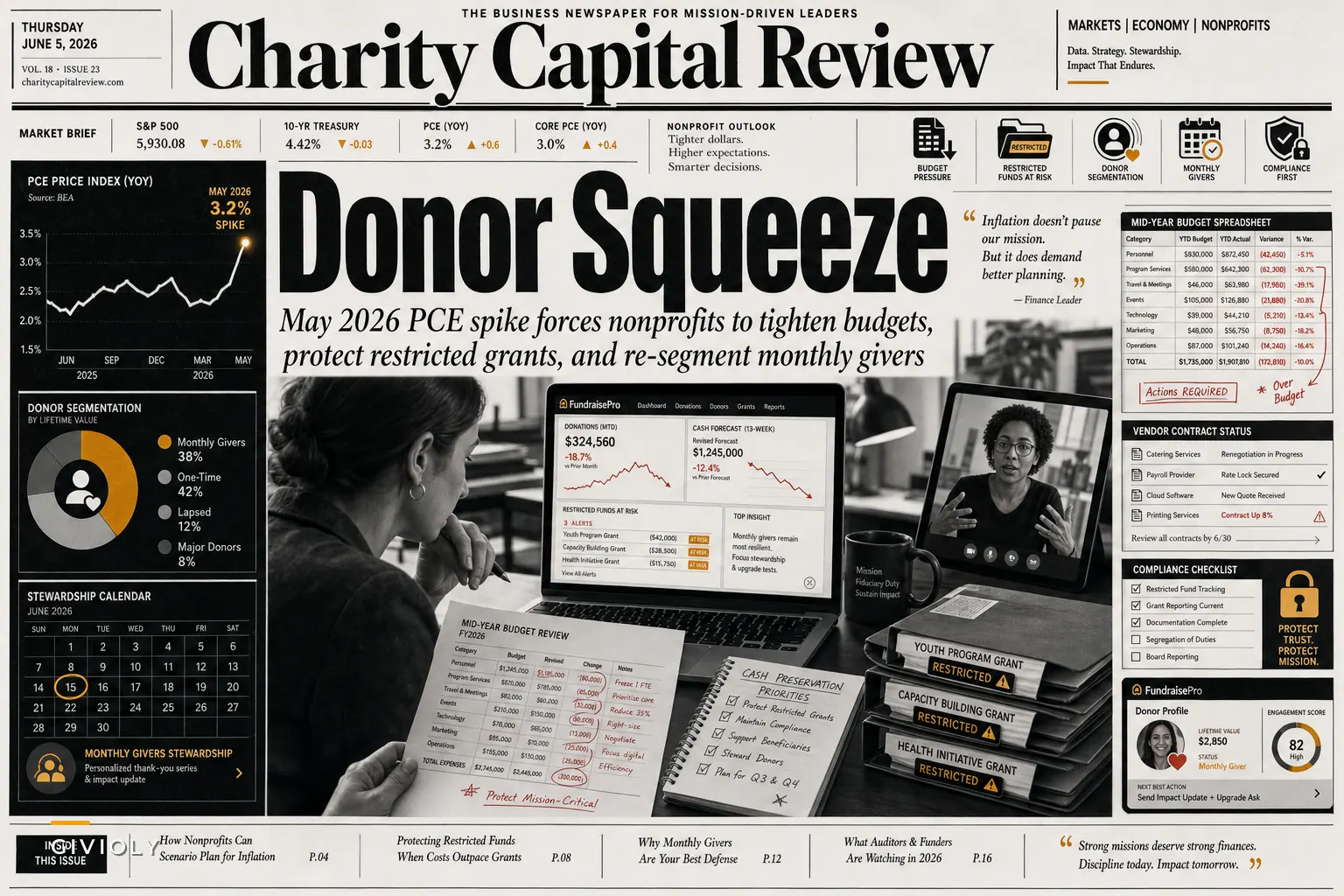

The PCE numbers that dropped last week should have every nonprofit finance director paying close attention. Core PCE inflation accelerated past 4% in May, the steepest climb since early 2024. For nonprofits already stretched thin, this isn't just another economic headline — it's a direct threat to grant compliance, budget integrity, and donor relationships.
Here's what this looks like operationally: a mid-sized food bank discovered their fuel costs for distribution trucks had blown past Q2 projections by 18%. Their federal grant explicitly capped transportation at 12% of program expenses. By the time they caught the variance, they were three weeks into noncompliance territory. The scramble to reallocate expenses and document everything burned through 40+ hours of staff time that should have gone toward programs.
That's one organization. Multiply it across thousands of nonprofits managing restricted funds and you've got a sector-wide problem most teams won't see coming until it's already messy.
The triple squeeze hitting nonprofit operations right now
Inflation creates three simultaneous pressures that most nonprofit operational systems genuinely can't handle well.
Expense acceleration outpacing budget cycles. Your annual budget approved in December assumed 2-3% cost growth. Now you're facing 4%+ inflation with vendors repricing quarterly. One youth services nonprofit watched program supplies jump 22% between January and April. Their board-approved budget became fiction by February.
Donor capacity compression without warning. When consumer sentiment data shows persistent cost-of-living anxiety, your monthly donors start skipping payments before they formally cancel. One arts organization tracked a 14% increase in failed monthly gift transactions between March and May — not cancellations, just declined cards and insufficient funds. Their CRM showed healthy retention metrics while actual cash flow quietly eroded week by week.
Grant compliance thresholds becoming moving targets. Federal and foundation grants lock in budget categories at application time, sometimes 18 months before you spend the money. When your approved $50,000 personnel line now costs $54,000, you're technically out of compliance even though you're delivering the exact same program. Documenting and justifying every variance can consume more resources than the actual program delivery.
Why standard nonprofit financial tracking breaks under inflation pressure
Most small-to-mid-size nonprofits run their financial operations through a patchwork of QuickBooks, Excel, and whatever grant management system they inherited from three directors ago. This works fine when costs rise predictably. Under inflation pressure, the same setup creates dangerous blind spots.
Simplify donor management and fundraising workflows.
Givioly helps you organize campaigns, engage donors, and maximize fundraising impact seamlessly.
- Unified donor profiles
- Real-time donation tracking
- Automated impact reporting
No credit card required
The core problem is lag time between expense recognition and budget reconciliation. A typical nonprofit reconciles expenses monthly, reviews variances quarterly, and reports to funders semi-annually. By the time you spot a cost overrun trending toward noncompliance, you've already burned through weeks of restricted funds incorrectly.
What happens in practice: your program manager approves a vendor invoice that looks reasonable — maybe 8% higher than last time, but inflation, right? That invoice gets coded to the grant and posted. Meanwhile, three other invoices come in with similar increases. Nobody connects the dots until the monthly reconciliation, by which point you've potentially violated your indirect cost rate agreement or blown past a category cap.
It gets worse with multi-year grants. A three-year federal award with annual budget periods doesn't adjust for inflation. You're locked into Year 1 numbers even as Year 2 costs spike. Most nonprofits don't have systems that flag when cumulative cost increases will push them over threshold limits months in advance.
Immediate operational adjustments to implement this week
Before you panic about system overhauls, here's what you can actually fix in the next five days.
Accelerate your reconciliation frequency. Move from monthly to weekly reviews for any grant representing more than 15% of your budget. Create a simple variance tracker that flags any line item trending above 3% monthly growth. One education nonprofit started doing "Wednesday morning variance checks" — a 20-minute review of the three largest expense categories across their major grants. They caught a facilities cost spike in week 2 instead of month 2, giving them time to negotiate with their landlord before eating the overrun.
Implement rolling reforecasts for restricted funds. Stop treating grant budgets as static documents. Every two weeks, project your burn rate for each restricted fund category based on the last 30 days of actual expenses. If you're trending toward exceeding any category by more than 5%, you need a plan now — not at quarter-end.
Build a basic tracking sheet with these columns:
-
Original budget by category
-
Spent to date
-
Current month run rate
-
Projected total at current rate
-
Variance from budget
-
Days until threshold breach
Negotiate vendor price locks. Contact your top five vendors by spend and push for 90-day price locks. Most vendors prefer predictable revenue over maximum pricing, especially if you can offer faster payment terms. One homeless services organization traded net-15 payment terms for quarterly price locks — essentially buying inflation protection with their cash flow flexibility.
Protecting donor relationships when everyone's feeling the squeeze
Inflation hits your donors as hard as it hits your operations. The mistake most nonprofits make is waiting until giving drops to adjust stewardship. By then, donors have already mentally reallocated their charitable budget elsewhere.
Segment your donor communications by actual giving behavior changes, not just giving levels. A donor who's maintained their $200 monthly gift for six months needs different messaging than one who's missed two payments but hasn't cancelled. The stable donor might respond to an upgrade ask framed around inflation impact — "your gift now does 15% less than last year." The stressed donor needs reassurance that any amount helps, with easy options to reduce rather than cancel.
Don't pretend costs aren't rising. One food pantry started including a simple line in their monthly newsletter: "Your $50 gift that provided 150 meals last year provides 127 meals today. Every meal still matters." Donors appreciated the honesty, and several actually increased their giving to maintain impact levels.
For monthly donors showing payment stress signals — failed transactions, calls about billing, skipped months — proactively offer gift holidays: a two-month pause with automatic resumption. Around 70% of donors who take a holiday resume giving, versus roughly 25% who resume after a full cancellation. The operational difference is real: maintaining an existing relationship versus trying to reacquire a lapsed donor.
Grant compliance tactics when costs explode mid-cycle
When inflation pushes toward noncompliance, most nonprofits either freeze or hope the funder won't notice. Neither works.
Document everything as it happens. Start a variance log the moment you detect a meaningful cost increase. Include vendor communications about price changes, comparable quotes showing market-wide increases, and internal emails discussing the impact. One environmental nonprofit created a simple "Inflation Impact Register" — a shared spreadsheet where any staff member could log cost increases as they encountered them. Took about 30 seconds per entry and saved them during their federal audit.
Keep a shared 'Inflation Impact Register' accessible to grants and program staff for quick, auditable entries.
Request budget modifications proactively. Most funders allow modifications up to 10% between categories without prior approval, but you still need to notify them. Don't wait until report time. A straightforward email — "We're projecting personnel costs will exceed budget by 7% due to market conditions, offset by a 7% reduction in travel expenses" — signals you're managing actively, not reactively.
Accelerate your indirect cost true-up. If you have a negotiated indirect cost rate agreement, inflation probably means your true costs exceed your approved rate. Start documenting actual indirect costs monthly rather than annually. When you approach your cognizant agency for an adjustment, you'll have trending data showing the change is structural, not a one-time blip.
Building inflation resistance into your operational workflows
The nonprofits getting through this without crisis are mostly the ones who built flexibility into their operations before they needed it.
Instead of annual budgets with quarterly reviews, run 18-month rolling budgets with monthly updates. Sounds like overkill until inflation hits and you've already got scenarios mapped out. One workforce development nonprofit maintains three budget scenarios at all times: expected, 10% cost increase, 20% cost increase. When inflation spiked, they shifted from tracking Scenario A to Scenario B. No scrambling.
Your grant tracking system needs dynamic category monitoring, not just static budget-to-actual reports. Set automatic alerts when any expense category hits 75% of budget regardless of time elapsed. The animal shelter that implemented this caught their veterinary cost spike in month 4 of a 12-month grant cycle, giving them eight months to adjust other spending.
For any expense category over $10,000 annually, maintain relationships with at least three vendors. Even if you're not actively purchasing from all three, quarterly check-ins keep options open. When a primary food supplier raised prices 20%, having two backups ready meant switching in 48 hours instead of eating the increase for weeks while scrambling for alternatives.
The technology infrastructure that actually helps
Most nonprofits assume they need expensive enterprise systems to handle inflation complexity. That's usually not true. The operational software that actually helps isn't the most sophisticated — it's the kind that combines basic automation with human judgment in ways your team can actually interpret and act on.
Automated expense categorization that flags variances in real-time, integrated budget tracking across multiple funding sources, and simple projection tools that extend current trends forward — that's the core of what you need. AI-powered operational platforms handle the repetitive reconciliation work so your team can focus on what actually matters: negotiating with vendors, communicating with funders, making real decisions about program delivery.
Instead of manually coding hundreds of transactions every month, automated categorization reads invoice data and assigns expenses based on your rules. When costs spike in a category, you get alerts immediately rather than at month-end. It's not about replacing your finance team — it's about getting them out of spreadsheet maintenance so they can actually manage instead of just record.
The integration between grant tracking and donor management matters more than most nonprofits realize. When grant expenses are trending over budget, you need to immediately know which donors might step up with unrestricted support. Systems that keep those data streams siloed force you to make decisions with half the picture.
| Operational Area | Common Failure Under Inflation | What Actually Helps |
|---|---|---|
| Expense tracking | Monthly reconciliation misses spikes | Weekly variance reviews by category |
| Grant compliance | Static budget-to-actual reports | Dynamic threshold alerts at 75% spend |
| Donor stewardship | Waiting for cancellations to react | Segmenting by payment behavior changes |
| Vendor management | Single-supplier dependency | 3+ vendor relationships per major category |
| Budget planning | Annual static budgets | 18-month rolling with scenario modeling |
These aren't aspirational fixes — they're operational decisions that either get made proactively or get forced on you later under worse conditions.
Your 30-day inflation response plan
Working through these in sequence matters. Expense visibility in week one shapes everything else — you can't write accurate funder modification requests or make smart donor appeals if you don't yet know where the cost pressure is actually concentrated.
Use this simple workflow to coordinate weekly tasks across finance, programs, and communications.
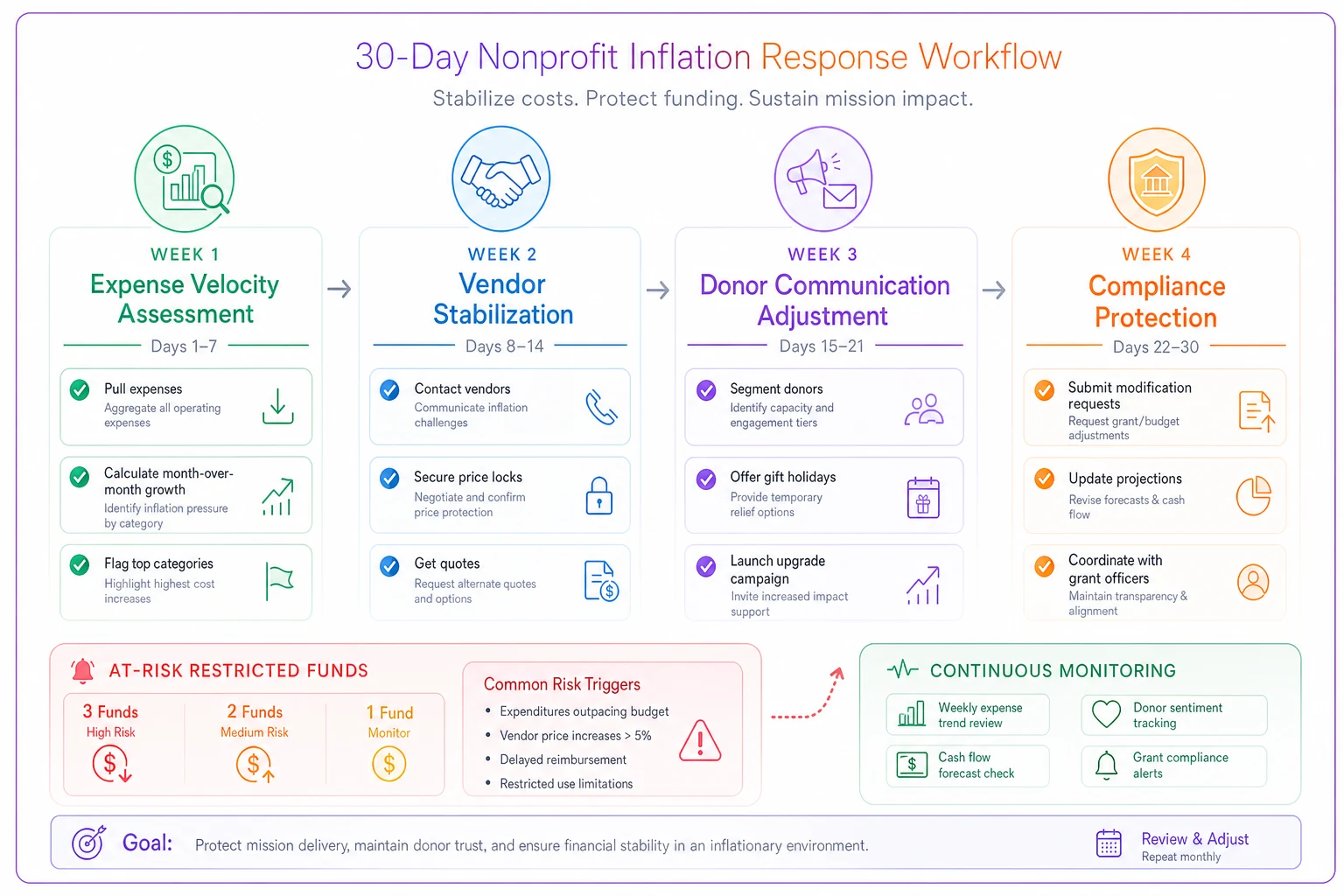
Follow the sequence week-by-week and update your projections after each check.
-
Week 1 — Expense velocity assessment
Pull all expenses from the last 90 days. Calculate month-over-month growth rates by category. Identify your top five inflation-vulnerable categories. Flag any restricted funds at risk of noncompliance.
-
Week 2 — Vendor stabilization
Contact top 10 vendors for price lock discussions. Get quotes from alternative suppliers for vulnerable categories. Document all price increase notifications. Negotiate payment term adjustments where possible.
-
Week 3 — Donor communication adjustment
Segment donors by payment behavior changes. Create inflation impact messaging for each segment. Implement gift holiday options for stressed monthly donors. Launch a "maintain your impact" upgrade campaign for stable donors.
-
Week 4 — Compliance protection
Review all active grant budgets for variance thresholds. Submit modification requests where needed. Update projection models with actual inflation data. Schedule check-ins with program officers for major grants.
Expense visibility in week one shapes everything else — you can't write accurate funder modification requests or make smart donor appeals if you don't yet know where the cost pressure is actually concentrated.
This spike isn't a blip — it's exposing operational fragilities that have existed in nonprofit finance for years. Organizations running on Excel-and-hope systems are going to face cascading compliance failures, donor attrition, and program cuts. Not all at once, but steadily, and in ways that are hard to reverse.
The nonprofits that weather this will be the ones who treat inflation impact as an operational problem, not just a budget problem. Your spreadsheets from 2022 can't handle 2026's reality. Neither can your vendor relationships, donor communication strategies, or grant compliance workflows if they haven't been updated.
Organizations that survived previous inflation spikes generally had one thing in common: they adjusted operations before their budgets forced them to. The ones that waited spent the next two years recovering.
The PCE data from the BEA isn't suggesting things will ease up next month. Start with the expense velocity assessment. Build from there. Treat every budget variance as an operational signal, not a finance department footnote.
Ready to elevate your fundraising efforts?
Join 2,000+ nonprofits using Givioly to save time, increase donations, and build lasting donor relationships.