


The mid-level tier is where most nonprofit revenue quietly leaks out. Not because those donors leave, but because nobody's really working them. They're too big for the automated appeal machine and too small for the major gifts officer's personal caseload. So they end up in a no-man's-land, getting the same year-end email as someone who gave $25 — while a third of them could probably give 5x more if anyone built a real relationship with them.
Below are the segmentation errors that keep this from happening, followed by a scoring model and nurture structure you can actually run.
The segmentation errors that quietly kill your upgrade pipeline
Most mid-level programs fail before a single email goes out because the segmentation itself is broken. A few patterns show up over and over.
Segmenting by gift size alone. This is the big one. A $1,200 donor who gives once and a $1,200 donor who's given three years running with rising amounts are completely different people. Treating them identically means you either over-invest in someone who's clearly a one-time event attendee or under-invest in someone signaling they want to go deeper. Gift amount is a snapshot. Behavior is the movie.
Using a fixed dollar band forever. Plenty of orgs set "mid-level = $1,000–$9,999" and never revisit it. But the band should reflect your donor distribution, not a number someone copied from a webinar. If 80% of your file gives under $250 and your mid-level threshold is $1,000, you've excluded a whole layer of $300–$800 donors who are the real upgrade candidates. Look at where the natural gaps in your giving histogram actually fall.
Confusing capacity with intent. Wealth screening tells you someone can give more. It says nothing about whether they want to give more to you. A common mistake is loading up the mid-level upgrade list with high-capacity names who've shown zero engagement — no email opens, no event attendance, no second gift. You end up pouring stewardship time into people who mildly like your mission and ignoring the modest-capacity donor who reads every update and volunteers twice a month.
Letting the tier become a dumping ground. Board members' friends, lapsed majors who slid down, event ticket buyers, memorial gift givers — they all get swept into "mid-level" because they don't fit anywhere else. The result is a segment with no coherent strategy because the people inside it have nothing in common.
No re-scoring cadence. Someone gets tagged as a warm upgrade prospect in January, goes cold by June, and the tag never changes. Static segments rot. If your list isn't refreshed on a schedule, you're working on eight-month-old assumptions.
A scoring model you can actually build
Forget elaborate predictive models if you're a small team. You want something you can run in a spreadsheet or your CRM and explain to a board member in two minutes. Score every mid-level donor on four dimensions, weight them, and rank.
Simplify donor management and fundraising workflows.
Givioly helps you organize campaigns, engage donors, and maximize fundraising impact seamlessly.
- Unified donor profiles
- Real-time donation tracking
- Automated impact reporting
No credit card required
| Factor | What you're measuring | Points range | Weight |
|---|---|---|---|
| Recency | Months since last gift | 0–25 | High |
| Consistency | Number of years/times given | 0–25 | High |
| Trajectory | Is their giving rising, flat, or falling | 0–20 | Medium-high |
| Engagement | Opens, event attendance, volunteering, replies | 0–20 | Medium |
| Capacity signal | Wealth/real estate/prior major gift indicator | 0–10 | Low-medium |
Notice capacity is weighted lowest, not highest. That's deliberate. Capacity is a tiebreaker, not a driver. Two donors with identical behavior — one with high capacity — sure, prioritize the high-capacity one. But capacity alone should never float someone to the top of your upgrade list.
A quick scoring rubric within each factor:
-
Recency gift in last 3 months = 25, 4–6 months = 18, 7–12 months = 10, 13–18 months = 4, older = 0.
-
Consistency 4+ gifts = 25, 3 gifts = 18, 2 gifts = 10, 1 gift = 3.
-
Trajectory each gift larger than the last = 20, flat = 10, declining = 3.
-
Engagement high (attends events, replies, opens most emails) = 20, moderate = 10, passive = 3.
-
Capacity confirmed high = 10, moderate = 5, unknown = 3.
Sum it. Anyone scoring roughly 75+ is a genuine upgrade candidate — put them in the active nurture flow. The 50–74 band is your "warm but not ready" group that needs more engagement before an ask. Below 50, keep them in general stewardship and re-score next quarter. The insight most teams miss: rising trajectory is the single strongest predictor of upgrade readiness, more than absolute gift amount. A donor who went $250 → $400 → $600 is telling you something a flat $1,000 donor isn't. Weight trajectory accordingly and you'll often find the "smaller" donor is the better bet.
Building the 6–12 month nurture flow
Once you have your 75+ list, the mistake to avoid is jumping straight to the ask. Mid-level upgrades are earned over months, not extracted in one meeting. Here's a flow structured across four phases.
-
Months 1–2
Prove you see them.
Send a genuine, specific thank-you that references what their past giving actually funded. No ask. If you can get a program staffer or a beneficiary to send a short note, do it. This is the single highest-ROI touch and almost nobody does it well. -
Months 3–4
Show impact, invite in.
Share a behind-the-scenes update — something the general list doesn't get. Invite them to a small event, a site visit, or a call with a program lead. The goal is to make them feel like an insider, not a wallet. Track who responds; response here is a strong upgrade signal. -
Months 5–7
Deepen the relationship.
Ask their opinion. Survey them, find out what part of your work matters most to them, and follow up personally on their answer. Donors who tell you what they care about have essentially handed you the script for the upgrade ask. This phase separates the ready from the not-ready. -
Months 8–12
The ask.
Now you make a specific, personalized upgrade ask tied to what they told you they cared about. Not "give more" — "your support last year funded X; a gift of $2,500 this year would let us do Y, which you mentioned matters to you." The ask amount should be a real stretch but believable — usually 2x to 3x their current giving, informed by capacity.
Here's a simple visual of that flow, which can help when you're explaining the timeline to a board or a colleague.
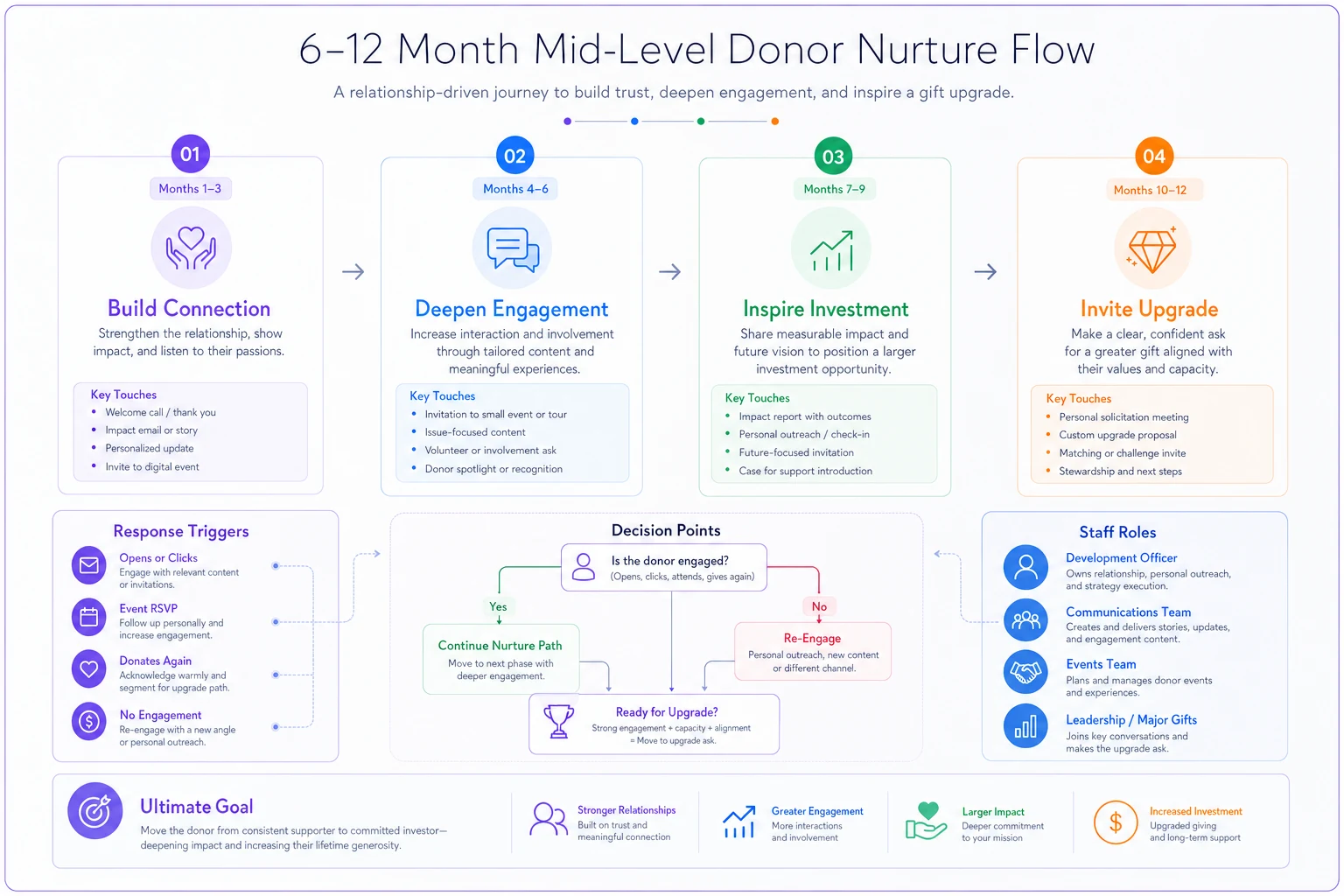
The pacing matters. Compress this into three months and you'll feel pushy. Stretch it past a year and momentum dies. Six to twelve months is the window where relationship and urgency actually coexist.
Messaging cadence: how often, and what kind
Cadence errors are almost as common as segmentation errors. Two failure modes dominate: total silence for months followed by a sudden ask, or blasting the mid-level list with the same volume as your mass email program.
-
1 personal touch per month — email, call, or note from a real person, not the org-wide newsletter.
-
General communications continue — they should still get your regular impact emails, but those don't count as your monthly personal touch.
-
1 non-ask for every ask — for every solicitation, there should be at least one touch that gives rather than takes.
-
Response-based branching — if someone replies, attends, or clicks through to a program page, accelerate. If they go quiet for two cycles, pause the personal cadence and drop them back to general stewardship, then re-score.
If someone replies, treat their response as a trigger to move them forward in the flow.
The donors who upgrade are almost always the ones who had a two-way interaction before the ask. A reply to an email, a conversation at an event, an answered survey. If your cadence is entirely one-directional broadcasts, you're leaving the upgrade on the table no matter how polished the messaging is.
The operational problem: this is hard to run manually
Here's the honest bottleneck. Everything above is doable for a team of two if they have 40 mid-level prospects. At 400, the manual version collapses. You can't hand-track where each donor sits in a 12-month flow, remember who replied to which touch, re-score quarterly, and branch cadences based on behavior — all in a spreadsheet — without things slipping through the cracks.
This is where operational software earns its place. Not for the strategy — the scoring model and nurture logic are yours — but for the execution. A workflow platform with some AI automation can re-score your list on a schedule, flag when a donor crosses the 75-point threshold, remind the right staffer that a personal touch is due, and surface behavioral signals like a reply or an event RSVP so no upgrade window gets missed.
The point isn't to automate the relationship. It's to make sure a human never forgets to show up for it. The judgment stays with your team; the tracking and the "who needs attention this week" list gets handled for you.
When this approach makes sense — and when it doesn't
When it makes sense: you have at least 75–100 donors in the mid-level range, some giving-history data, and a person who can own the flow even part-time. If your file has a real mid-tier and it's currently getting only mass-market treatment, the upside here is significant.
When it's a bad idea: if your entire donor base is under 150 people, skip the formal scoring model and just build real relationships with everyone. Segmentation is for when you have too many people to treat individually. Under that threshold, you should probably just be making phone calls.
Who should NOT do this: any org with no clean giving-history data. If you can't reliably tell how many times someone gave or whether their giving is rising, fix your data hygiene first. A scoring model built on garbage inputs produces confident, wrong rankings — which is worse than no rankings at all, because you'll act on them.
A real scenario
A regional environmental nonprofit had about 280 donors in the $500–$4,000 range, all lumped into a single "mid-level" bucket getting the standard quarterly newsletter and a year-end appeal. No dedicated attention, no upgrade path.
They built a version of the scoring model above and found something fairly typical: only around 90 of the 280 scored above 75. The rest were mostly one-time event givers with flat or declining trajectories. Instead of spreading effort across all 280, the team focused their nurture flow on those 90.
Over the following year, roughly 20 of those 90 upgraded — most from the $600–$1,200 range into the $2,000–$3,500 range. A handful of the highest-scoring donors moved into major-gift territory and got handed off to the development director. The rest of the mid-level file stayed in general stewardship, and the team stopped burning hours on prospects who weren't signaling any real interest. The revenue lift was meaningful, but the bigger win was clarity — they finally knew which donors were worth their limited time.
Pulling it together
The core shift is simple to say and hard to do: stop defining your mid-level tier by dollar amount and start defining it by behavior and trajectory. Build a lightweight score, work the top of it patiently over 6–12 months, keep the cadence two-directional, and re-score on a schedule so your assumptions stay fresh.
Most orgs already have the donors they need to build a real upgrade pipeline. What they're missing is a repeatable way to identify who's actually ready to move and a disciplined flow to get them there. Fix the segmentation errors first — everything downstream depends on getting that layer right.
Most orgs already have the donors they need to build a real upgrade pipeline. What they're missing is a repeatable way to identify who's actually ready to move and a disciplined flow to get them there. Fix the segmentation errors first — everything downstream depends on getting that layer right.
Ready to elevate your fundraising efforts?
Join 2,000+ nonprofits using Givioly to save time, increase donations, and build lasting donor relationships.